

1 Nanoplasmonics: From Present into Future
19
20
40
60
80
100
x ( n m )
20
40
60
80
100
y ( n m )
0
0.05
0.1
20
40
60
80
100
x ( n m )
20
40
60
80
100
y ( n m )
0
0.02
0.04
|E n | 2
s n =0.3202
s n =0.3203
|E n | 2
(a)
(b)
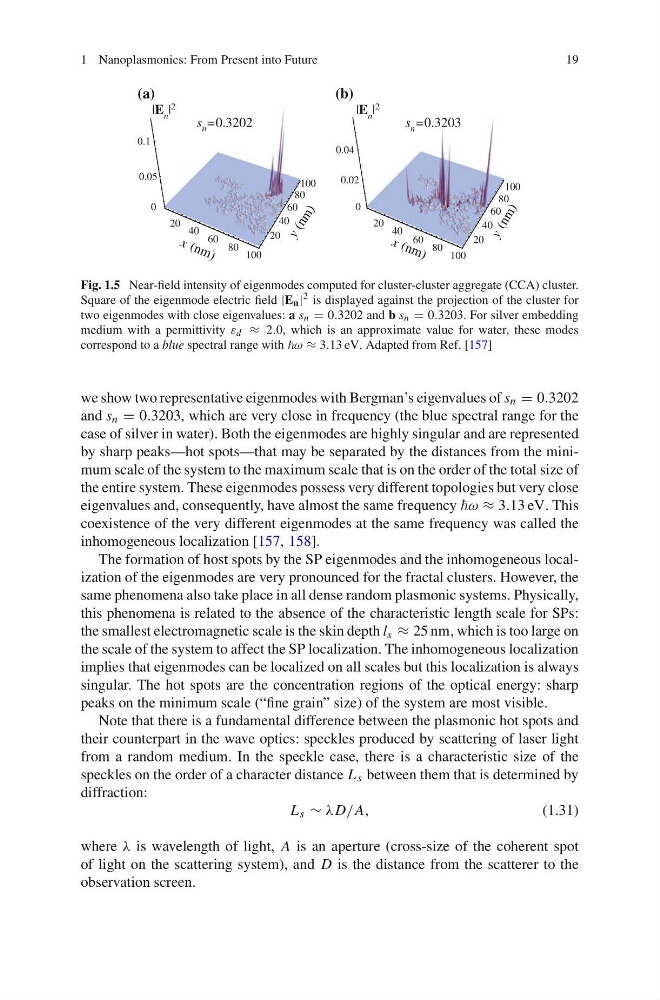
Fig. 1.5 Near-field intensity of eigenmodes computed for cluster-cluster aggregate (CCA) cluster.
Square of the eigenmode electric field |E n | 2 is displayed against the projection of the cluster for
two eigenmodes with close eigenvalues: a s n = 0.3202 and b s n = 0.3203. For silver embedding
medium with a permittivity ε d ≈ 2.0, which is an approximate value for water, these modes
correspond to a blue spectral range with ω ≈ 3.13 eV. Adapted from Ref. [157]
we show two representative eigenmodes with Bergman’s eigenvalues of s n = 0.3202
and s n = 0.3203, which are very close in frequency (the blue spectral range for the
case of silver in water). Both the eigenmodes are highly singular and are represented
by sharp peaks—hot spots—that may be separated by the distances from the minimum scale of the system to the maximum scale that is on the order of the total size of
the entire system. These eigenmodes possess very different topologies but very close
eigenvalues and, consequently, have almost the same frequency ω ≈ 3.13 eV. This
coexistence of the very different eigenmodes at the same frequency was called the
inhomogeneous localization [157, 158].
The formation of host spots by the SP eigenmodes and the inhomogeneous localization of the eigenmodes are very pronounced for the fractal clusters. However, the
same phenomena also take place in all dense random plasmonic systems. Physically,
this phenomena is related to the absence of the characteristic length scale for SPs:
the smallest electromagnetic scale is the skin depth l s ≈ 25 nm, which is too large on
the scale of the system to affect the SP localization. The inhomogeneous localization
implies that eigenmodes can be localized on all scales but this localization is always
singular. The hot spots are the concentration regions of the optical energy: sharp
peaks on the minimum scale (“fine grain” size) of the system are most visible.
Note that there is a fundamental difference between the plasmonic hot spots and
their counterpart in the wave optics: speckles produced by scattering of laser light
from a random medium. In the speckle case, there is a characteristic size of the
speckles on the order of a character distance L s between them that is determined by
diffraction:
L s ∼ λD/A,
(1.31)
where λ is wavelength of light, A is an aperture (cross-size of the coherent spot
of light on the scattering system), and D is the distance from the scatterer to the
observation screen.
19
20
40
60
80
100
x ( n m )
20
40
60
80
100
y ( n m )
0
0.05
0.1
20
40
60
80
100
x ( n m )
20
40
60
80
100
y ( n m )
0
0.02
0.04
|E n | 2
s n =0.3202
s n =0.3203
|E n | 2
(a)
(b)
Fig. 1.5 Near-field intensity of eigenmodes computed for cluster-cluster aggregate (CCA) cluster.
Square of the eigenmode electric field |E n | 2 is displayed against the projection of the cluster for
two eigenmodes with close eigenvalues: a s n = 0.3202 and b s n = 0.3203. For silver embedding
medium with a permittivity ε d ≈ 2.0, which is an approximate value for water, these modes
correspond to a blue spectral range with ω ≈ 3.13 eV. Adapted from Ref. [157]
we show two representative eigenmodes with Bergman’s eigenvalues of s n = 0.3202
and s n = 0.3203, which are very close in frequency (the blue spectral range for the
case of silver in water). Both the eigenmodes are highly singular and are represented
by sharp peaks—hot spots—that may be separated by the distances from the minimum scale of the system to the maximum scale that is on the order of the total size of
the entire system. These eigenmodes possess very different topologies but very close
eigenvalues and, consequently, have almost the same frequency ω ≈ 3.13 eV. This
coexistence of the very different eigenmodes at the same frequency was called the
inhomogeneous localization [157, 158].
The formation of host spots by the SP eigenmodes and the inhomogeneous localization of the eigenmodes are very pronounced for the fractal clusters. However, the
same phenomena also take place in all dense random plasmonic systems. Physically,
this phenomena is related to the absence of the characteristic length scale for SPs:
the smallest electromagnetic scale is the skin depth l s ≈ 25 nm, which is too large on
the scale of the system to affect the SP localization. The inhomogeneous localization
implies that eigenmodes can be localized on all scales but this localization is always
singular. The hot spots are the concentration regions of the optical energy: sharp
peaks on the minimum scale (“fine grain” size) of the system are most visible.
Note that there is a fundamental difference between the plasmonic hot spots and
their counterpart in the wave optics: speckles produced by scattering of laser light
from a random medium. In the speckle case, there is a characteristic size of the
speckles on the order of a character distance L s between them that is determined by
diffraction:
L s ∼ λD/A,
(1.31)
where λ is wavelength of light, A is an aperture (cross-size of the coherent spot
of light on the scattering system), and D is the distance from the scatterer to the
observation screen.