

1 Nanoplasmonics: From Present into Future
17
where ϕ 1 (r) is the local field.
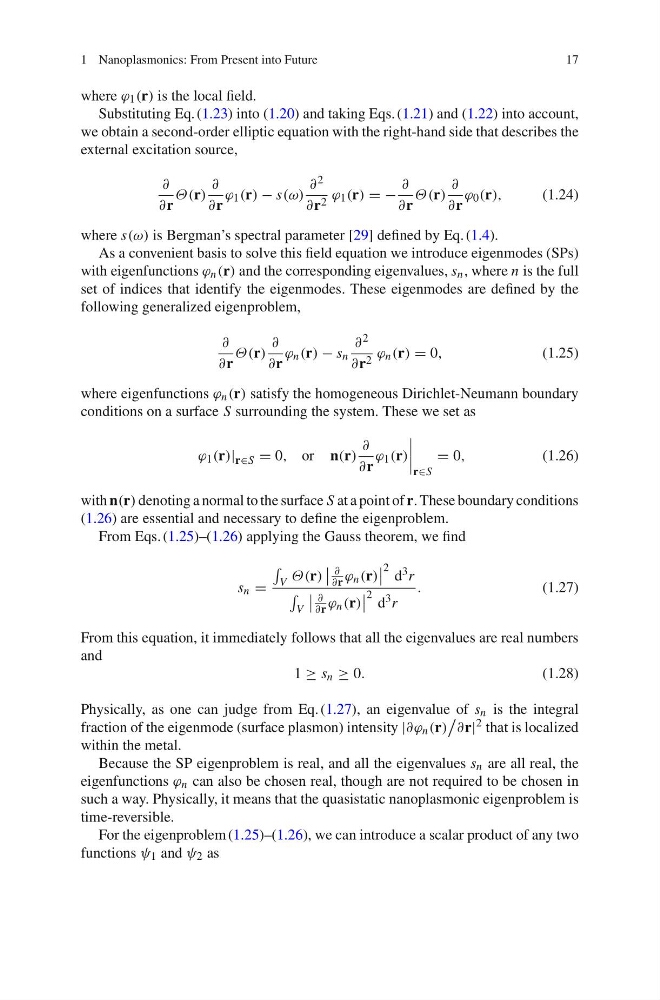
Substituting Eq. (1.23) into (1.20) and taking Eqs. (1.21) and (1.22) into account,
we obtain a second-order elliptic equation with the right-hand side that describes the
external excitation source,
∂
∂r
Θ(r)
∂
∂r
ϕ 1 (r) − s(ω)
∂ 2
∂r 2 ϕ 1 (r) = −
∂
∂r
Θ(r)
∂
∂r
ϕ 0 (r),
(1.24)
where s(ω) is Bergman’s spectral parameter [29] defined by Eq. (1.4).
As a convenient basis to solve this field equation we introduce eigenmodes (SPs)
with eigenfunctions ϕ n (r) and the corresponding eigenvalues, s n , where n is the full
set of indices that identify the eigenmodes. These eigenmodes are defined by the
following generalized eigenproblem,
∂
∂r
Θ(r)
∂
∂r
ϕ n (r) − s n
∂ 2
∂r 2 ϕ n (r) = 0,
(1.25)
where eigenfunctions ϕ n (r) satisfy the homogeneous Dirichlet-Neumann boundary
conditions on a surface S surrounding the system. These we set as
ϕ 1 (r)| r∈S = 0, or n(r)
∂
∂r
ϕ 1 (r)
r∈S
= 0,
(1.26)
with n(r) denoting a normal to the surface S at a point of r. These boundary conditions
(1.26) are essential and necessary to define the eigenproblem.
From Eqs. (1.25)–(1.26) applying the Gauss theorem, we find
s n =
V Θ(r)
∂
∂r ϕ n (r)
2 d 3 r
V
∂
∂r ϕ n (r)
2 d 3 r
.
(1.27)
From this equation, it immediately follows that all the eigenvalues are real numbers
and
1 ≥ s n ≥ 0.
(1.28)
Physically, as one can judge from Eq. (1.27), an eigenvalue of s n is the integral
fraction of the eigenmode (surface plasmon) intensity |∂ϕ n (r)
∂r| 2 that is localized
within the metal.
Because the SP eigenproblem is real, and all the eigenvalues s n are all real, the
eigenfunctions ϕ n can also be chosen real, though are not required to be chosen in
such a way. Physically, it means that the quasistatic nanoplasmonic eigenproblem is
time-reversible.
For the eigenproblem (1.25)–(1.26), we can introduce a scalar product of any two
functions ψ 1 and ψ 2 as
17
where ϕ 1 (r) is the local field.
Substituting Eq. (1.23) into (1.20) and taking Eqs. (1.21) and (1.22) into account,
we obtain a second-order elliptic equation with the right-hand side that describes the
external excitation source,
∂
∂r
Θ(r)
∂
∂r
ϕ 1 (r) − s(ω)
∂ 2
∂r 2 ϕ 1 (r) = −
∂
∂r
Θ(r)
∂
∂r
ϕ 0 (r),
(1.24)
where s(ω) is Bergman’s spectral parameter [29] defined by Eq. (1.4).
As a convenient basis to solve this field equation we introduce eigenmodes (SPs)
with eigenfunctions ϕ n (r) and the corresponding eigenvalues, s n , where n is the full
set of indices that identify the eigenmodes. These eigenmodes are defined by the
following generalized eigenproblem,
∂
∂r
Θ(r)
∂
∂r
ϕ n (r) − s n
∂ 2
∂r 2 ϕ n (r) = 0,
(1.25)
where eigenfunctions ϕ n (r) satisfy the homogeneous Dirichlet-Neumann boundary
conditions on a surface S surrounding the system. These we set as
ϕ 1 (r)| r∈S = 0, or n(r)
∂
∂r
ϕ 1 (r)
r∈S
= 0,
(1.26)
with n(r) denoting a normal to the surface S at a point of r. These boundary conditions
(1.26) are essential and necessary to define the eigenproblem.
From Eqs. (1.25)–(1.26) applying the Gauss theorem, we find
s n =
V Θ(r)
∂
∂r ϕ n (r)
2 d 3 r
V
∂
∂r ϕ n (r)
2 d 3 r
.
(1.27)
From this equation, it immediately follows that all the eigenvalues are real numbers
and
1 ≥ s n ≥ 0.
(1.28)
Physically, as one can judge from Eq. (1.27), an eigenvalue of s n is the integral
fraction of the eigenmode (surface plasmon) intensity |∂ϕ n (r)
∂r| 2 that is localized
within the metal.
Because the SP eigenproblem is real, and all the eigenvalues s n are all real, the
eigenfunctions ϕ n can also be chosen real, though are not required to be chosen in
such a way. Physically, it means that the quasistatic nanoplasmonic eigenproblem is
time-reversible.
For the eigenproblem (1.25)–(1.26), we can introduce a scalar product of any two
functions ψ 1 and ψ 2 as