

304
P. Ben-Abdallah et al.
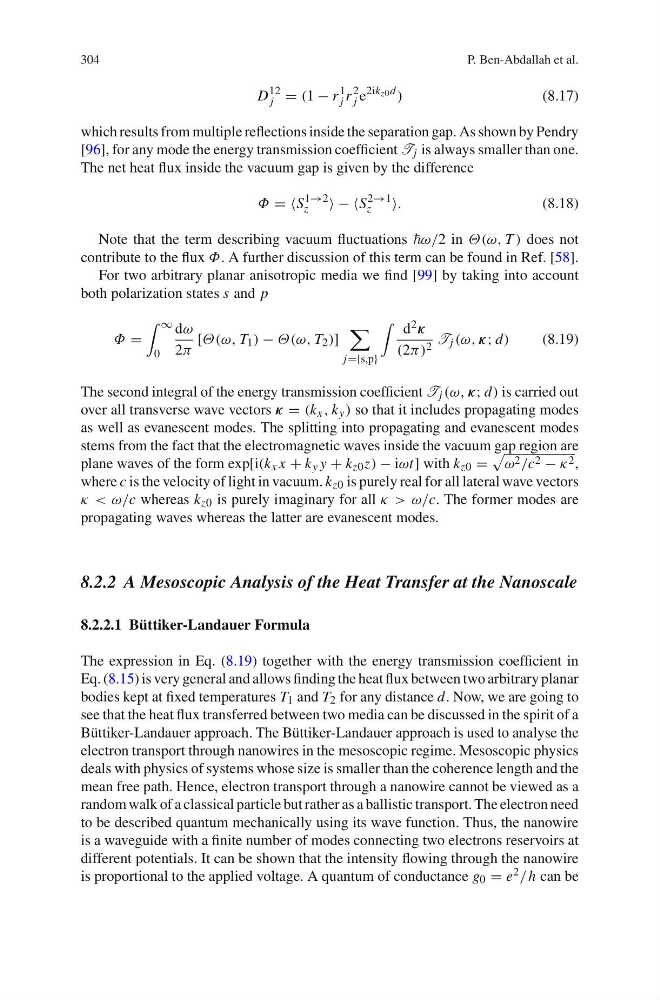
D
12
j = (1 − r
1
j r
2
j e
2ik z0 d
)
(8.17)
which results from multiple reflections inside the separation gap. As shown by Pendry
[96], for any mode the energy transmission coefficient T j is always smaller than one.
The net heat flux inside the vacuum gap is given by the difference
Φ = ∪S
1→2
z
∼ − ∪S
2→1
z
∼.
(8.18)
Note that the term describing vacuum fluctuations ω/2 in Θ(ω, T ) does not
contribute to the flux Φ. A further discussion of this term can be found in Ref. [58].
For two arbitrary planar anisotropic media we find [99] by taking into account
both polarization states s and p
Φ =
∞
0
dω
2π
[Θ(ω, T 1 ) − Θ(ω, T 2 )]
j={s,p}
d 2 κ
(2π) 2 T j (ω, κ; d)
(8.19)
The second integral of the energy transmission coefficient T j (ω, κ; d) is carried out
over all transverse wave vectors κ = (k x , k y ) so that it includes propagating modes
as well as evanescent modes. The splitting into propagating and evanescent modes
stems from the fact that the electromagnetic waves inside the vacuum gap region are
plane waves of the form exp[i(k x x + k y y + k z0 z) − iωt] with k z0 =
ω 2 /c 2 − κ 2 ,
where c is the velocity of light in vacuum. k z0 is purely real for all lateral wave vectors
κ < ω/c whereas k z0 is purely imaginary for all κ > ω/c. The former modes are
propagating waves whereas the latter are evanescent modes.
8.2.2 A Mesoscopic Analysis of the Heat Transfer at the Nanoscale
8.2.2.1 Büttiker-Landauer Formula
The expression in Eq. (8.19) together with the energy transmission coefficient in
Eq. (8.15) is very general and allows finding the heat flux between two arbitrary planar
bodies kept at fixed temperatures T 1 and T 2 for any distance d. Now, we are going to
see that the heat flux transferred between two media can be discussed in the spirit of a
Büttiker-Landauer approach. The Büttiker-Landauer approach is used to analyse the
electron transport through nanowires in the mesoscopic regime. Mesoscopic physics
deals with physics of systems whose size is smaller than the coherence length and the
mean free path. Hence, electron transport through a nanowire cannot be viewed as a
random walk of a classical particle but rather as a ballistic transport. The electron need
to be described quantum mechanically using its wave function. Thus, the nanowire
is a waveguide with a finite number of modes connecting two electrons reservoirs at
different potentials. It can be shown that the intensity flowing through the nanowire
is proportional to the applied voltage. A quantum of conductance g 0 = e 2 / h can be
P. Ben-Abdallah et al.
D
12
j = (1 − r
1
j r
2
j e
2ik z0 d
)
(8.17)
which results from multiple reflections inside the separation gap. As shown by Pendry
[96], for any mode the energy transmission coefficient T j is always smaller than one.
The net heat flux inside the vacuum gap is given by the difference
Φ = ∪S
1→2
z
∼ − ∪S
2→1
z
∼.
(8.18)
Note that the term describing vacuum fluctuations ω/2 in Θ(ω, T ) does not
contribute to the flux Φ. A further discussion of this term can be found in Ref. [58].
For two arbitrary planar anisotropic media we find [99] by taking into account
both polarization states s and p
Φ =
∞
0
dω
2π
[Θ(ω, T 1 ) − Θ(ω, T 2 )]
j={s,p}
d 2 κ
(2π) 2 T j (ω, κ; d)
(8.19)
The second integral of the energy transmission coefficient T j (ω, κ; d) is carried out
over all transverse wave vectors κ = (k x , k y ) so that it includes propagating modes
as well as evanescent modes. The splitting into propagating and evanescent modes
stems from the fact that the electromagnetic waves inside the vacuum gap region are
plane waves of the form exp[i(k x x + k y y + k z0 z) − iωt] with k z0 =
ω 2 /c 2 − κ 2 ,
where c is the velocity of light in vacuum. k z0 is purely real for all lateral wave vectors
κ < ω/c whereas k z0 is purely imaginary for all κ > ω/c. The former modes are
propagating waves whereas the latter are evanescent modes.
8.2.2 A Mesoscopic Analysis of the Heat Transfer at the Nanoscale
8.2.2.1 Büttiker-Landauer Formula
The expression in Eq. (8.19) together with the energy transmission coefficient in
Eq. (8.15) is very general and allows finding the heat flux between two arbitrary planar
bodies kept at fixed temperatures T 1 and T 2 for any distance d. Now, we are going to
see that the heat flux transferred between two media can be discussed in the spirit of a
Büttiker-Landauer approach. The Büttiker-Landauer approach is used to analyse the
electron transport through nanowires in the mesoscopic regime. Mesoscopic physics
deals with physics of systems whose size is smaller than the coherence length and the
mean free path. Hence, electron transport through a nanowire cannot be viewed as a
random walk of a classical particle but rather as a ballistic transport. The electron need
to be described quantum mechanically using its wave function. Thus, the nanowire
is a waveguide with a finite number of modes connecting two electrons reservoirs at
different potentials. It can be shown that the intensity flowing through the nanowire
is proportional to the applied voltage. A quantum of conductance g 0 = e 2 / h can be