

300
P. Ben-Abdallah et al.
algorithm. It has also been shown how to design spatially coherent sources with
multilayered systems [10, 22, 69].
The potential of photonic crystals has been explored by many authors [24, 40, 42,
73, 100]. In Ref. [68] the authors take advantage of the fact that a surface wave exists
at the interface between a truncated photonic crystal and a homogeneous dielectric.
This surface wave is a leaky wave and exists in the photonic gap. It is thus possible to
design a monochromatic directional source. In Ref. [59], the authors take advantage
of a wave guided by a large refractive index dielectric layer on top of an absorbing
substrate. Here, the guided wave plays the role of the surface mode. By properly
designing a grating, it is possible to generate directional emission. A completely
different approach has been taken by Noda’s group [36]. Here, the photonic crystal
is essentially a transparent medium. Several tens of quantum wells are inserted in the
photonic crystal in order to produce an absorption band at a desired frequency. This
frequency can be adjusted by engineering the intersubband transition. The photonic
crystal is used to control the frequency and the direction of emission.
8.2 Radiative Heat Transfer at the Nanoscale
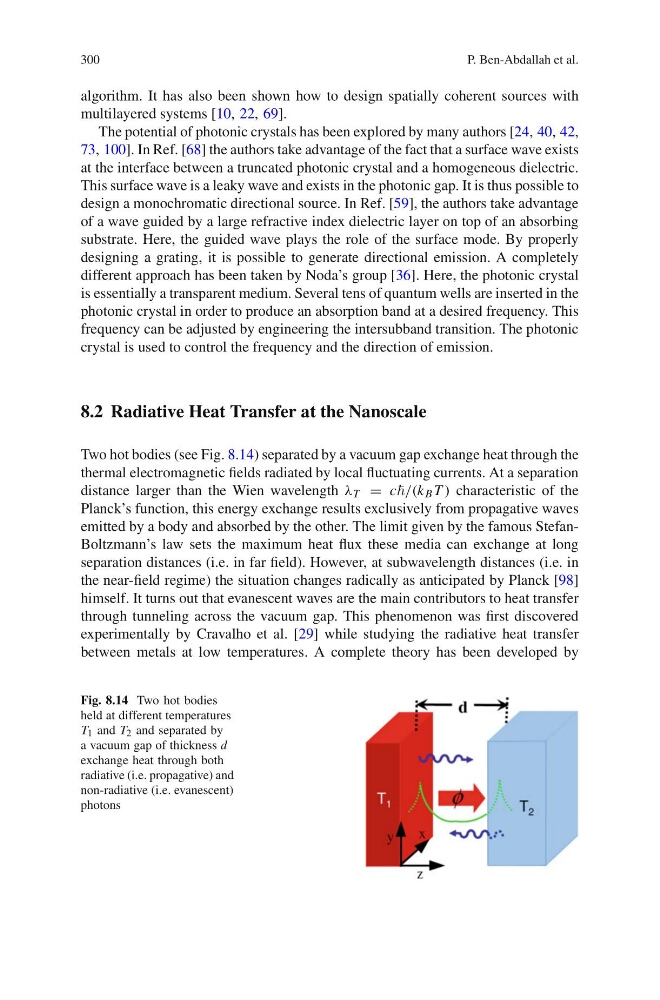
Two hot bodies (see Fig. 8.14) separated by a vacuum gap exchange heat through the
thermal electromagnetic fields radiated by local fluctuating currents. At a separation
distance larger than the Wien wavelength λ T = c/(k B T ) characteristic of the
Planck’s function, this energy exchange results exclusively from propagative waves
emitted by a body and absorbed by the other. The limit given by the famous StefanBoltzmann’s law sets the maximum heat flux these media can exchange at long
separation distances (i.e. in far field). However, at subwavelength distances (i.e. in
the near-field regime) the situation changes radically as anticipated by Planck [98]
himself. It turns out that evanescent waves are the main contributors to heat transfer
through tunneling across the vacuum gap. This phenomenon was first discovered
experimentally by Cravalho et al. [29] while studying the radiative heat transfer
between metals at low temperatures. A complete theory has been developed by
Fig. 8.14 Two hot bodies
held at different temperatures
T 1 and T 2 and separated by
a vacuum gap of thickness d
exchange heat through both
radiative (i.e. propagative) and
non-radiative (i.e. evanescent)
photons
P. Ben-Abdallah et al.
algorithm. It has also been shown how to design spatially coherent sources with
multilayered systems [10, 22, 69].
The potential of photonic crystals has been explored by many authors [24, 40, 42,
73, 100]. In Ref. [68] the authors take advantage of the fact that a surface wave exists
at the interface between a truncated photonic crystal and a homogeneous dielectric.
This surface wave is a leaky wave and exists in the photonic gap. It is thus possible to
design a monochromatic directional source. In Ref. [59], the authors take advantage
of a wave guided by a large refractive index dielectric layer on top of an absorbing
substrate. Here, the guided wave plays the role of the surface mode. By properly
designing a grating, it is possible to generate directional emission. A completely
different approach has been taken by Noda’s group [36]. Here, the photonic crystal
is essentially a transparent medium. Several tens of quantum wells are inserted in the
photonic crystal in order to produce an absorption band at a desired frequency. This
frequency can be adjusted by engineering the intersubband transition. The photonic
crystal is used to control the frequency and the direction of emission.
8.2 Radiative Heat Transfer at the Nanoscale
Two hot bodies (see Fig. 8.14) separated by a vacuum gap exchange heat through the
thermal electromagnetic fields radiated by local fluctuating currents. At a separation
distance larger than the Wien wavelength λ T = c/(k B T ) characteristic of the
Planck’s function, this energy exchange results exclusively from propagative waves
emitted by a body and absorbed by the other. The limit given by the famous StefanBoltzmann’s law sets the maximum heat flux these media can exchange at long
separation distances (i.e. in far field). However, at subwavelength distances (i.e. in
the near-field regime) the situation changes radically as anticipated by Planck [98]
himself. It turns out that evanescent waves are the main contributors to heat transfer
through tunneling across the vacuum gap. This phenomenon was first discovered
experimentally by Cravalho et al. [29] while studying the radiative heat transfer
between metals at low temperatures. A complete theory has been developed by
Fig. 8.14 Two hot bodies
held at different temperatures
T 1 and T 2 and separated by
a vacuum gap of thickness d
exchange heat through both
radiative (i.e. propagative) and
non-radiative (i.e. evanescent)
photons