

7 Ultrafast and Nonlinear Plasmon Dynamics
277
have demonstrated spectral shifts between near-field and far-field, and confirmed
that within nanoparticle geometries the nonlinear response remains sensitive to deviations in shape and other defects. These techniques are applicable to various antenna
geometries and wavelengths, provide design criteria for more complex architectures
and modeling, and can facilitate impedance matching of optical antennas to quantum
systems [56].
The adiabatic focusing tips provide an avenue to extend ultrafast spectroscopic
imaging from its conventional far-field spatial resolution limit to the nanoscale. Historically, the development of femtosecond pulsed lasers has enabled the investigation
of ultrafast dynamics on the characteristic time scales of the elementary electronic
and vibrational excitations in matter, with direct and selective spectroscopic access
to the corresponding energy levels. The combination with spectral pulse shaping [70]
provides the additional capability to control the coherent evolution of these quantum
excitations (quantum coherent control), which allows steering of chemical reactions
or control of optical and electronic material properties [71].
It would be highly desirable to extend the spatial resolution to the nanoscale to
simultaneously access ultrafast dynamics on their associated natural length scales
of the elementary electronic, visible, and spin excitations. The potential use of plasmonic properties to achieve this nanometer-femtosecond spatio-temporal control of
optical excitations for imaging and spectroscopy has attracted much interest. With
such a nano-optical technique, individual molecules, quantum dots, and plasmonic
structures, for example, could be investigated even in dense inhomogeneous media, in addition to spatial and non-local dynamics to probe transport, propagation,
and spatial coupling properties. The adiabatic focusing tips are one optical antenna
concept for overcoming the diffraction limit and providing the desired high spatial
field localization, with high bandwidth, and high off-resonant field enhancement thus
supporting even the shortest possible few-fs optical pulses.
Quantum dots
J-aggregates
Dye molecules
x
y
SPP
Grating tip
τ
nω, Δω...
feedback
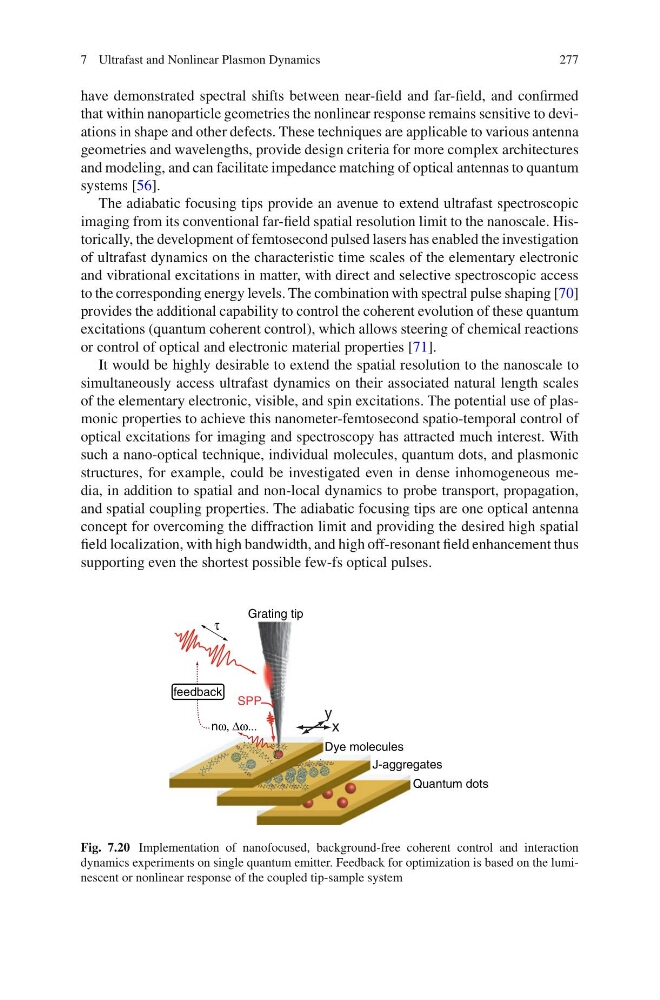
Fig. 7.20 Implementation of nanofocused, background-free coherent control and interaction
dynamics experiments on single quantum emitter. Feedback for optimization is based on the luminescent or nonlinear response of the coupled tip-sample system
277
have demonstrated spectral shifts between near-field and far-field, and confirmed
that within nanoparticle geometries the nonlinear response remains sensitive to deviations in shape and other defects. These techniques are applicable to various antenna
geometries and wavelengths, provide design criteria for more complex architectures
and modeling, and can facilitate impedance matching of optical antennas to quantum
systems [56].
The adiabatic focusing tips provide an avenue to extend ultrafast spectroscopic
imaging from its conventional far-field spatial resolution limit to the nanoscale. Historically, the development of femtosecond pulsed lasers has enabled the investigation
of ultrafast dynamics on the characteristic time scales of the elementary electronic
and vibrational excitations in matter, with direct and selective spectroscopic access
to the corresponding energy levels. The combination with spectral pulse shaping [70]
provides the additional capability to control the coherent evolution of these quantum
excitations (quantum coherent control), which allows steering of chemical reactions
or control of optical and electronic material properties [71].
It would be highly desirable to extend the spatial resolution to the nanoscale to
simultaneously access ultrafast dynamics on their associated natural length scales
of the elementary electronic, visible, and spin excitations. The potential use of plasmonic properties to achieve this nanometer-femtosecond spatio-temporal control of
optical excitations for imaging and spectroscopy has attracted much interest. With
such a nano-optical technique, individual molecules, quantum dots, and plasmonic
structures, for example, could be investigated even in dense inhomogeneous media, in addition to spatial and non-local dynamics to probe transport, propagation,
and spatial coupling properties. The adiabatic focusing tips are one optical antenna
concept for overcoming the diffraction limit and providing the desired high spatial
field localization, with high bandwidth, and high off-resonant field enhancement thus
supporting even the shortest possible few-fs optical pulses.
Quantum dots
J-aggregates
Dye molecules
x
y
SPP
Grating tip
τ
nω, Δω...
feedback
Fig. 7.20 Implementation of nanofocused, background-free coherent control and interaction
dynamics experiments on single quantum emitter. Feedback for optimization is based on the luminescent or nonlinear response of the coupled tip-sample system