

7 Ultrafast and Nonlinear Plasmon Dynamics
251
Dephasing Time (fs)
0
50
100
150
200
20
30
40
50
60
Particle Radius, R
Drude with damping
Drude without damping
2.1
2.5
1.5
Energy (eV)
Energy (eV)
Particle radius
10
60 nm
Scattering cross-section
(a.u.)
Scattering cross-section
(a.u.)
(a)
(b)
(c)
Particle radius
10 60 nm
SPP with
damping
SPP without
damping
T o tal dephasing T 2
T 2
T 2
rad
total
1. 7
1.9
2.3
2.1
2.5
1.5
1. 7
1.9
2.3
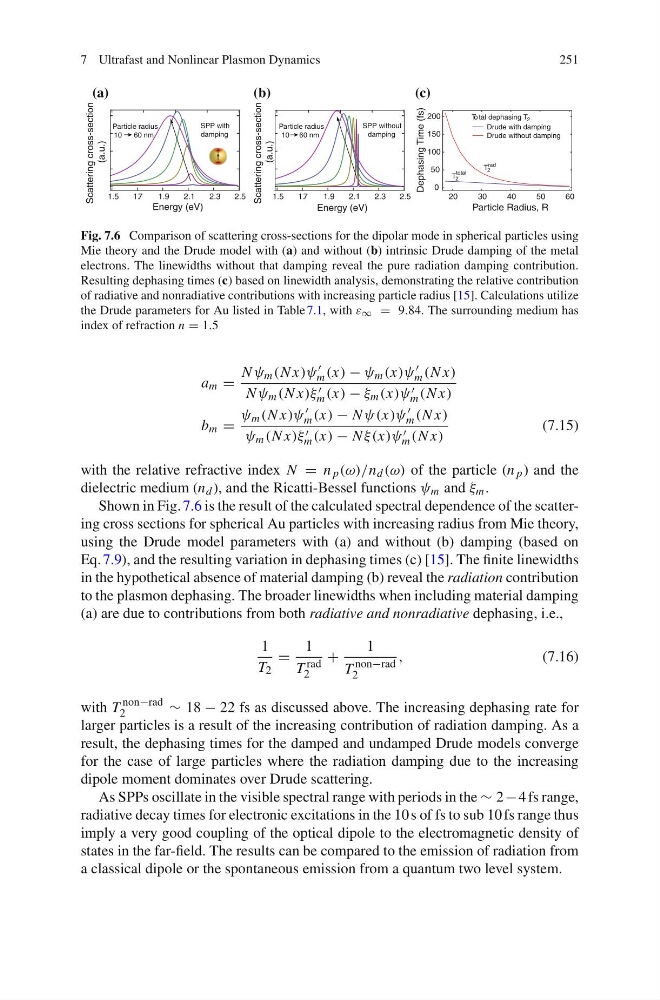
Fig. 7.6 Comparison of scattering cross-sections for the dipolar mode in spherical particles using
Mie theory and the Drude model with (a) and without (b) intrinsic Drude damping of the metal
electrons. The linewidths without that damping reveal the pure radiation damping contribution.
Resulting dephasing times (c) based on linewidth analysis, demonstrating the relative contribution
of radiative and nonradiative contributions with increasing particle radius [15]. Calculations utilize
the Drude parameters for Au listed in Table 7.1, with ε ≈ = 9.84. The surrounding medium has
index of refraction n = 1.5
a m =
N ψ m (N x)ψ ∼
m (x) − ψ m (x)ψ ∼
m (N x)
N ψ m (N x)ξ ∼
m (x) − ξ m (x)ψ ∼
m (N x)
b m =
ψ m (N x)ψ ∼
m (x) − N ψ(x)ψ ∼
m (N x)
ψ m (N x)ξ ∼
m (x) − N ξ(x)ψ ∼
m (N x)
(7.15)
with the relative refractive index N = n p (ω)/n d (ω) of the particle (n p ) and the
dielectric medium (n d ), and the Ricatti-Bessel functions ψ m and ξ m .
Shown in Fig. 7.6 is the result of the calculated spectral dependence of the scattering cross sections for spherical Au particles with increasing radius from Mie theory,
using the Drude model parameters with (a) and without (b) damping (based on
Eq. 7.9), and the resulting variation in dephasing times (c) [15]. The finite linewidths
in the hypothetical absence of material damping (b) reveal the radiation contribution
to the plasmon dephasing. The broader linewidths when including material damping
(a) are due to contributions from both radiative and nonradiative dephasing, i.e.,
1
T 2
=
1
T rad
2
+
1
T
non−rad
2
,
(7.16)
with T
non−rad
2
∝ 18 − 22 fs as discussed above. The increasing dephasing rate for
larger particles is a result of the increasing contribution of radiation damping. As a
result, the dephasing times for the damped and undamped Drude models converge
for the case of large particles where the radiation damping due to the increasing
dipole moment dominates over Drude scattering.
As SPPs oscillate in the visible spectral range with periods in the ∝ 2 − 4 fs range,
radiative decay times for electronic excitations in the 10 s of fs to sub 10 fs range thus
imply a very good coupling of the optical dipole to the electromagnetic density of
states in the far-field. The results can be compared to the emission of radiation from
a classical dipole or the spontaneous emission from a quantum two level system.
251
Dephasing Time (fs)
0
50
100
150
200
20
30
40
50
60
Particle Radius, R
Drude with damping
Drude without damping
2.1
2.5
1.5
Energy (eV)
Energy (eV)
Particle radius
10
60 nm
Scattering cross-section
(a.u.)
Scattering cross-section
(a.u.)
(a)
(b)
(c)
Particle radius
10 60 nm
SPP with
damping
SPP without
damping
T o tal dephasing T 2
T 2
T 2
rad
total
1. 7
1.9
2.3
2.1
2.5
1.5
1. 7
1.9
2.3
Fig. 7.6 Comparison of scattering cross-sections for the dipolar mode in spherical particles using
Mie theory and the Drude model with (a) and without (b) intrinsic Drude damping of the metal
electrons. The linewidths without that damping reveal the pure radiation damping contribution.
Resulting dephasing times (c) based on linewidth analysis, demonstrating the relative contribution
of radiative and nonradiative contributions with increasing particle radius [15]. Calculations utilize
the Drude parameters for Au listed in Table 7.1, with ε ≈ = 9.84. The surrounding medium has
index of refraction n = 1.5
a m =
N ψ m (N x)ψ ∼
m (x) − ψ m (x)ψ ∼
m (N x)
N ψ m (N x)ξ ∼
m (x) − ξ m (x)ψ ∼
m (N x)
b m =
ψ m (N x)ψ ∼
m (x) − N ψ(x)ψ ∼
m (N x)
ψ m (N x)ξ ∼
m (x) − N ξ(x)ψ ∼
m (N x)
(7.15)
with the relative refractive index N = n p (ω)/n d (ω) of the particle (n p ) and the
dielectric medium (n d ), and the Ricatti-Bessel functions ψ m and ξ m .
Shown in Fig. 7.6 is the result of the calculated spectral dependence of the scattering cross sections for spherical Au particles with increasing radius from Mie theory,
using the Drude model parameters with (a) and without (b) damping (based on
Eq. 7.9), and the resulting variation in dephasing times (c) [15]. The finite linewidths
in the hypothetical absence of material damping (b) reveal the radiation contribution
to the plasmon dephasing. The broader linewidths when including material damping
(a) are due to contributions from both radiative and nonradiative dephasing, i.e.,
1
T 2
=
1
T rad
2
+
1
T
non−rad
2
,
(7.16)
with T
non−rad
2
∝ 18 − 22 fs as discussed above. The increasing dephasing rate for
larger particles is a result of the increasing contribution of radiation damping. As a
result, the dephasing times for the damped and undamped Drude models converge
for the case of large particles where the radiation damping due to the increasing
dipole moment dominates over Drude scattering.
As SPPs oscillate in the visible spectral range with periods in the ∝ 2 − 4 fs range,
radiative decay times for electronic excitations in the 10 s of fs to sub 10 fs range thus
imply a very good coupling of the optical dipole to the electromagnetic density of
states in the far-field. The results can be compared to the emission of radiation from
a classical dipole or the spontaneous emission from a quantum two level system.