

10
M. I. Stockman
one needs to quantize the SPs, which we have originally done in Ref. [31] and present
below in Sect. 1.5.4.1.
However, there is a general way to do it without the explicit SP quantization, which
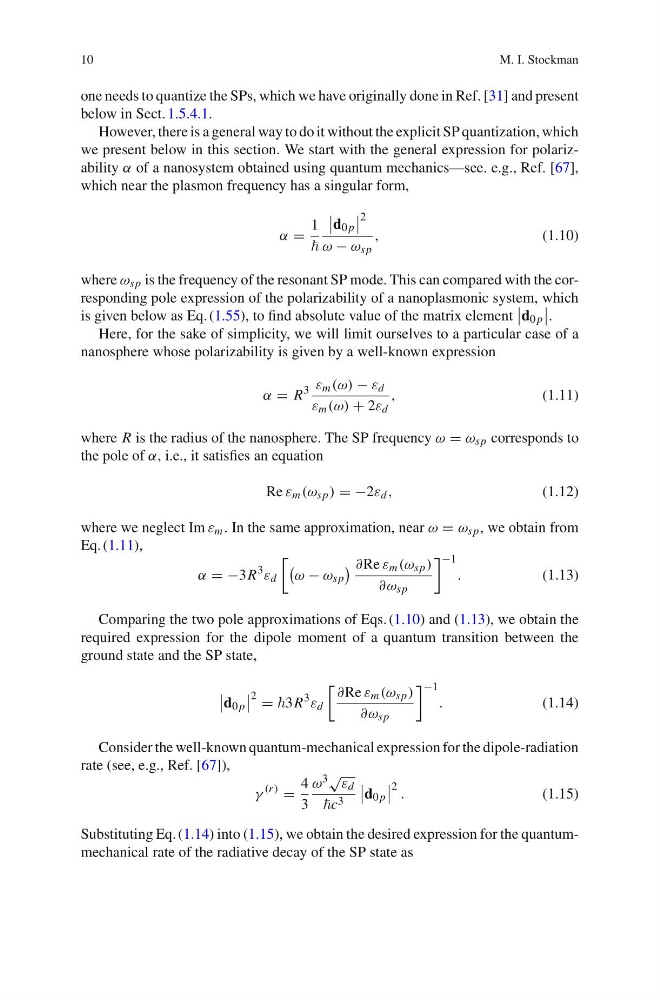
we present below in this section. We start with the general expression for polarizability α of a nanosystem obtained using quantum mechanics—see. e.g., Ref. [67],
which near the plasmon frequency has a singular form,
α =
1
d 0 p
2
ω − ω sp
,
(1.10)
where ω sp is the frequency of the resonant SP mode. This can compared with the corresponding pole expression of the polarizability of a nanoplasmonic system, which
is given below as Eq. (1.55), to find absolute value of the matrix element
d 0 p
.
Here, for the sake of simplicity, we will limit ourselves to a particular case of a
nanosphere whose polarizability is given by a well-known expression
α = R
3 ε m (ω) − ε d
ε m (ω) + 2ε d
,
(1.11)
where R is the radius of the nanosphere. The SP frequency ω = ω sp corresponds to
the pole of α, i.e., it satisfies an equation
Re ε m (ω sp ) = −2ε d ,
(1.12)
where we neglect Im ε m . In the same approximation, near ω = ω sp , we obtain from
Eq. (1.11),
α = −3R
3
ε d
ω − ω sp
∂Re ε m (ω sp )
∂ω sp
−1
.
(1.13)
Comparing the two pole approximations of Eqs. (1.10) and (1.13), we obtain the
required expression for the dipole moment of a quantum transition between the
ground state and the SP state,
d 0 p
2 = 3R
3
ε d
∂Re ε m (ω sp )
∂ω sp
−1
.
(1.14)
Consider the well-known quantum-mechanical expression for the dipole-radiation
rate (see, e.g., Ref. [67]),
γ
(r )
=
4
3
ω 3 √ ε d
c 3
d 0 p
2 .
(1.15)
Substituting Eq. (1.14) into (1.15), we obtain the desired expression for the quantummechanical rate of the radiative decay of the SP state as
M. I. Stockman
one needs to quantize the SPs, which we have originally done in Ref. [31] and present
below in Sect. 1.5.4.1.
However, there is a general way to do it without the explicit SP quantization, which
we present below in this section. We start with the general expression for polarizability α of a nanosystem obtained using quantum mechanics—see. e.g., Ref. [67],
which near the plasmon frequency has a singular form,
α =
1
d 0 p
2
ω − ω sp
,
(1.10)
where ω sp is the frequency of the resonant SP mode. This can compared with the corresponding pole expression of the polarizability of a nanoplasmonic system, which
is given below as Eq. (1.55), to find absolute value of the matrix element
d 0 p
.
Here, for the sake of simplicity, we will limit ourselves to a particular case of a
nanosphere whose polarizability is given by a well-known expression
α = R
3 ε m (ω) − ε d
ε m (ω) + 2ε d
,
(1.11)
where R is the radius of the nanosphere. The SP frequency ω = ω sp corresponds to
the pole of α, i.e., it satisfies an equation
Re ε m (ω sp ) = −2ε d ,
(1.12)
where we neglect Im ε m . In the same approximation, near ω = ω sp , we obtain from
Eq. (1.11),
α = −3R
3
ε d
ω − ω sp
∂Re ε m (ω sp )
∂ω sp
−1
.
(1.13)
Comparing the two pole approximations of Eqs. (1.10) and (1.13), we obtain the
required expression for the dipole moment of a quantum transition between the
ground state and the SP state,
d 0 p
2 = 3R
3
ε d
∂Re ε m (ω sp )
∂ω sp
−1
.
(1.14)
Consider the well-known quantum-mechanical expression for the dipole-radiation
rate (see, e.g., Ref. [67]),
γ
(r )
=
4
3
ω 3 √ ε d
c 3
d 0 p
2 .
(1.15)
Substituting Eq. (1.14) into (1.15), we obtain the desired expression for the quantummechanical rate of the radiative decay of the SP state as