

240
M. B. Raschke et al.
The well known Kramers-Kronig relationship relates real and imaginary parts of the
susceptibility to each other.
A medium is considered instantaneously responding when the excitation is far
off-resonant, meaning that the polarization at t = t 0 depends only on the electric
field at that point in time. Resonant interactions are associated with memory effects,
and relaxation processes following the excitation.
The usual Fourier transform relationships hold between the time and frequency
domains and the two descriptions are complementary. While the frequency-domain
description is typically employed for monochromatic optical interactions, the timedomain provides a more convenient way of analyzing problems where the excitation
is induced by a short optical transient. The time domain analysis is therefore useful
in particular for the dynamical properties of SPPs.
7.1.4 Electronic Properties of Metals
The spectral and temporal characteristics of SPPs for a metal are ultimately determined by the intrinsic electronic structure of the supporting metal. Most typical
metals have hybridized sp bands that are parabolic to first order, with a density of
states (DOS) that varies weakly within the range of a few eV above and below the
Fermi level. sp bands resemble the free electron behavior typical for an s-metal [4].
In the absence of other electronic states or for sufficiently small photon energies, the
optical response of the metal is determined by indirect intraband excitations.
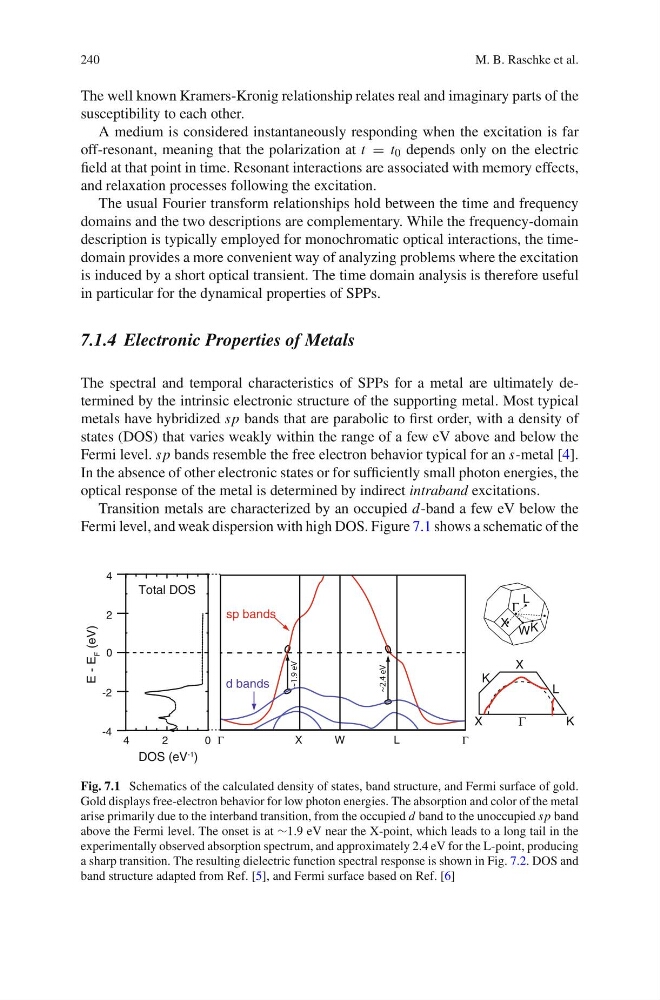
Transition metals are characterized by an occupied d-band a few eV below the
Fermi level, and weak dispersion with high DOS. Figure 7.1 shows a schematic of the
d bands
sp bands
Total DOS
E - E
F
(eV)
-4
-2
0
2
4
DOS (eV
-1 )
0
2
4
Γ
Γ
L
W
X
X
Γ
K
X
K
L
X
K
L
Γ
W
Fig. 7.1 Schematics of the calculated density of states, band structure, and Fermi surface of gold.
Gold displays free-electron behavior for low photon energies. The absorption and color of the metal
arise primarily due to the interband transition, from the occupied d band to the unoccupied sp band
above the Fermi level. The onset is at ∝1.9 eV near the X-point, which leads to a long tail in the
experimentally observed absorption spectrum, and approximately 2.4 eV for the L-point, producing
a sharp transition. The resulting dielectric function spectral response is shown in Fig. 7.2. DOS and
band structure adapted from Ref. [5], and Fermi surface based on Ref. [6]
M. B. Raschke et al.
The well known Kramers-Kronig relationship relates real and imaginary parts of the
susceptibility to each other.
A medium is considered instantaneously responding when the excitation is far
off-resonant, meaning that the polarization at t = t 0 depends only on the electric
field at that point in time. Resonant interactions are associated with memory effects,
and relaxation processes following the excitation.
The usual Fourier transform relationships hold between the time and frequency
domains and the two descriptions are complementary. While the frequency-domain
description is typically employed for monochromatic optical interactions, the timedomain provides a more convenient way of analyzing problems where the excitation
is induced by a short optical transient. The time domain analysis is therefore useful
in particular for the dynamical properties of SPPs.
7.1.4 Electronic Properties of Metals
The spectral and temporal characteristics of SPPs for a metal are ultimately determined by the intrinsic electronic structure of the supporting metal. Most typical
metals have hybridized sp bands that are parabolic to first order, with a density of
states (DOS) that varies weakly within the range of a few eV above and below the
Fermi level. sp bands resemble the free electron behavior typical for an s-metal [4].
In the absence of other electronic states or for sufficiently small photon energies, the
optical response of the metal is determined by indirect intraband excitations.
Transition metals are characterized by an occupied d-band a few eV below the
Fermi level, and weak dispersion with high DOS. Figure 7.1 shows a schematic of the
d bands
sp bands
Total DOS
E - E
F
(eV)
-4
-2
0
2
4
DOS (eV
-1 )
0
2
4
Γ
Γ
L
W
X
X
Γ
K
X
K
L
X
K
L
Γ
W
Fig. 7.1 Schematics of the calculated density of states, band structure, and Fermi surface of gold.
Gold displays free-electron behavior for low photon energies. The absorption and color of the metal
arise primarily due to the interband transition, from the occupied d band to the unoccupied sp band
above the Fermi level. The onset is at ∝1.9 eV near the X-point, which leads to a long tail in the
experimentally observed absorption spectrum, and approximately 2.4 eV for the L-point, producing
a sharp transition. The resulting dielectric function spectral response is shown in Fig. 7.2. DOS and
band structure adapted from Ref. [5], and Fermi surface based on Ref. [6]