

1 Nanoplasmonics: From Present into Future
7
1
2
3
5
10
1
2
3
20
40
60
(eV)
(fs)
(fs)
(eV)
(a)
(b)
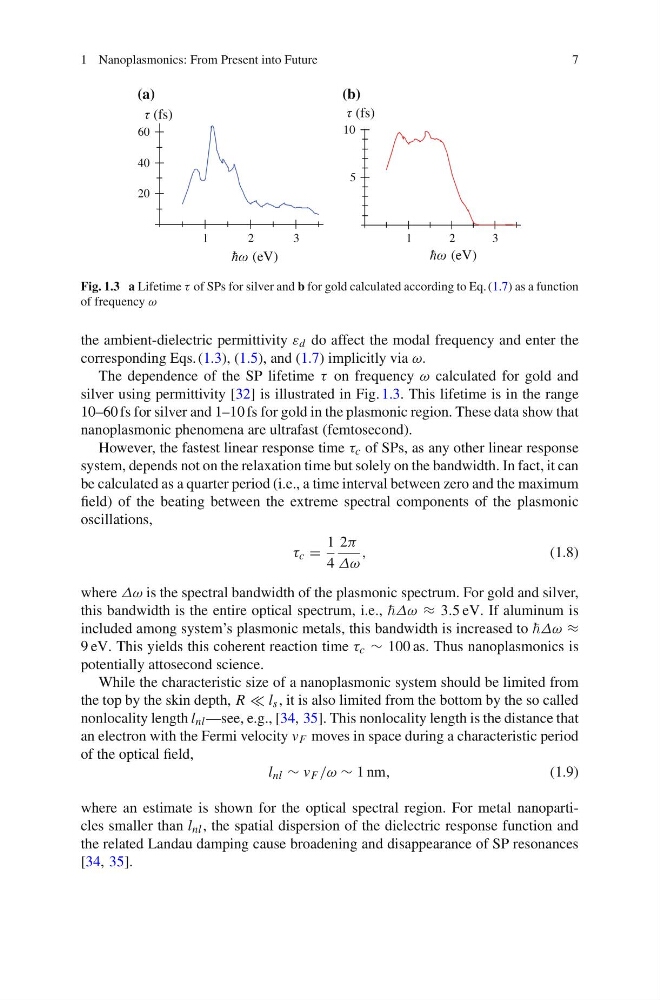
Fig. 1.3 a Lifetime τ of SPs for silver and b for gold calculated according to Eq. (1.7) as a function
of frequency ω
the ambient-dielectric permittivity ε d do affect the modal frequency and enter the
corresponding Eqs. (1.3), (1.5), and (1.7) implicitly via ω.
The dependence of the SP lifetime τ on frequency ω calculated for gold and
silver using permittivity [32] is illustrated in Fig. 1.3. This lifetime is in the range
10–60 fs for silver and 1–10 fs for gold in the plasmonic region. These data show that
nanoplasmonic phenomena are ultrafast (femtosecond).
However, the fastest linear response time τ c of SPs, as any other linear response
system, depends not on the relaxation time but solely on the bandwidth. In fact, it can
be calculated as a quarter period (i.e., a time interval between zero and the maximum
field) of the beating between the extreme spectral components of the plasmonic
oscillations,
τ c =
1
4
2π
Δω
,
(1.8)
where Δω is the spectral bandwidth of the plasmonic spectrum. For gold and silver,
this bandwidth is the entire optical spectrum, i.e., Δω ≈ 3.5 eV. If aluminum is
included among system’s plasmonic metals, this bandwidth is increased to Δω ≈
9 eV. This yields this coherent reaction time τ c ∼ 100 as. Thus nanoplasmonics is
potentially attosecond science.
While the characteristic size of a nanoplasmonic system should be limited from
the top by the skin depth, R ∪ l s , it is also limited from the bottom by the so called
nonlocality length l nl —see, e.g., [34, 35]. This nonlocality length is the distance that
an electron with the Fermi velocity v F moves in space during a characteristic period
of the optical field,
l nl ∼ v F /ω ∼ 1 nm,
(1.9)
where an estimate is shown for the optical spectral region. For metal nanoparticles smaller than l nl , the spatial dispersion of the dielectric response function and
the related Landau damping cause broadening and disappearance of SP resonances
[34, 35].
7
1
2
3
5
10
1
2
3
20
40
60
(eV)
(fs)
(fs)
(eV)
(a)
(b)
Fig. 1.3 a Lifetime τ of SPs for silver and b for gold calculated according to Eq. (1.7) as a function
of frequency ω
the ambient-dielectric permittivity ε d do affect the modal frequency and enter the
corresponding Eqs. (1.3), (1.5), and (1.7) implicitly via ω.
The dependence of the SP lifetime τ on frequency ω calculated for gold and
silver using permittivity [32] is illustrated in Fig. 1.3. This lifetime is in the range
10–60 fs for silver and 1–10 fs for gold in the plasmonic region. These data show that
nanoplasmonic phenomena are ultrafast (femtosecond).
However, the fastest linear response time τ c of SPs, as any other linear response
system, depends not on the relaxation time but solely on the bandwidth. In fact, it can
be calculated as a quarter period (i.e., a time interval between zero and the maximum
field) of the beating between the extreme spectral components of the plasmonic
oscillations,
τ c =
1
4
2π
Δω
,
(1.8)
where Δω is the spectral bandwidth of the plasmonic spectrum. For gold and silver,
this bandwidth is the entire optical spectrum, i.e., Δω ≈ 3.5 eV. If aluminum is
included among system’s plasmonic metals, this bandwidth is increased to Δω ≈
9 eV. This yields this coherent reaction time τ c ∼ 100 as. Thus nanoplasmonics is
potentially attosecond science.
While the characteristic size of a nanoplasmonic system should be limited from
the top by the skin depth, R ∪ l s , it is also limited from the bottom by the so called
nonlocality length l nl —see, e.g., [34, 35]. This nonlocality length is the distance that
an electron with the Fermi velocity v F moves in space during a characteristic period
of the optical field,
l nl ∼ v F /ω ∼ 1 nm,
(1.9)
where an estimate is shown for the optical spectral region. For metal nanoparticles smaller than l nl , the spatial dispersion of the dielectric response function and
the related Landau damping cause broadening and disappearance of SP resonances
[34, 35].