

6 Second-Order Nonlinear Optical Properties of Plasmonic Nanostructures
215
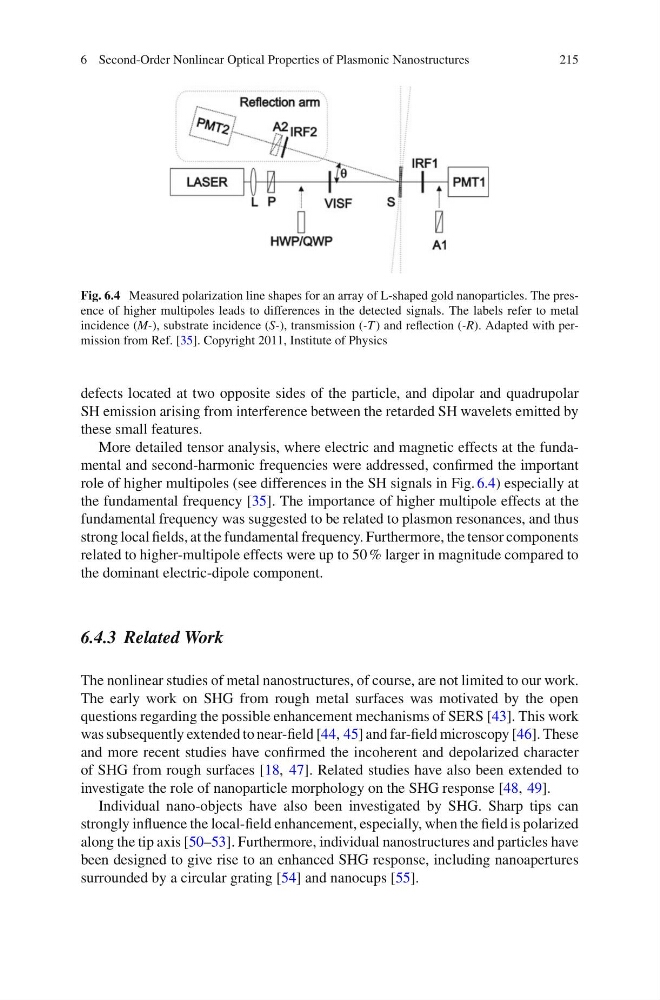
Fig. 6.4 Measured polarization line shapes for an array of L-shaped gold nanoparticles. The presence of higher multipoles leads to differences in the detected signals. The labels refer to metal
incidence (M-), substrate incidence (S-), transmission (-T ) and reflection (-R). Adapted with permission from Ref. [35]. Copyright 2011, Institute of Physics
defects located at two opposite sides of the particle, and dipolar and quadrupolar
SH emission arising from interference between the retarded SH wavelets emitted by
these small features.
More detailed tensor analysis, where electric and magnetic effects at the fundamental and second-harmonic frequencies were addressed, confirmed the important
role of higher multipoles (see differences in the SH signals in Fig. 6.4) especially at
the fundamental frequency [35]. The importance of higher multipole effects at the
fundamental frequency was suggested to be related to plasmon resonances, and thus
strong local fields, at the fundamental frequency. Furthermore, the tensor components
related to higher-multipole effects were up to 50 % larger in magnitude compared to
the dominant electric-dipole component.
6.4.3 Related Work
The nonlinear studies of metal nanostructures, of course, are not limited to our work.
The early work on SHG from rough metal surfaces was motivated by the open
questions regarding the possible enhancement mechanisms of SERS [43]. This work
was subsequently extended to near-field [44, 45] and far-field microscopy [46]. These
and more recent studies have confirmed the incoherent and depolarized character
of SHG from rough surfaces [18, 47]. Related studies have also been extended to
investigate the role of nanoparticle morphology on the SHG response [48, 49].
Individual nano-objects have also been investigated by SHG. Sharp tips can
strongly influence the local-field enhancement, especially, when the field is polarized
along the tip axis [50–53]. Furthermore, individual nanostructures and particles have
been designed to give rise to an enhanced SHG response, including nanoapertures
surrounded by a circular grating [54] and nanocups [55].
215
Fig. 6.4 Measured polarization line shapes for an array of L-shaped gold nanoparticles. The presence of higher multipoles leads to differences in the detected signals. The labels refer to metal
incidence (M-), substrate incidence (S-), transmission (-T ) and reflection (-R). Adapted with permission from Ref. [35]. Copyright 2011, Institute of Physics
defects located at two opposite sides of the particle, and dipolar and quadrupolar
SH emission arising from interference between the retarded SH wavelets emitted by
these small features.
More detailed tensor analysis, where electric and magnetic effects at the fundamental and second-harmonic frequencies were addressed, confirmed the important
role of higher multipoles (see differences in the SH signals in Fig. 6.4) especially at
the fundamental frequency [35]. The importance of higher multipole effects at the
fundamental frequency was suggested to be related to plasmon resonances, and thus
strong local fields, at the fundamental frequency. Furthermore, the tensor components
related to higher-multipole effects were up to 50 % larger in magnitude compared to
the dominant electric-dipole component.
6.4.3 Related Work
The nonlinear studies of metal nanostructures, of course, are not limited to our work.
The early work on SHG from rough metal surfaces was motivated by the open
questions regarding the possible enhancement mechanisms of SERS [43]. This work
was subsequently extended to near-field [44, 45] and far-field microscopy [46]. These
and more recent studies have confirmed the incoherent and depolarized character
of SHG from rough surfaces [18, 47]. Related studies have also been extended to
investigate the role of nanoparticle morphology on the SHG response [48, 49].
Individual nano-objects have also been investigated by SHG. Sharp tips can
strongly influence the local-field enhancement, especially, when the field is polarized
along the tip axis [50–53]. Furthermore, individual nanostructures and particles have
been designed to give rise to an enhanced SHG response, including nanoapertures
surrounded by a circular grating [54] and nanocups [55].