

188
F. Vallée and N. Del Fatti
5.4.2.2 Intraband Dielectric Function
Lattice heating modifies the intraband contribution to ε both via increase of the
electron scattering rate λ e− ph and by reduction of the plasma frequency ω p . The
former effect is a direct consequence of increase of the phonon occupation number
with the lattice temperature (Eq. 5.3). As for the electron temperature induced change
of λ , it mostly affects the imaginary part of ε (Eq. 5.30).
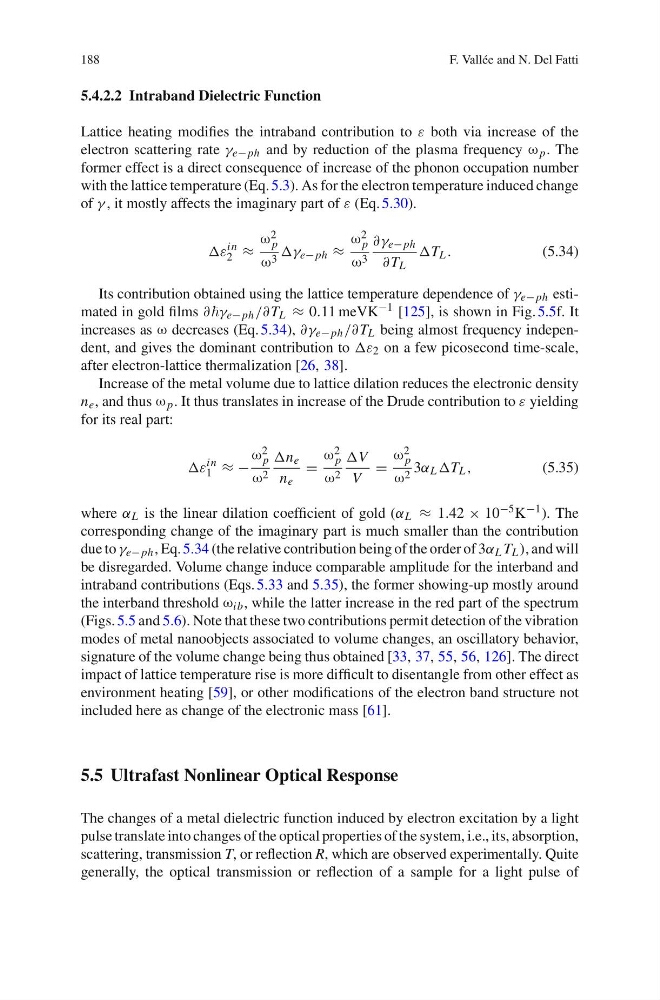
ωε
in
2 ≈
ω 2
p
ω 3 ωλ e− ph ≈
ω 2
p
ω 3
γλ e− ph
γ T L
ωT L .
(5.34)
Its contribution obtained using the lattice temperature dependence of λ e− ph estimated in gold films γλ e− ph /γ T L ≈ 0.11 meVK −1 [125], is shown in Fig. 5.5f. It
increases as ω decreases (Eq. 5.34), γλ e− ph /γ T L being almost frequency independent, and gives the dominant contribution to ωε 2 on a few picosecond time-scale,
after electron-lattice thermalization [26, 38].
Increase of the metal volume due to lattice dilation reduces the electronic density
n e , and thus ω p . It thus translates in increase of the Drude contribution to ε yielding
for its real part:
ωε
in
1 ≈ −
ω 2
p
ω 2
ωn e
n e
=
ω 2
p
ω 2
ωV
V
=
ω 2
p
ω 2 3β L ωT L ,
(5.35)
where β L is the linear dilation coefficient of gold (β L ≈ 1.42 × 10 −5 K −1 ). The
corresponding change of the imaginary part is much smaller than the contribution
due to λ e− ph , Eq. 5.34 (the relative contribution being of the order of 3β L T L ), and will
be disregarded. Volume change induce comparable amplitude for the interband and
intraband contributions (Eqs. 5.33 and 5.35), the former showing-up mostly around
the interband threshold ω ib , while the latter increase in the red part of the spectrum
(Figs. 5.5 and 5.6). Note that these two contributions permit detection of the vibration
modes of metal nanoobjects associated to volume changes, an oscillatory behavior,
signature of the volume change being thus obtained [33, 37, 55, 56, 126]. The direct
impact of lattice temperature rise is more difficult to disentangle from other effect as
environment heating [59], or other modifications of the electron band structure not
included here as change of the electronic mass [61].
5.5 Ultrafast Nonlinear Optical Response
The changes of a metal dielectric function induced by electron excitation by a light
pulse translate into changes of the optical properties of the system, i.e., its, absorption,
scattering, transmission T, or reflection R, which are observed experimentally. Quite
generally, the optical transmission or reflection of a sample for a light pulse of
F. Vallée and N. Del Fatti
5.4.2.2 Intraband Dielectric Function
Lattice heating modifies the intraband contribution to ε both via increase of the
electron scattering rate λ e− ph and by reduction of the plasma frequency ω p . The
former effect is a direct consequence of increase of the phonon occupation number
with the lattice temperature (Eq. 5.3). As for the electron temperature induced change
of λ , it mostly affects the imaginary part of ε (Eq. 5.30).
ωε
in
2 ≈
ω 2
p
ω 3 ωλ e− ph ≈
ω 2
p
ω 3
γλ e− ph
γ T L
ωT L .
(5.34)
Its contribution obtained using the lattice temperature dependence of λ e− ph estimated in gold films γλ e− ph /γ T L ≈ 0.11 meVK −1 [125], is shown in Fig. 5.5f. It
increases as ω decreases (Eq. 5.34), γλ e− ph /γ T L being almost frequency independent, and gives the dominant contribution to ωε 2 on a few picosecond time-scale,
after electron-lattice thermalization [26, 38].
Increase of the metal volume due to lattice dilation reduces the electronic density
n e , and thus ω p . It thus translates in increase of the Drude contribution to ε yielding
for its real part:
ωε
in
1 ≈ −
ω 2
p
ω 2
ωn e
n e
=
ω 2
p
ω 2
ωV
V
=
ω 2
p
ω 2 3β L ωT L ,
(5.35)
where β L is the linear dilation coefficient of gold (β L ≈ 1.42 × 10 −5 K −1 ). The
corresponding change of the imaginary part is much smaller than the contribution
due to λ e− ph , Eq. 5.34 (the relative contribution being of the order of 3β L T L ), and will
be disregarded. Volume change induce comparable amplitude for the interband and
intraband contributions (Eqs. 5.33 and 5.35), the former showing-up mostly around
the interband threshold ω ib , while the latter increase in the red part of the spectrum
(Figs. 5.5 and 5.6). Note that these two contributions permit detection of the vibration
modes of metal nanoobjects associated to volume changes, an oscillatory behavior,
signature of the volume change being thus obtained [33, 37, 55, 56, 126]. The direct
impact of lattice temperature rise is more difficult to disentangle from other effect as
environment heating [59], or other modifications of the electron band structure not
included here as change of the electronic mass [61].
5.5 Ultrafast Nonlinear Optical Response
The changes of a metal dielectric function induced by electron excitation by a light
pulse translate into changes of the optical properties of the system, i.e., its, absorption,
scattering, transmission T, or reflection R, which are observed experimentally. Quite
generally, the optical transmission or reflection of a sample for a light pulse of