

186
F. Vallée and N. Del Fatti
-2.0
-1.5
-1.0
-0.5
0.0
0.5
1.0
(a)
Δε
1
ib
-0.5
0.0
0.5
1.0
1.5
2.0
(b)
Δε
2
ib
-4
-2
0
2
4
6
8
10
(d)
Δε
2
ib
(x 10
-2
)
-4
-2
0
2
4
6
8
10
(c)
Δε
1
ib
(x 10
-2
)
1.5
2.0
2.5
3.0
3.5
0
2
4
6
8
10
ω (eV)
(e)
Δε
1
in
(x 10
-2
)
1.5
2.0
2.5
3.0
3.5
0
2
4
6
8
10
1.5
2.0
2.5
3.0
3.5
0.0
0.5
1.0
ω (eV)
(f)
Δε
2
in
(x 10
-2
)
Δε
2
in
(x 10
-2
)
ω (eV)
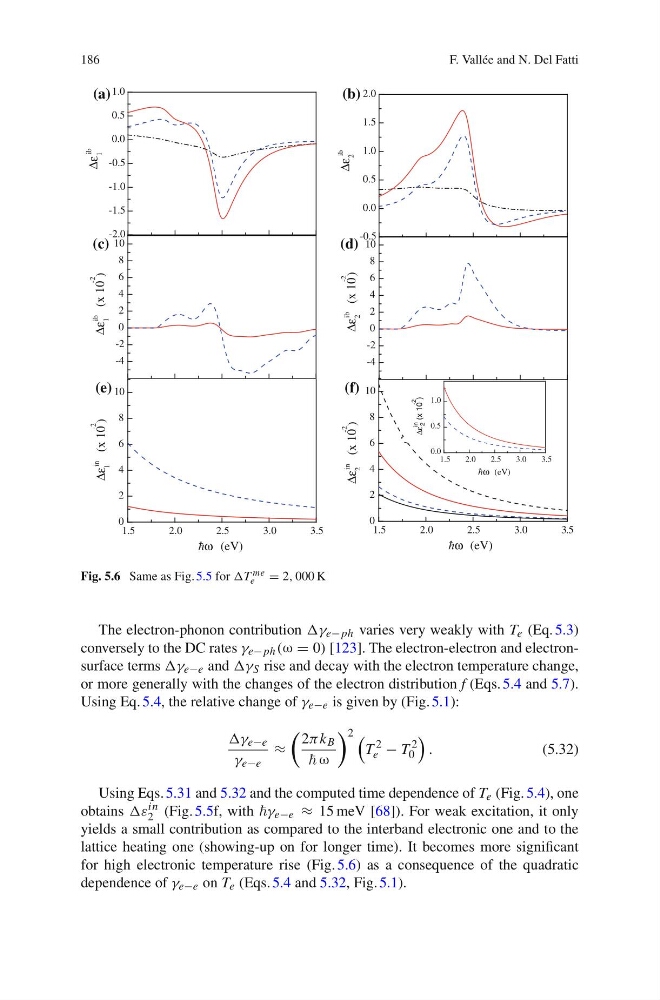
Fig. 5.6 Same as Fig. 5.5 for ωT me
e = 2, 000 K
The electron-phonon contribution ωλ e− ph varies very weakly with T e (Eq. 5.3)
conversely to the DC rates λ e− ph (ω = 0) [123]. The electron-electron and electronsurface terms ωλ e−e and ωλ S rise and decay with the electron temperature change,
or more generally with the changes of the electron distribution f (Eqs. 5.4 and 5.7).
Using Eq. 5.4, the relative change of λ e−e is given by (Fig. 5.1):
ωλ e−e
λ e−e
≈
2π k B
ω
2
T
2
e − T
2
0
.
(5.32)
Using Eqs. 5.31 and 5.32 and the computed time dependence of T e (Fig. 5.4), one
obtains ωε in
2 (Fig. 5.5f, with λ e−e ≈ 15 meV [68]). For weak excitation, it only
yields a small contribution as compared to the interband electronic one and to the
lattice heating one (showing-up on for longer time). It becomes more significant
for high electronic temperature rise (Fig. 5.6) as a consequence of the quadratic
dependence of λ e−e on T e (Eqs. 5.4 and 5.32, Fig. 5.1).
F. Vallée and N. Del Fatti
-2.0
-1.5
-1.0
-0.5
0.0
0.5
1.0
(a)
Δε
1
ib
-0.5
0.0
0.5
1.0
1.5
2.0
(b)
Δε
2
ib
-4
-2
0
2
4
6
8
10
(d)
Δε
2
ib
(x 10
-2
)
-4
-2
0
2
4
6
8
10
(c)
Δε
1
ib
(x 10
-2
)
1.5
2.0
2.5
3.0
3.5
0
2
4
6
8
10
ω (eV)
(e)
Δε
1
in
(x 10
-2
)
1.5
2.0
2.5
3.0
3.5
0
2
4
6
8
10
1.5
2.0
2.5
3.0
3.5
0.0
0.5
1.0
ω (eV)
(f)
Δε
2
in
(x 10
-2
)
Δε
2
in
(x 10
-2
)
ω (eV)
Fig. 5.6 Same as Fig. 5.5 for ωT me
e = 2, 000 K
The electron-phonon contribution ωλ e− ph varies very weakly with T e (Eq. 5.3)
conversely to the DC rates λ e− ph (ω = 0) [123]. The electron-electron and electronsurface terms ωλ e−e and ωλ S rise and decay with the electron temperature change,
or more generally with the changes of the electron distribution f (Eqs. 5.4 and 5.7).
Using Eq. 5.4, the relative change of λ e−e is given by (Fig. 5.1):
ωλ e−e
λ e−e
≈
2π k B
ω
2
T
2
e − T
2
0
.
(5.32)
Using Eqs. 5.31 and 5.32 and the computed time dependence of T e (Fig. 5.4), one
obtains ωε in
2 (Fig. 5.5f, with λ e−e ≈ 15 meV [68]). For weak excitation, it only
yields a small contribution as compared to the interband electronic one and to the
lattice heating one (showing-up on for longer time). It becomes more significant
for high electronic temperature rise (Fig. 5.6) as a consequence of the quadratic
dependence of λ e−e on T e (Eqs. 5.4 and 5.32, Fig. 5.1).