

184
F. Vallée and N. Del Fatti
where, in contrast to the Rosei’s description, ωε ib
2 (ω) is sensitive only to electron
states with energy: E = ω +(E F − ω ib ) [26].
Using these models (Eq. 5.9 for gold), ωε ib
2 can be calculated as a function of time
t, frequency ω, and electron excitation amplitude ωT me
e using the computed ω f . As
an example, the ωε ib
2 spectra and amplitude computed after intraband absorption of
25 fs pulse are shown in Figs. 5.5b and 5.6b at the time t = 0 (maximum of the pulse)
and after 500 fs and 3 ps, for low and high excitation temperatures (ωT me
e = 100 K
and 2,000 K) in bulk gold. ωε ib
1 (ω) is subsequently calculated by Kramers-Kronig
transformation (Figs. 5.5a and 5.6a, note that this approach is valid as ωε ib
2 (ω) is
non-zero only over a limited range around ω ib ). The short time ωε ib
2 (ω) and ωε ib
1 (ω)
exhibit very broad almost featureless spectra, reflecting change of f over a broad
electron energy range (Fig. 5.3). The ωε ib
2 (ω) and ωε ib
1 (ω) amplitudes increase
with time around ω ib as electrons internally thermalize, and ω f mostly concentrates
around E F (Fig. 5.3). They show two distinct features associated to contribution
around the X and L points of the Brillouin zone (Fig. 5.1, with maxima around 1.9
and 2.3 eV, respectively, for ωε ib
2 (ω)), the latter yielding as expected the largest
contribution. These structures are much broader for large excitation as a consequence
of increased smearing of the electron distribution around E F with increasing T e . The
rise of ωε ib as the electrons internally thermalize has been used to optically monitor
this process in noble metal films and nanoparticles [26, 29, 52]. When the electrons
are internally thermalized, after about 500 fs for weak excitation in gold, and faster
for large excitation, their amplitudes, are mostly related to the electron excess energy
ωu e (t) and subsequently decrease as electron energy is transferred to the lattice (with
the time α e−L for weak excitation, and a longer time for large excitation, Fig. 5.4).
5.4.1.2 Intraband Dielectric Function
The intraband contribution to ε is also modified by electron excitation. It is a consequence of the dependence of the rate of all electron scattering processes on the
electronic distribution (or temperature T e when it is established), Eqs. 5.2 and 5.6.
In the case of nanoparticles, taking into account electron-surface ωλ n can be written
(Eqs.5.2 and 5.6):
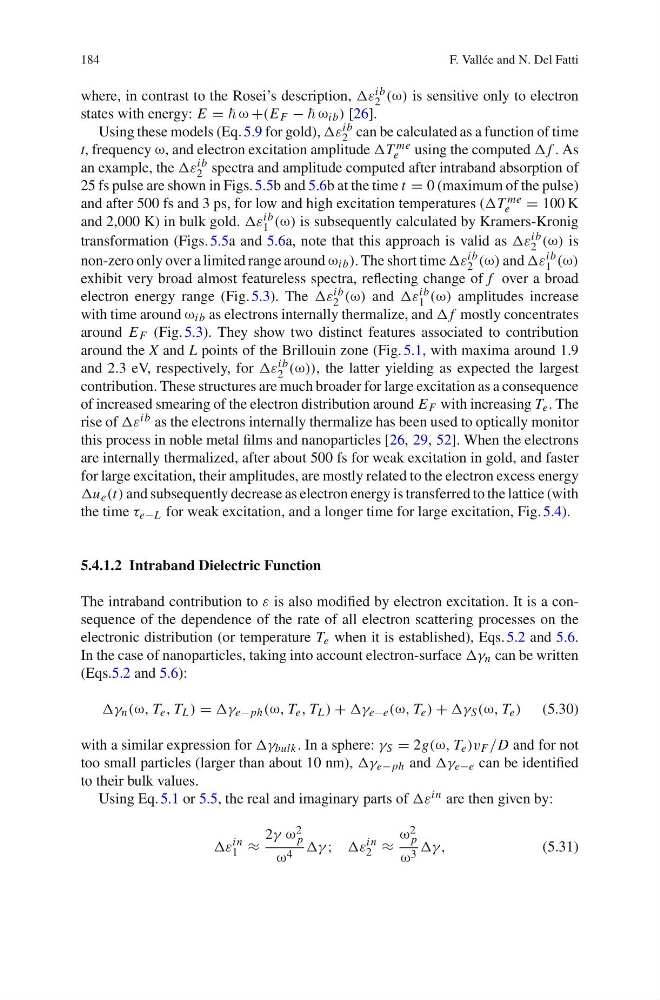
ωλ n (ω, T e , T L ) = ωλ e− ph (ω, T e , T L ) + ωλ e−e (ω, T e ) + ωλ S (ω, T e ) (5.30)
with a similar expression for ωλ bulk . In a sphere: λ S = 2g(ω, T e )v F /D and for not
too small particles (larger than about 10 nm), ωλ e− ph and ωλ e−e can be identified
to their bulk values.
Using Eq. 5.1 or 5.5, the real and imaginary parts of ωε in are then given by:
ωε
in
1 ≈
2λ ω 2
p
ω 4 ωλ ; ωε
in
2 ≈
ω 2
p
ω 3 ωλ ,
(5.31)
F. Vallée and N. Del Fatti
where, in contrast to the Rosei’s description, ωε ib
2 (ω) is sensitive only to electron
states with energy: E = ω +(E F − ω ib ) [26].
Using these models (Eq. 5.9 for gold), ωε ib
2 can be calculated as a function of time
t, frequency ω, and electron excitation amplitude ωT me
e using the computed ω f . As
an example, the ωε ib
2 spectra and amplitude computed after intraband absorption of
25 fs pulse are shown in Figs. 5.5b and 5.6b at the time t = 0 (maximum of the pulse)
and after 500 fs and 3 ps, for low and high excitation temperatures (ωT me
e = 100 K
and 2,000 K) in bulk gold. ωε ib
1 (ω) is subsequently calculated by Kramers-Kronig
transformation (Figs. 5.5a and 5.6a, note that this approach is valid as ωε ib
2 (ω) is
non-zero only over a limited range around ω ib ). The short time ωε ib
2 (ω) and ωε ib
1 (ω)
exhibit very broad almost featureless spectra, reflecting change of f over a broad
electron energy range (Fig. 5.3). The ωε ib
2 (ω) and ωε ib
1 (ω) amplitudes increase
with time around ω ib as electrons internally thermalize, and ω f mostly concentrates
around E F (Fig. 5.3). They show two distinct features associated to contribution
around the X and L points of the Brillouin zone (Fig. 5.1, with maxima around 1.9
and 2.3 eV, respectively, for ωε ib
2 (ω)), the latter yielding as expected the largest
contribution. These structures are much broader for large excitation as a consequence
of increased smearing of the electron distribution around E F with increasing T e . The
rise of ωε ib as the electrons internally thermalize has been used to optically monitor
this process in noble metal films and nanoparticles [26, 29, 52]. When the electrons
are internally thermalized, after about 500 fs for weak excitation in gold, and faster
for large excitation, their amplitudes, are mostly related to the electron excess energy
ωu e (t) and subsequently decrease as electron energy is transferred to the lattice (with
the time α e−L for weak excitation, and a longer time for large excitation, Fig. 5.4).
5.4.1.2 Intraband Dielectric Function
The intraband contribution to ε is also modified by electron excitation. It is a consequence of the dependence of the rate of all electron scattering processes on the
electronic distribution (or temperature T e when it is established), Eqs. 5.2 and 5.6.
In the case of nanoparticles, taking into account electron-surface ωλ n can be written
(Eqs.5.2 and 5.6):
ωλ n (ω, T e , T L ) = ωλ e− ph (ω, T e , T L ) + ωλ e−e (ω, T e ) + ωλ S (ω, T e ) (5.30)
with a similar expression for ωλ bulk . In a sphere: λ S = 2g(ω, T e )v F /D and for not
too small particles (larger than about 10 nm), ωλ e− ph and ωλ e−e can be identified
to their bulk values.
Using Eq. 5.1 or 5.5, the real and imaginary parts of ωε in are then given by:
ωε
in
1 ≈
2λ ω 2
p
ω 4 ωλ ; ωε
in
2 ≈
ω 2
p
ω 3 ωλ ,
(5.31)