

172
F. Vallée and N. Del Fatti
300
600
900
1200
0
1
2
3
4
5
1.8
2.0
2.2
2.4
2.6
2.8
0
1
2
3
4
(X)
(L)
ε
ib
2
ω (eV)
(a)
(b)
Δγ
ee
/
γ
ee
;
(x 10
-2
)
T e (K)
(x 10)
Δg / g
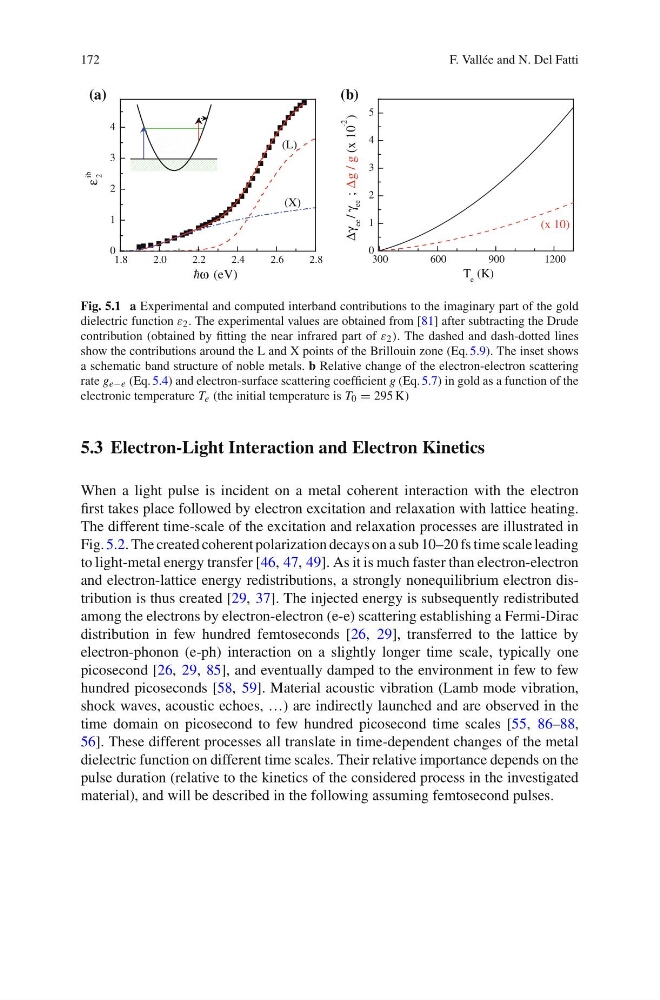
Fig. 5.1 a Experimental and computed interband contributions to the imaginary part of the gold
dielectric function ε 2 . The experimental values are obtained from [81] after subtracting the Drude
contribution (obtained by fitting the near infrared part of ε 2 ). The dashed and dash-dotted lines
show the contributions around the L and X points of the Brillouin zone (Eq. 5.9). The inset shows
a schematic band structure of noble metals. b Relative change of the electron-electron scattering
rate g e−e (Eq. 5.4) and electron-surface scattering coefficient g (Eq. 5.7) in gold as a function of the
electronic temperature T e (the initial temperature is T 0 = 295 K)
5.3 Electron-Light Interaction and Electron Kinetics
When a light pulse is incident on a metal coherent interaction with the electron
first takes place followed by electron excitation and relaxation with lattice heating.
The different time-scale of the excitation and relaxation processes are illustrated in
Fig. 5.2. The created coherent polarization decays on a sub 10–20 fs time scale leading
to light-metal energy transfer [46, 47, 49]. As it is much faster than electron-electron
and electron-lattice energy redistributions, a strongly nonequilibrium electron distribution is thus created [29, 37]. The injected energy is subsequently redistributed
among the electrons by electron-electron (e-e) scattering establishing a Fermi-Dirac
distribution in few hundred femtoseconds [26, 29], transferred to the lattice by
electron-phonon (e-ph) interaction on a slightly longer time scale, typically one
picosecond [26, 29, 85], and eventually damped to the environment in few to few
hundred picoseconds [58, 59]. Material acoustic vibration (Lamb mode vibration,
shock waves, acoustic echoes, …) are indirectly launched and are observed in the
time domain on picosecond to few hundred picosecond time scales [55, 86–88,
56]. These different processes all translate in time-dependent changes of the metal
dielectric function on different time scales. Their relative importance depends on the
pulse duration (relative to the kinetics of the considered process in the investigated
material), and will be described in the following assuming femtosecond pulses.
F. Vallée and N. Del Fatti
300
600
900
1200
0
1
2
3
4
5
1.8
2.0
2.2
2.4
2.6
2.8
0
1
2
3
4
(X)
(L)
ε
ib
2
ω (eV)
(a)
(b)
Δγ
ee
/
γ
ee
;
(x 10
-2
)
T e (K)
(x 10)
Δg / g
Fig. 5.1 a Experimental and computed interband contributions to the imaginary part of the gold
dielectric function ε 2 . The experimental values are obtained from [81] after subtracting the Drude
contribution (obtained by fitting the near infrared part of ε 2 ). The dashed and dash-dotted lines
show the contributions around the L and X points of the Brillouin zone (Eq. 5.9). The inset shows
a schematic band structure of noble metals. b Relative change of the electron-electron scattering
rate g e−e (Eq. 5.4) and electron-surface scattering coefficient g (Eq. 5.7) in gold as a function of the
electronic temperature T e (the initial temperature is T 0 = 295 K)
5.3 Electron-Light Interaction and Electron Kinetics
When a light pulse is incident on a metal coherent interaction with the electron
first takes place followed by electron excitation and relaxation with lattice heating.
The different time-scale of the excitation and relaxation processes are illustrated in
Fig. 5.2. The created coherent polarization decays on a sub 10–20 fs time scale leading
to light-metal energy transfer [46, 47, 49]. As it is much faster than electron-electron
and electron-lattice energy redistributions, a strongly nonequilibrium electron distribution is thus created [29, 37]. The injected energy is subsequently redistributed
among the electrons by electron-electron (e-e) scattering establishing a Fermi-Dirac
distribution in few hundred femtoseconds [26, 29], transferred to the lattice by
electron-phonon (e-ph) interaction on a slightly longer time scale, typically one
picosecond [26, 29, 85], and eventually damped to the environment in few to few
hundred picoseconds [58, 59]. Material acoustic vibration (Lamb mode vibration,
shock waves, acoustic echoes, …) are indirectly launched and are observed in the
time domain on picosecond to few hundred picosecond time scales [55, 86–88,
56]. These different processes all translate in time-dependent changes of the metal
dielectric function on different time scales. Their relative importance depends on the
pulse duration (relative to the kinetics of the considered process in the investigated
material), and will be described in the following assuming femtosecond pulses.