

3 Plasmonically Enhanced Dye-Sensitized Solar Cells
141
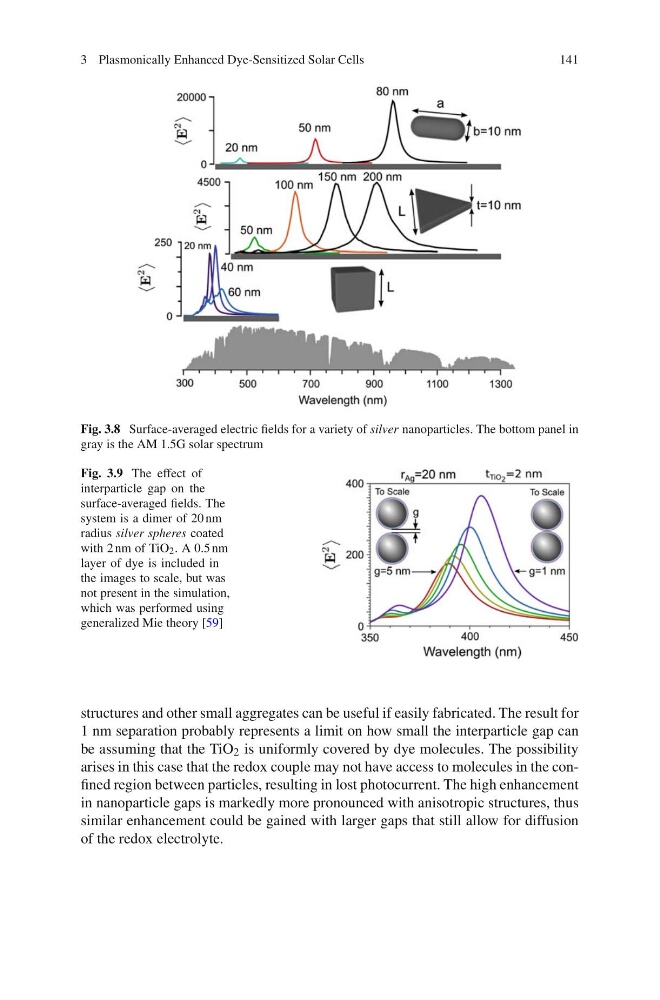
Fig. 3.8 Surface-averaged electric fields for a variety of silver nanoparticles. The bottom panel in
gray is the AM 1.5G solar spectrum
Fig. 3.9 The effect of
interparticle gap on the
surface-averaged fields. The
system is a dimer of 20 nm
radius silver spheres coated
with 2 nm of TiO 2 . A 0.5nm
layer of dye is included in
the images to scale, but was
not present in the simulation,
which was performed using
generalized Mie theory [59]
structures and other small aggregates can be useful if easily fabricated. The result for
1 nm separation probably represents a limit on how small the interparticle gap can
be assuming that the TiO 2 is uniformly covered by dye molecules. The possibility
arises in this case that the redox couple may not have access to molecules in the confined region between particles, resulting in lost photocurrent. The high enhancement
in nanoparticle gaps is markedly more pronounced with anisotropic structures, thus
similar enhancement could be gained with larger gaps that still allow for diffusion
of the redox electrolyte.
141
Fig. 3.8 Surface-averaged electric fields for a variety of silver nanoparticles. The bottom panel in
gray is the AM 1.5G solar spectrum
Fig. 3.9 The effect of
interparticle gap on the
surface-averaged fields. The
system is a dimer of 20 nm
radius silver spheres coated
with 2 nm of TiO 2 . A 0.5nm
layer of dye is included in
the images to scale, but was
not present in the simulation,
which was performed using
generalized Mie theory [59]
structures and other small aggregates can be useful if easily fabricated. The result for
1 nm separation probably represents a limit on how small the interparticle gap can
be assuming that the TiO 2 is uniformly covered by dye molecules. The possibility
arises in this case that the redox couple may not have access to molecules in the confined region between particles, resulting in lost photocurrent. The high enhancement
in nanoparticle gaps is markedly more pronounced with anisotropic structures, thus
similar enhancement could be gained with larger gaps that still allow for diffusion
of the redox electrolyte.