

3 Plasmonically Enhanced Dye-Sensitized Solar Cells
139
for the longitudinal resonance and
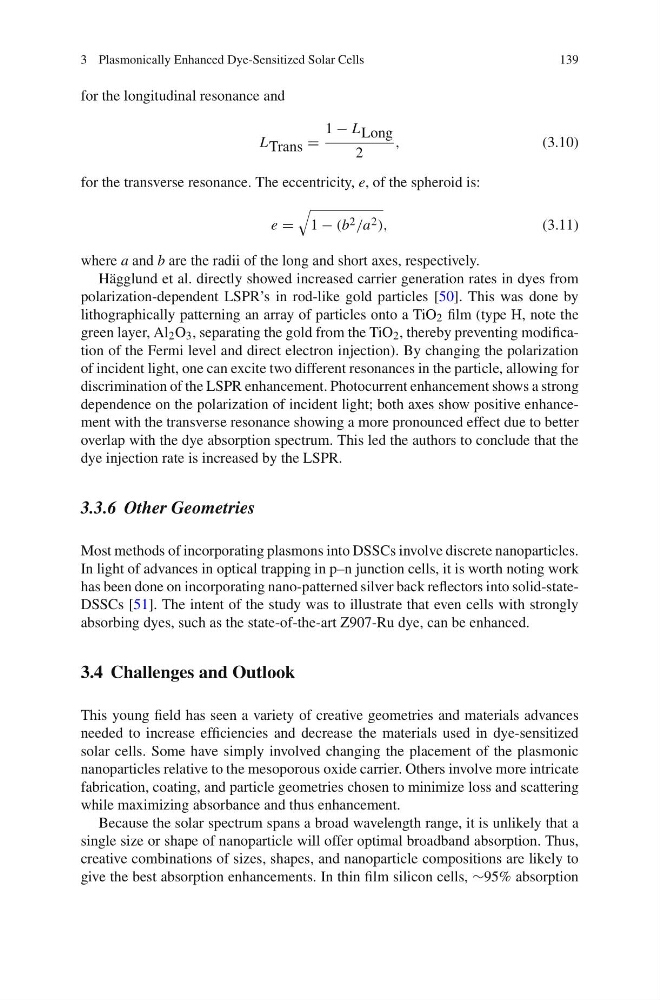
L Trans =
1 − L Long
2
,
(3.10)
for the transverse resonance. The eccentricity, e, of the spheroid is:
e =
1 − (b 2 /a 2 ),
(3.11)
where a and b are the radii of the long and short axes, respectively.
Hägglund et al. directly showed increased carrier generation rates in dyes from
polarization-dependent LSPR’s in rod-like gold particles [50]. This was done by
lithographically patterning an array of particles onto a TiO 2 film (type H, note the
green layer, Al 2 O 3 , separating the gold from the TiO 2 , thereby preventing modification of the Fermi level and direct electron injection). By changing the polarization
of incident light, one can excite two different resonances in the particle, allowing for
discrimination of the LSPR enhancement. Photocurrent enhancement shows a strong
dependence on the polarization of incident light; both axes show positive enhancement with the transverse resonance showing a more pronounced effect due to better
overlap with the dye absorption spectrum. This led the authors to conclude that the
dye injection rate is increased by the LSPR.
3.3.6 Other Geometries
Most methods of incorporating plasmons into DSSCs involve discrete nanoparticles.
In light of advances in optical trapping in p–n junction cells, it is worth noting work
has been done on incorporating nano-patterned silver back reflectors into solid-stateDSSCs [51]. The intent of the study was to illustrate that even cells with strongly
absorbing dyes, such as the state-of-the-art Z907-Ru dye, can be enhanced.
3.4 Challenges and Outlook
This young field has seen a variety of creative geometries and materials advances
needed to increase efficiencies and decrease the materials used in dye-sensitized
solar cells. Some have simply involved changing the placement of the plasmonic
nanoparticles relative to the mesoporous oxide carrier. Others involve more intricate
fabrication, coating, and particle geometries chosen to minimize loss and scattering
while maximizing absorbance and thus enhancement.
Because the solar spectrum spans a broad wavelength range, it is unlikely that a
single size or shape of nanoparticle will offer optimal broadband absorption. Thus,
creative combinations of sizes, shapes, and nanoparticle compositions are likely to
give the best absorption enhancements. In thin film silicon cells, ∪95% absorption
139
for the longitudinal resonance and
L Trans =
1 − L Long
2
,
(3.10)
for the transverse resonance. The eccentricity, e, of the spheroid is:
e =
1 − (b 2 /a 2 ),
(3.11)
where a and b are the radii of the long and short axes, respectively.
Hägglund et al. directly showed increased carrier generation rates in dyes from
polarization-dependent LSPR’s in rod-like gold particles [50]. This was done by
lithographically patterning an array of particles onto a TiO 2 film (type H, note the
green layer, Al 2 O 3 , separating the gold from the TiO 2 , thereby preventing modification of the Fermi level and direct electron injection). By changing the polarization
of incident light, one can excite two different resonances in the particle, allowing for
discrimination of the LSPR enhancement. Photocurrent enhancement shows a strong
dependence on the polarization of incident light; both axes show positive enhancement with the transverse resonance showing a more pronounced effect due to better
overlap with the dye absorption spectrum. This led the authors to conclude that the
dye injection rate is increased by the LSPR.
3.3.6 Other Geometries
Most methods of incorporating plasmons into DSSCs involve discrete nanoparticles.
In light of advances in optical trapping in p–n junction cells, it is worth noting work
has been done on incorporating nano-patterned silver back reflectors into solid-stateDSSCs [51]. The intent of the study was to illustrate that even cells with strongly
absorbing dyes, such as the state-of-the-art Z907-Ru dye, can be enhanced.
3.4 Challenges and Outlook
This young field has seen a variety of creative geometries and materials advances
needed to increase efficiencies and decrease the materials used in dye-sensitized
solar cells. Some have simply involved changing the placement of the plasmonic
nanoparticles relative to the mesoporous oxide carrier. Others involve more intricate
fabrication, coating, and particle geometries chosen to minimize loss and scattering
while maximizing absorbance and thus enhancement.
Because the solar spectrum spans a broad wavelength range, it is unlikely that a
single size or shape of nanoparticle will offer optimal broadband absorption. Thus,
creative combinations of sizes, shapes, and nanoparticle compositions are likely to
give the best absorption enhancements. In thin film silicon cells, ∪95% absorption