

3 Plasmonically Enhanced Dye-Sensitized Solar Cells
127
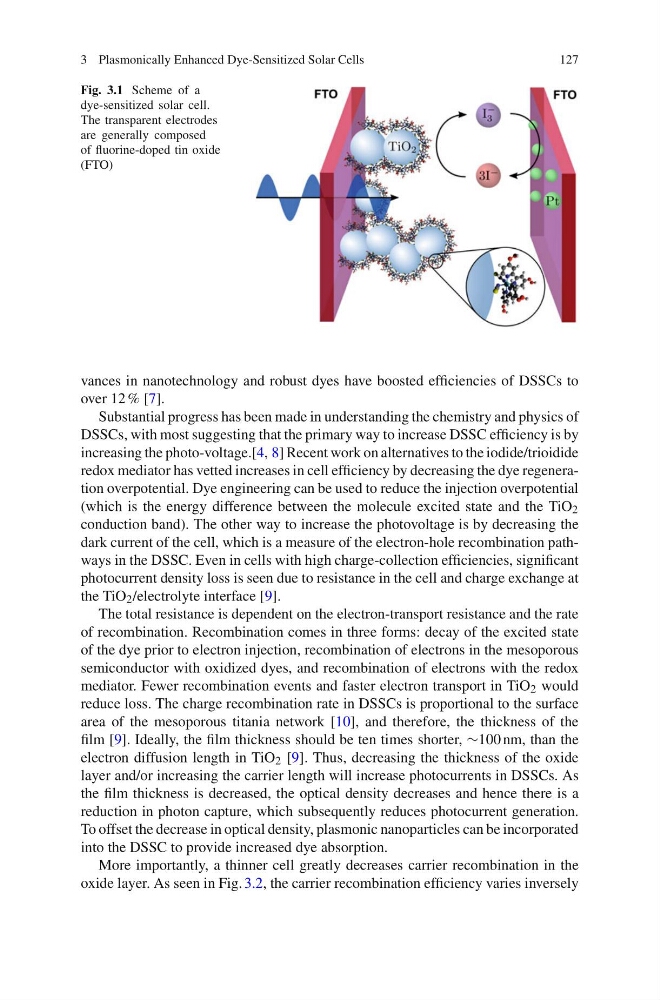
Fig. 3.1 Scheme of a
dye-sensitized solar cell.
The transparent electrodes
are generally composed
of fluorine-doped tin oxide
(FTO)
vances in nanotechnology and robust dyes have boosted efficiencies of DSSCs to
over 12 % [7].
Substantial progress has been made in understanding the chemistry and physics of
DSSCs, with most suggesting that the primary way to increase DSSC efficiency is by
increasing the photo-voltage.[4, 8] Recent work on alternatives to the iodide/trioidide
redox mediator has vetted increases in cell efficiency by decreasing the dye regeneration overpotential. Dye engineering can be used to reduce the injection overpotential
(which is the energy difference between the molecule excited state and the TiO 2
conduction band). The other way to increase the photovoltage is by decreasing the
dark current of the cell, which is a measure of the electron-hole recombination pathways in the DSSC. Even in cells with high charge-collection efficiencies, significant
photocurrent density loss is seen due to resistance in the cell and charge exchange at
the TiO 2 /electrolyte interface [9].
The total resistance is dependent on the electron-transport resistance and the rate
of recombination. Recombination comes in three forms: decay of the excited state
of the dye prior to electron injection, recombination of electrons in the mesoporous
semiconductor with oxidized dyes, and recombination of electrons with the redox
mediator. Fewer recombination events and faster electron transport in TiO 2 would
reduce loss. The charge recombination rate in DSSCs is proportional to the surface
area of the mesoporous titania network [10], and therefore, the thickness of the
film [9]. Ideally, the film thickness should be ten times shorter, ∪100 nm, than the
electron diffusion length in TiO 2 [9]. Thus, decreasing the thickness of the oxide
layer and/or increasing the carrier length will increase photocurrents in DSSCs. As
the film thickness is decreased, the optical density decreases and hence there is a
reduction in photon capture, which subsequently reduces photocurrent generation.
To offset the decrease in optical density, plasmonic nanoparticles can be incorporated
into the DSSC to provide increased dye absorption.
More importantly, a thinner cell greatly decreases carrier recombination in the
oxide layer. As seen in Fig. 3.2, the carrier recombination efficiency varies inversely
127
Fig. 3.1 Scheme of a
dye-sensitized solar cell.
The transparent electrodes
are generally composed
of fluorine-doped tin oxide
(FTO)
vances in nanotechnology and robust dyes have boosted efficiencies of DSSCs to
over 12 % [7].
Substantial progress has been made in understanding the chemistry and physics of
DSSCs, with most suggesting that the primary way to increase DSSC efficiency is by
increasing the photo-voltage.[4, 8] Recent work on alternatives to the iodide/trioidide
redox mediator has vetted increases in cell efficiency by decreasing the dye regeneration overpotential. Dye engineering can be used to reduce the injection overpotential
(which is the energy difference between the molecule excited state and the TiO 2
conduction band). The other way to increase the photovoltage is by decreasing the
dark current of the cell, which is a measure of the electron-hole recombination pathways in the DSSC. Even in cells with high charge-collection efficiencies, significant
photocurrent density loss is seen due to resistance in the cell and charge exchange at
the TiO 2 /electrolyte interface [9].
The total resistance is dependent on the electron-transport resistance and the rate
of recombination. Recombination comes in three forms: decay of the excited state
of the dye prior to electron injection, recombination of electrons in the mesoporous
semiconductor with oxidized dyes, and recombination of electrons with the redox
mediator. Fewer recombination events and faster electron transport in TiO 2 would
reduce loss. The charge recombination rate in DSSCs is proportional to the surface
area of the mesoporous titania network [10], and therefore, the thickness of the
film [9]. Ideally, the film thickness should be ten times shorter, ∪100 nm, than the
electron diffusion length in TiO 2 [9]. Thus, decreasing the thickness of the oxide
layer and/or increasing the carrier length will increase photocurrents in DSSCs. As
the film thickness is decreased, the optical density decreases and hence there is a
reduction in photon capture, which subsequently reduces photocurrent generation.
To offset the decrease in optical density, plasmonic nanoparticles can be incorporated
into the DSSC to provide increased dye absorption.
More importantly, a thinner cell greatly decreases carrier recombination in the
oxide layer. As seen in Fig. 3.2, the carrier recombination efficiency varies inversely