

104
K. Kneipp et al.
2.1 Introduction
Building blocks of matter such as atoms in a molecule are in periodic motion
and exhibit intrinsic vibrational modes. Typical vibrational frequencies range from
approximately 10 14 Hz (∼3,000 cm −1 ) for vibrations involving light atoms such as
C-H groups down to the THz range (<100 cm −1 ) corresponding, for example, to
motions of sub-domains in proteins [1, 2]. Spectroscopic observation of vibrational
modes provides a non-invasive key to the chemical composition and structure of matter. Applying vibrational spectroscopies to small quantities of matter at nanoscale
dimensions and at single molecule level is a great challenge [3]. It can be met by combining vibrational spectroscopy with plasmonics and performing vibrational spectroscopy in enhanced local fields in the vicinity of plasmonic structures [4–7].
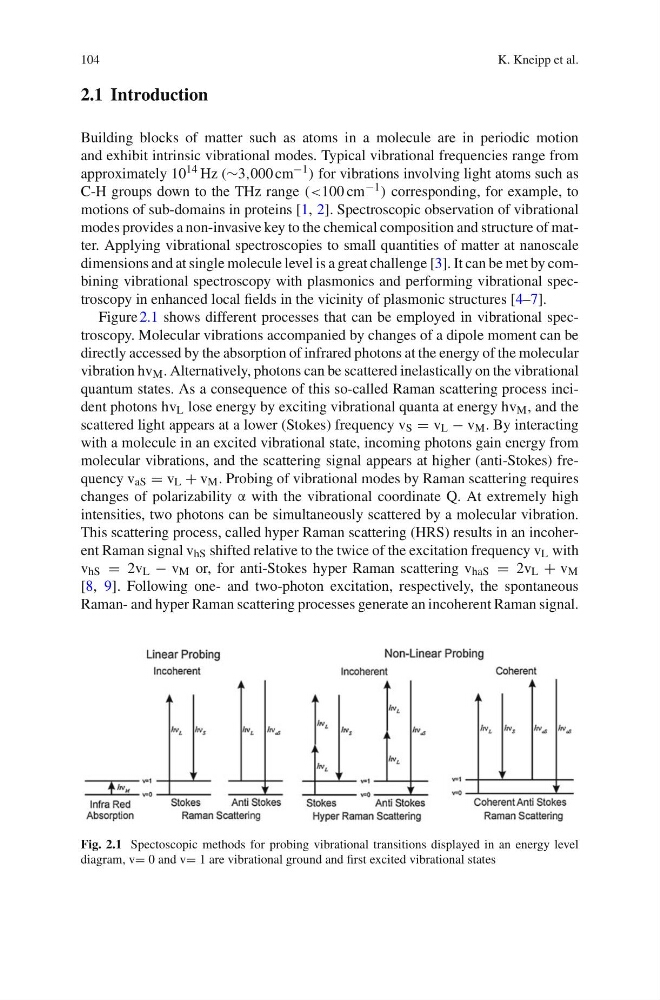
Figure 2.1 shows different processes that can be employed in vibrational spectroscopy. Molecular vibrations accompanied by changes of a dipole moment can be
directly accessed by the absorption of infrared photons at the energy of the molecular
vibration hv M . Alternatively, photons can be scattered inelastically on the vibrational
quantum states. As a consequence of this so-called Raman scattering process incident photons hv L lose energy by exciting vibrational quanta at energy hv M , and the
scattered light appears at a lower (Stokes) frequency v S = v L − v M . By interacting
with a molecule in an excited vibrational state, incoming photons gain energy from
molecular vibrations, and the scattering signal appears at higher (anti-Stokes) frequency v aS = v L + v M . Probing of vibrational modes by Raman scattering requires
changes of polarizability α with the vibrational coordinate Q. At extremely high
intensities, two photons can be simultaneously scattered by a molecular vibration.
This scattering process, called hyper Raman scattering (HRS) results in an incoherent Raman signal v hS shifted relative to the twice of the excitation frequency v L with
v hS = 2v L − v M or, for anti-Stokes hyper Raman scattering v haS = 2v L + v M
[8, 9]. Following one- and two-photon excitation, respectively, the spontaneous
Raman- and hyper Raman scattering processes generate an incoherent Raman signal.
Fig. 2.1 Spectoscopic methods for probing vibrational transitions displayed in an energy level
diagram, v= 0 and v= 1 are vibrational ground and first excited vibrational states
K. Kneipp et al.
2.1 Introduction
Building blocks of matter such as atoms in a molecule are in periodic motion
and exhibit intrinsic vibrational modes. Typical vibrational frequencies range from
approximately 10 14 Hz (∼3,000 cm −1 ) for vibrations involving light atoms such as
C-H groups down to the THz range (<100 cm −1 ) corresponding, for example, to
motions of sub-domains in proteins [1, 2]. Spectroscopic observation of vibrational
modes provides a non-invasive key to the chemical composition and structure of matter. Applying vibrational spectroscopies to small quantities of matter at nanoscale
dimensions and at single molecule level is a great challenge [3]. It can be met by combining vibrational spectroscopy with plasmonics and performing vibrational spectroscopy in enhanced local fields in the vicinity of plasmonic structures [4–7].
Figure 2.1 shows different processes that can be employed in vibrational spectroscopy. Molecular vibrations accompanied by changes of a dipole moment can be
directly accessed by the absorption of infrared photons at the energy of the molecular
vibration hv M . Alternatively, photons can be scattered inelastically on the vibrational
quantum states. As a consequence of this so-called Raman scattering process incident photons hv L lose energy by exciting vibrational quanta at energy hv M , and the
scattered light appears at a lower (Stokes) frequency v S = v L − v M . By interacting
with a molecule in an excited vibrational state, incoming photons gain energy from
molecular vibrations, and the scattering signal appears at higher (anti-Stokes) frequency v aS = v L + v M . Probing of vibrational modes by Raman scattering requires
changes of polarizability α with the vibrational coordinate Q. At extremely high
intensities, two photons can be simultaneously scattered by a molecular vibration.
This scattering process, called hyper Raman scattering (HRS) results in an incoherent Raman signal v hS shifted relative to the twice of the excitation frequency v L with
v hS = 2v L − v M or, for anti-Stokes hyper Raman scattering v haS = 2v L + v M
[8, 9]. Following one- and two-photon excitation, respectively, the spontaneous
Raman- and hyper Raman scattering processes generate an incoherent Raman signal.
Fig. 2.1 Spectoscopic methods for probing vibrational transitions displayed in an energy level
diagram, v= 0 and v= 1 are vibrational ground and first excited vibrational states