

5 Introduction to Quantum Vibrational Spectroscopy
89
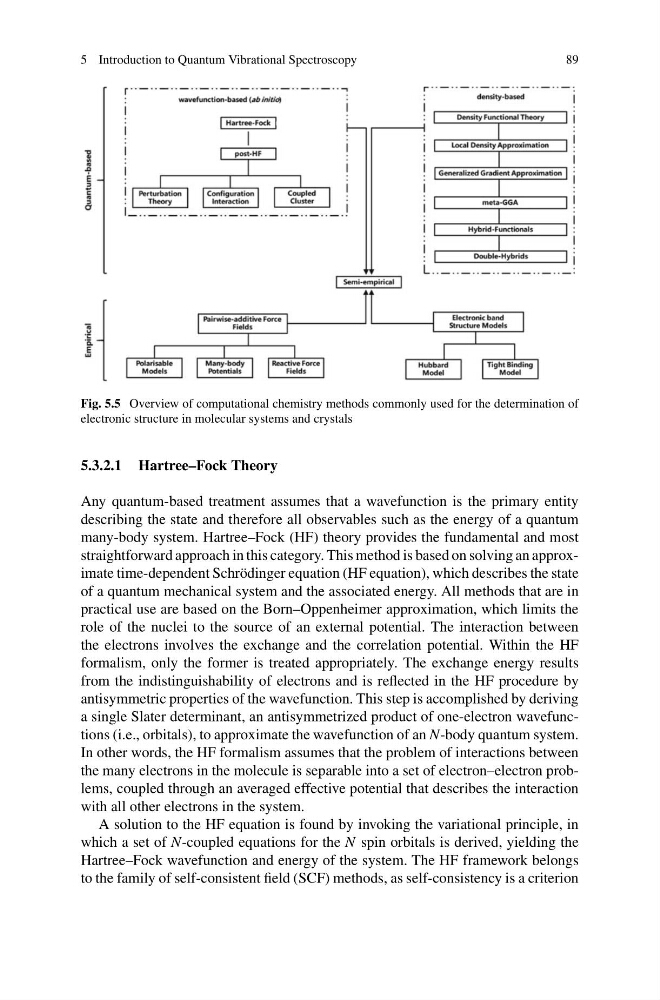
Fig. 5.5 Overview of computational chemistry methods commonly used for the determination of
electronic structure in molecular systems and crystals
5.3.2.1 Hartree–Fock Theory
Any quantum-based treatment assumes that a wavefunction is the primary entity
describing the state and therefore all observables such as the energy of a quantum
many-body system. Hartree–Fock (HF) theory provides the fundamental and most
straightforward approach in this category. This method is based on solving an approximate time-dependent Schrödinger equation (HF equation), which describes the state
of a quantum mechanical system and the associated energy. All methods that are in
practical use are based on the Born–Oppenheimer approximation, which limits the
role of the nuclei to the source of an external potential. The interaction between
the electrons involves the exchange and the correlation potential. Within the HF
formalism, only the former is treated appropriately. The exchange energy results
from the indistinguishability of electrons and is reflected in the HF procedure by
antisymmetric properties of the wavefunction. This step is accomplished by deriving
a single Slater determinant, an antisymmetrized product of one-electron wavefunctions (i.e., orbitals), to approximate the wavefunction of an N-body quantum system.
In other words, the HF formalism assumes that the problem of interactions between
the many electrons in the molecule is separable into a set of electron–electron problems, coupled through an averaged effective potential that describes the interaction
with all other electrons in the system.
A solution to the HF equation is found by invoking the variational principle, in
which a set of N-coupled equations for the N spin orbitals is derived, yielding the
Hartree–Fock wavefunction and energy of the system. The HF framework belongs
to the family of self-consistent field (SCF) methods, as self-consistency is a criterion
89
Fig. 5.5 Overview of computational chemistry methods commonly used for the determination of
electronic structure in molecular systems and crystals
5.3.2.1 Hartree–Fock Theory
Any quantum-based treatment assumes that a wavefunction is the primary entity
describing the state and therefore all observables such as the energy of a quantum
many-body system. Hartree–Fock (HF) theory provides the fundamental and most
straightforward approach in this category. This method is based on solving an approximate time-dependent Schrödinger equation (HF equation), which describes the state
of a quantum mechanical system and the associated energy. All methods that are in
practical use are based on the Born–Oppenheimer approximation, which limits the
role of the nuclei to the source of an external potential. The interaction between
the electrons involves the exchange and the correlation potential. Within the HF
formalism, only the former is treated appropriately. The exchange energy results
from the indistinguishability of electrons and is reflected in the HF procedure by
antisymmetric properties of the wavefunction. This step is accomplished by deriving
a single Slater determinant, an antisymmetrized product of one-electron wavefunctions (i.e., orbitals), to approximate the wavefunction of an N-body quantum system.
In other words, the HF formalism assumes that the problem of interactions between
the many electrons in the molecule is separable into a set of electron–electron problems, coupled through an averaged effective potential that describes the interaction
with all other electrons in the system.
A solution to the HF equation is found by invoking the variational principle, in
which a set of N-coupled equations for the N spin orbitals is derived, yielding the
Hartree–Fock wavefunction and energy of the system. The HF framework belongs
to the family of self-consistent field (SCF) methods, as self-consistency is a criterion