

23 Inline and Online Process Analytical Technology with an Outlook …
583
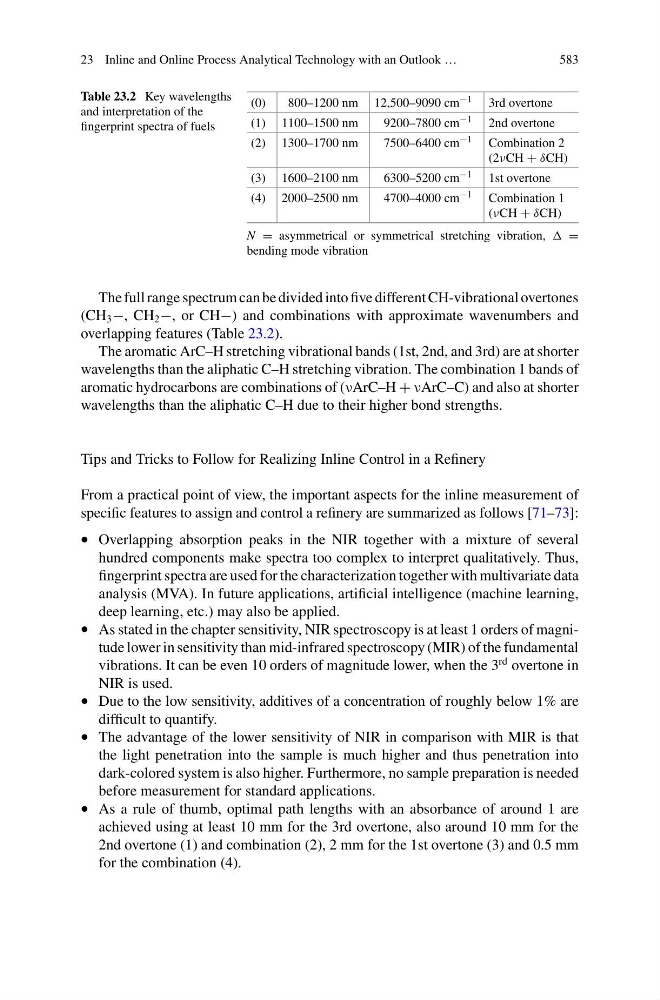
Table 23.2 Key wavelengths
and interpretation of the
fingerprint spectra of fuels
(0)
800–1200 nm 12,500–9090 cm −1 3rd overtone
(1) 1100–1500 nm
9200–7800 cm −1 2nd overtone
(2) 1300–1700 nm
7500–6400 cm −1 Combination 2
(2νCH + δCH)
(3) 1600–2100 nm
6300–5200 cm −1 1st overtone
(4) 2000–2500 nm
4700–4000 cm −1 Combination 1
(νCH + δCH)
N = asymmetrical or symmetrical stretching vibration, =
bending mode vibration
The full range spectrum can be divided into five different CH-vibrational overtones
(CH 3 −, CH 2 −, or CH−) and combinations with approximate wavenumbers and
overlapping features (Table 23.2).
The aromatic ArC–H stretching vibrational bands (1st, 2nd, and 3rd) are at shorter
wavelengths than the aliphatic C–H stretching vibration. The combination 1 bands of
aromatic hydrocarbons are combinations of (νArC–H + νArC–C) and also at shorter
wavelengths than the aliphatic C–H due to their higher bond strengths.
Tips and Tricks to Follow for Realizing Inline Control in a Refinery
From a practical point of view, the important aspects for the inline measurement of
specific features to assign and control a refinery are summarized as follows [71–73]:
• Overlapping absorption peaks in the NIR together with a mixture of several
hundred components make spectra too complex to interpret qualitatively. Thus,
fingerprint spectra are used for the characterization together with multivariate data
analysis (MVA). In future applications, artificial intelligence (machine learning,
deep learning, etc.) may also be applied.
• As stated in the chapter sensitivity, NIR spectroscopy is at least 1 orders of magnitude lower in sensitivity than mid-infrared spectroscopy (MIR) of the fundamental
vibrations. It can be even 10 orders of magnitude lower, when the 3
rd overtone in
NIR is used.
• Due to the low sensitivity, additives of a concentration of roughly below 1% are
difficult to quantify.
• The advantage of the lower sensitivity of NIR in comparison with MIR is that
the light penetration into the sample is much higher and thus penetration into
dark-colored system is also higher. Furthermore, no sample preparation is needed
before measurement for standard applications.
• As a rule of thumb, optimal path lengths with an absorbance of around 1 are
achieved using at least 10 mm for the 3rd overtone, also around 10 mm for the
2nd overtone (1) and combination (2), 2 mm for the 1st overtone (3) and 0.5 mm
for the combination (4).
583
Table 23.2 Key wavelengths
and interpretation of the
fingerprint spectra of fuels
(0)
800–1200 nm 12,500–9090 cm −1 3rd overtone
(1) 1100–1500 nm
9200–7800 cm −1 2nd overtone
(2) 1300–1700 nm
7500–6400 cm −1 Combination 2
(2νCH + δCH)
(3) 1600–2100 nm
6300–5200 cm −1 1st overtone
(4) 2000–2500 nm
4700–4000 cm −1 Combination 1
(νCH + δCH)
N = asymmetrical or symmetrical stretching vibration, =
bending mode vibration
The full range spectrum can be divided into five different CH-vibrational overtones
(CH 3 −, CH 2 −, or CH−) and combinations with approximate wavenumbers and
overlapping features (Table 23.2).
The aromatic ArC–H stretching vibrational bands (1st, 2nd, and 3rd) are at shorter
wavelengths than the aliphatic C–H stretching vibration. The combination 1 bands of
aromatic hydrocarbons are combinations of (νArC–H + νArC–C) and also at shorter
wavelengths than the aliphatic C–H due to their higher bond strengths.
Tips and Tricks to Follow for Realizing Inline Control in a Refinery
From a practical point of view, the important aspects for the inline measurement of
specific features to assign and control a refinery are summarized as follows [71–73]:
• Overlapping absorption peaks in the NIR together with a mixture of several
hundred components make spectra too complex to interpret qualitatively. Thus,
fingerprint spectra are used for the characterization together with multivariate data
analysis (MVA). In future applications, artificial intelligence (machine learning,
deep learning, etc.) may also be applied.
• As stated in the chapter sensitivity, NIR spectroscopy is at least 1 orders of magnitude lower in sensitivity than mid-infrared spectroscopy (MIR) of the fundamental
vibrations. It can be even 10 orders of magnitude lower, when the 3
rd overtone in
NIR is used.
• Due to the low sensitivity, additives of a concentration of roughly below 1% are
difficult to quantify.
• The advantage of the lower sensitivity of NIR in comparison with MIR is that
the light penetration into the sample is much higher and thus penetration into
dark-colored system is also higher. Furthermore, no sample preparation is needed
before measurement for standard applications.
• As a rule of thumb, optimal path lengths with an absorbance of around 1 are
achieved using at least 10 mm for the 3rd overtone, also around 10 mm for the
2nd overtone (1) and combination (2), 2 mm for the 1st overtone (3) and 0.5 mm
for the combination (4).