

21 Applications of NIR Techniques in Polymer Coatings …
483
0
50
100
150
200
250
0
5
10
15
20
25
Predicted Thickness
Actual Thickness
19.8µm
16.1µm
13.1 µm
9.7 µm
8.3 µm
10.5 µm
13.8 µm
19.0 µm
21.9 µm
Thickness [µm]
Time [sec]
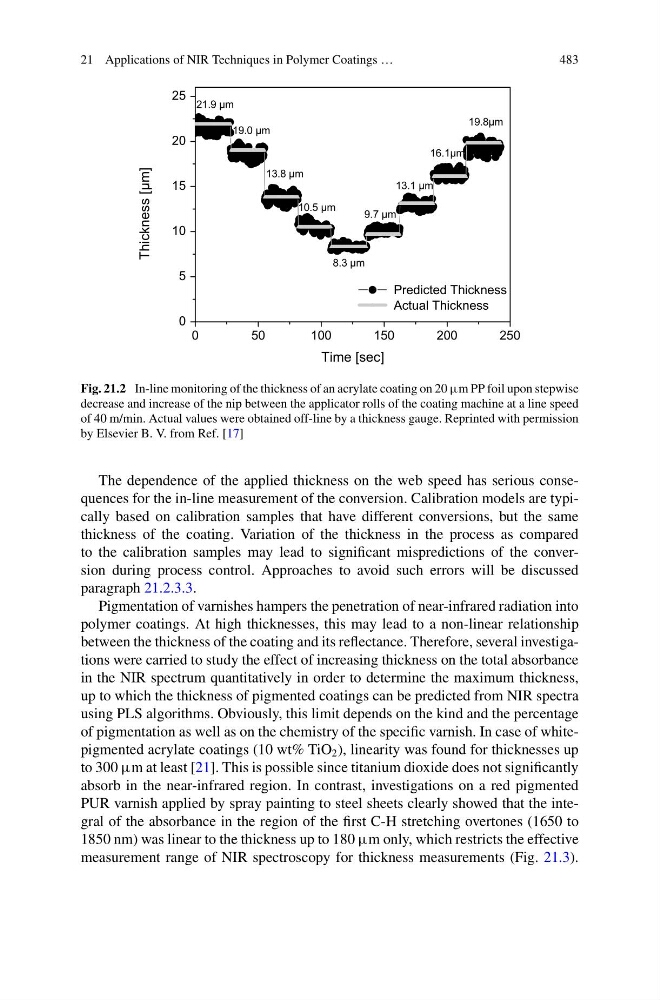
Fig. 21.2 In-line monitoring of the thickness of an acrylate coating on 20 μm PP foil upon stepwise
decrease and increase of the nip between the applicator rolls of the coating machine at a line speed
of 40 m/min. Actual values were obtained off-line by a thickness gauge. Reprinted with permission
by Elsevier B. V. from Ref. [17]
The dependence of the applied thickness on the web speed has serious consequences for the in-line measurement of the conversion. Calibration models are typically based on calibration samples that have different conversions, but the same
thickness of the coating. Variation of the thickness in the process as compared
to the calibration samples may lead to significant mispredictions of the conversion during process control. Approaches to avoid such errors will be discussed
paragraph 21.2.3.3.
Pigmentation of varnishes hampers the penetration of near-infrared radiation into
polymer coatings. At high thicknesses, this may lead to a non-linear relationship
between the thickness of the coating and its reflectance. Therefore, several investigations were carried to study the effect of increasing thickness on the total absorbance
in the NIR spectrum quantitatively in order to determine the maximum thickness,
up to which the thickness of pigmented coatings can be predicted from NIR spectra
using PLS algorithms. Obviously, this limit depends on the kind and the percentage
of pigmentation as well as on the chemistry of the specific varnish. In case of whitepigmented acrylate coatings (10 wt% TiO 2 ), linearity was found for thicknesses up
to 300 μm at least [21]. This is possible since titanium dioxide does not significantly
absorb in the near-infrared region. In contrast, investigations on a red pigmented
PUR varnish applied by spray painting to steel sheets clearly showed that the integral of the absorbance in the region of the first C-H stretching overtones (1650 to
1850 nm) was linear to the thickness up to 180 μm only, which restricts the effective
measurement range of NIR spectroscopy for thickness measurements (Fig. 21.3).
483
0
50
100
150
200
250
0
5
10
15
20
25
Predicted Thickness
Actual Thickness
19.8µm
16.1µm
13.1 µm
9.7 µm
8.3 µm
10.5 µm
13.8 µm
19.0 µm
21.9 µm
Thickness [µm]
Time [sec]
Fig. 21.2 In-line monitoring of the thickness of an acrylate coating on 20 μm PP foil upon stepwise
decrease and increase of the nip between the applicator rolls of the coating machine at a line speed
of 40 m/min. Actual values were obtained off-line by a thickness gauge. Reprinted with permission
by Elsevier B. V. from Ref. [17]
The dependence of the applied thickness on the web speed has serious consequences for the in-line measurement of the conversion. Calibration models are typically based on calibration samples that have different conversions, but the same
thickness of the coating. Variation of the thickness in the process as compared
to the calibration samples may lead to significant mispredictions of the conversion during process control. Approaches to avoid such errors will be discussed
paragraph 21.2.3.3.
Pigmentation of varnishes hampers the penetration of near-infrared radiation into
polymer coatings. At high thicknesses, this may lead to a non-linear relationship
between the thickness of the coating and its reflectance. Therefore, several investigations were carried to study the effect of increasing thickness on the total absorbance
in the NIR spectrum quantitatively in order to determine the maximum thickness,
up to which the thickness of pigmented coatings can be predicted from NIR spectra
using PLS algorithms. Obviously, this limit depends on the kind and the percentage
of pigmentation as well as on the chemistry of the specific varnish. In case of whitepigmented acrylate coatings (10 wt% TiO 2 ), linearity was found for thicknesses up
to 300 μm at least [21]. This is possible since titanium dioxide does not significantly
absorb in the near-infrared region. In contrast, investigations on a red pigmented
PUR varnish applied by spray painting to steel sheets clearly showed that the integral of the absorbance in the region of the first C-H stretching overtones (1650 to
1850 nm) was linear to the thickness up to 180 μm only, which restricts the effective
measurement range of NIR spectroscopy for thickness measurements (Fig. 21.3).