

21 Applications of NIR Techniques in Polymer Coatings …
481
Wavelength [nm]
1600
1700
1800
1900
2000
Relative Intensity
Wavelength [nm]
1600
1700
1800
1900
2000
Relative Intensity
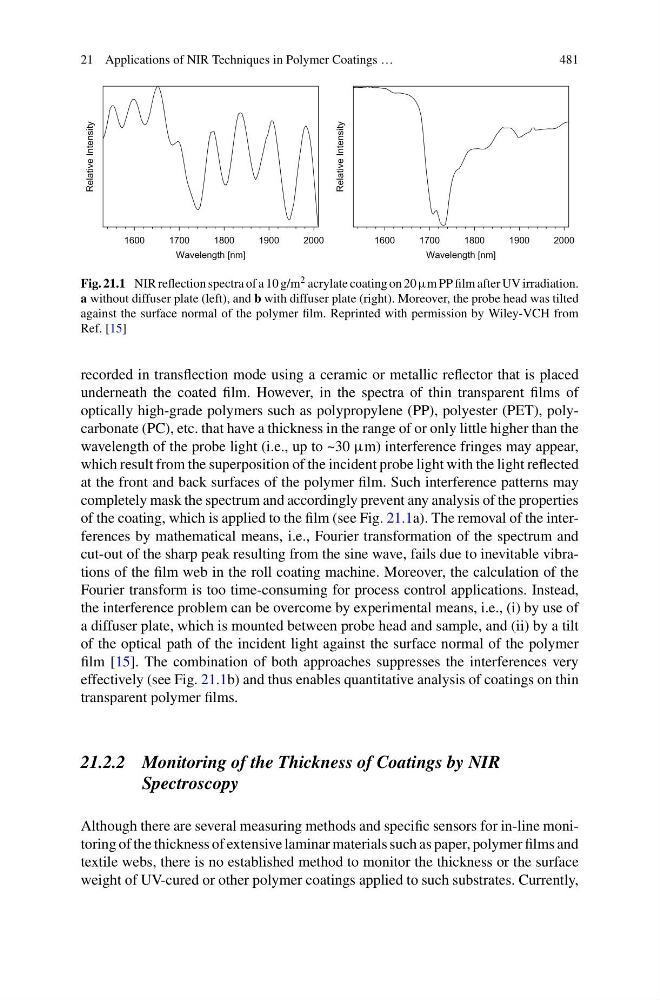
Fig. 21.1 NIR reflection spectra of a 10 g/m 2 acrylate coating on 20 μm PP film after UV irradiation.
a without diffuser plate (left), and b with diffuser plate (right). Moreover, the probe head was tilted
against the surface normal of the polymer film. Reprinted with permission by Wiley-VCH from
Ref. [15]
recorded in transflection mode using a ceramic or metallic reflector that is placed
underneath the coated film. However, in the spectra of thin transparent films of
optically high-grade polymers such as polypropylene (PP), polyester (PET), polycarbonate (PC), etc. that have a thickness in the range of or only little higher than the
wavelength of the probe light (i.e., up to ~30 μm) interference fringes may appear,
which result from the superposition of the incident probe light with the light reflected
at the front and back surfaces of the polymer film. Such interference patterns may
completely mask the spectrum and accordingly prevent any analysis of the properties
of the coating, which is applied to the film (see Fig. 21.1a). The removal of the interferences by mathematical means, i.e., Fourier transformation of the spectrum and
cut-out of the sharp peak resulting from the sine wave, fails due to inevitable vibrations of the film web in the roll coating machine. Moreover, the calculation of the
Fourier transform is too time-consuming for process control applications. Instead,
the interference problem can be overcome by experimental means, i.e., (i) by use of
a diffuser plate, which is mounted between probe head and sample, and (ii) by a tilt
of the optical path of the incident light against the surface normal of the polymer
film [15]. The combination of both approaches suppresses the interferences very
effectively (see Fig. 21.1b) and thus enables quantitative analysis of coatings on thin
transparent polymer films.
21.2.2 Monitoring of the Thickness of Coatings by NIR
Spectroscopy
Although there are several measuring methods and specific sensors for in-line monitoring of the thickness of extensive laminar materials such as paper, polymer films and
textile webs, there is no established method to monitor the thickness or the surface
weight of UV-cured or other polymer coatings applied to such substrates. Currently,
481
Wavelength [nm]
1600
1700
1800
1900
2000
Relative Intensity
Wavelength [nm]
1600
1700
1800
1900
2000
Relative Intensity
Fig. 21.1 NIR reflection spectra of a 10 g/m 2 acrylate coating on 20 μm PP film after UV irradiation.
a without diffuser plate (left), and b with diffuser plate (right). Moreover, the probe head was tilted
against the surface normal of the polymer film. Reprinted with permission by Wiley-VCH from
Ref. [15]
recorded in transflection mode using a ceramic or metallic reflector that is placed
underneath the coated film. However, in the spectra of thin transparent films of
optically high-grade polymers such as polypropylene (PP), polyester (PET), polycarbonate (PC), etc. that have a thickness in the range of or only little higher than the
wavelength of the probe light (i.e., up to ~30 μm) interference fringes may appear,
which result from the superposition of the incident probe light with the light reflected
at the front and back surfaces of the polymer film. Such interference patterns may
completely mask the spectrum and accordingly prevent any analysis of the properties
of the coating, which is applied to the film (see Fig. 21.1a). The removal of the interferences by mathematical means, i.e., Fourier transformation of the spectrum and
cut-out of the sharp peak resulting from the sine wave, fails due to inevitable vibrations of the film web in the roll coating machine. Moreover, the calculation of the
Fourier transform is too time-consuming for process control applications. Instead,
the interference problem can be overcome by experimental means, i.e., (i) by use of
a diffuser plate, which is mounted between probe head and sample, and (ii) by a tilt
of the optical path of the incident light against the surface normal of the polymer
film [15]. The combination of both approaches suppresses the interferences very
effectively (see Fig. 21.1b) and thus enables quantitative analysis of coatings on thin
transparent polymer films.
21.2.2 Monitoring of the Thickness of Coatings by NIR
Spectroscopy
Although there are several measuring methods and specific sensors for in-line monitoring of the thickness of extensive laminar materials such as paper, polymer films and
textile webs, there is no established method to monitor the thickness or the surface
weight of UV-cured or other polymer coatings applied to such substrates. Currently,