

466
H. M. Heise
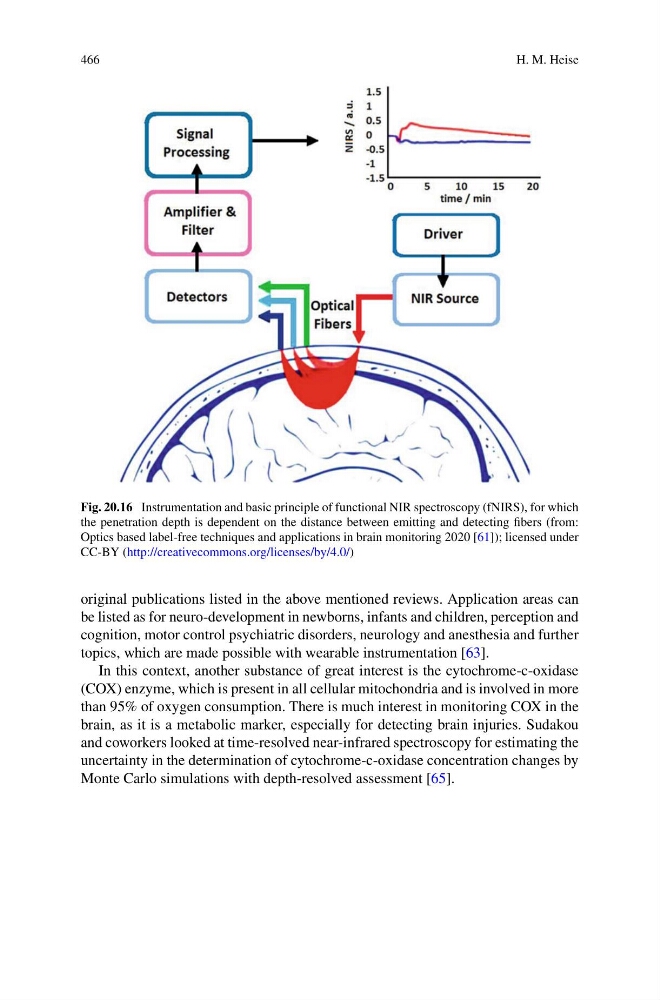
Fig. 20.16 Instrumentation and basic principle of functional NIR spectroscopy (fNIRS), for which
the penetration depth is dependent on the distance between emitting and detecting fibers (from:
Optics based label-free techniques and applications in brain monitoring 2020 [61]); licensed under
CC-BY (http://creativecommons.org/licenses/by/4.0/)
original publications listed in the above mentioned reviews. Application areas can
be listed as for neuro-development in newborns, infants and children, perception and
cognition, motor control psychiatric disorders, neurology and anesthesia and further
topics, which are made possible with wearable instrumentation [63].
In this context, another substance of great interest is the cytochrome-c-oxidase
(COX) enzyme, which is present in all cellular mitochondria and is involved in more
than 95% of oxygen consumption. There is much interest in monitoring COX in the
brain, as it is a metabolic marker, especially for detecting brain injuries. Sudakou
and coworkers looked at time-resolved near-infrared spectroscopy for estimating the
uncertainty in the determination of cytochrome-c-oxidase concentration changes by
Monte Carlo simulations with depth-resolved assessment [65].
H. M. Heise
Fig. 20.16 Instrumentation and basic principle of functional NIR spectroscopy (fNIRS), for which
the penetration depth is dependent on the distance between emitting and detecting fibers (from:
Optics based label-free techniques and applications in brain monitoring 2020 [61]); licensed under
CC-BY (http://creativecommons.org/licenses/by/4.0/)
original publications listed in the above mentioned reviews. Application areas can
be listed as for neuro-development in newborns, infants and children, perception and
cognition, motor control psychiatric disorders, neurology and anesthesia and further
topics, which are made possible with wearable instrumentation [63].
In this context, another substance of great interest is the cytochrome-c-oxidase
(COX) enzyme, which is present in all cellular mitochondria and is involved in more
than 95% of oxygen consumption. There is much interest in monitoring COX in the
brain, as it is a metabolic marker, especially for detecting brain injuries. Sudakou
and coworkers looked at time-resolved near-infrared spectroscopy for estimating the
uncertainty in the determination of cytochrome-c-oxidase concentration changes by
Monte Carlo simulations with depth-resolved assessment [65].