

20 Medical Applications of NIR Spectroscopy
457
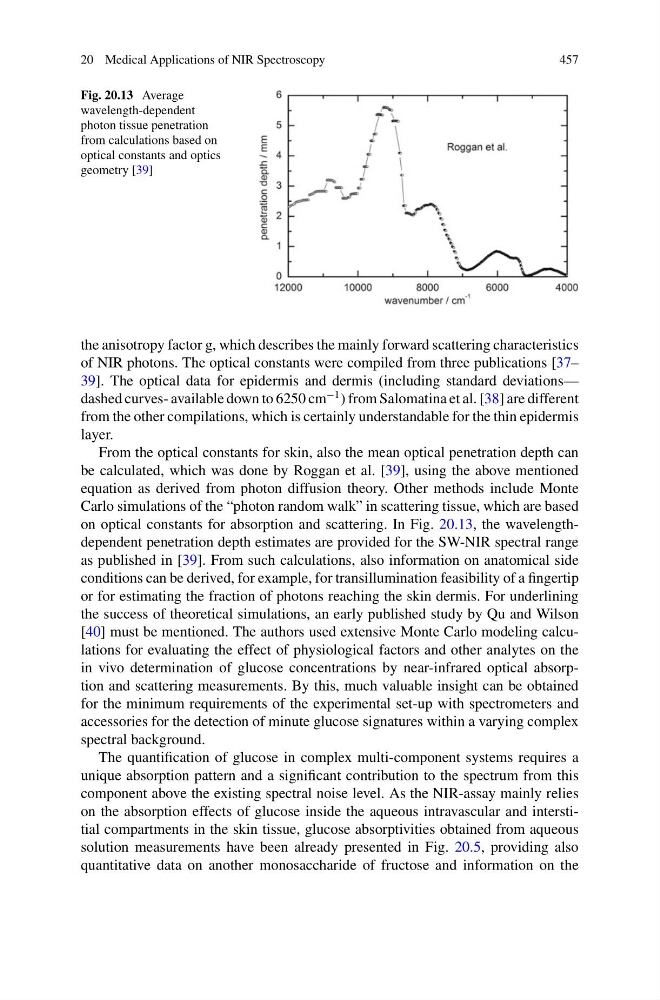
Fig. 20.13 Average
wavelength-dependent
photon tissue penetration
from calculations based on
optical constants and optics
geometry [39]
the anisotropy factor g, which describes the mainly forward scattering characteristics
of NIR photons. The optical constants were compiled from three publications [37–
39]. The optical data for epidermis and dermis (including standard deviations—
dashed curves- available down to 6250 cm
−1 ) from Salomatina et al. [38] are different
from the other compilations, which is certainly understandable for the thin epidermis
layer.
From the optical constants for skin, also the mean optical penetration depth can
be calculated, which was done by Roggan et al. [39], using the above mentioned
equation as derived from photon diffusion theory. Other methods include Monte
Carlo simulations of the “photon random walk” in scattering tissue, which are based
on optical constants for absorption and scattering. In Fig. 20.13, the wavelengthdependent penetration depth estimates are provided for the SW-NIR spectral range
as published in [39]. From such calculations, also information on anatomical side
conditions can be derived, for example, for transillumination feasibility of a fingertip
or for estimating the fraction of photons reaching the skin dermis. For underlining
the success of theoretical simulations, an early published study by Qu and Wilson
[40] must be mentioned. The authors used extensive Monte Carlo modeling calculations for evaluating the effect of physiological factors and other analytes on the
in vivo determination of glucose concentrations by near-infrared optical absorption and scattering measurements. By this, much valuable insight can be obtained
for the minimum requirements of the experimental set-up with spectrometers and
accessories for the detection of minute glucose signatures within a varying complex
spectral background.
The quantification of glucose in complex multi-component systems requires a
unique absorption pattern and a significant contribution to the spectrum from this
component above the existing spectral noise level. As the NIR-assay mainly relies
on the absorption effects of glucose inside the aqueous intravascular and interstitial compartments in the skin tissue, glucose absorptivities obtained from aqueous
solution measurements have been already presented in Fig. 20.5, providing also
quantitative data on another monosaccharide of fructose and information on the
457
Fig. 20.13 Average
wavelength-dependent
photon tissue penetration
from calculations based on
optical constants and optics
geometry [39]
the anisotropy factor g, which describes the mainly forward scattering characteristics
of NIR photons. The optical constants were compiled from three publications [37–
39]. The optical data for epidermis and dermis (including standard deviations—
dashed curves- available down to 6250 cm
−1 ) from Salomatina et al. [38] are different
from the other compilations, which is certainly understandable for the thin epidermis
layer.
From the optical constants for skin, also the mean optical penetration depth can
be calculated, which was done by Roggan et al. [39], using the above mentioned
equation as derived from photon diffusion theory. Other methods include Monte
Carlo simulations of the “photon random walk” in scattering tissue, which are based
on optical constants for absorption and scattering. In Fig. 20.13, the wavelengthdependent penetration depth estimates are provided for the SW-NIR spectral range
as published in [39]. From such calculations, also information on anatomical side
conditions can be derived, for example, for transillumination feasibility of a fingertip
or for estimating the fraction of photons reaching the skin dermis. For underlining
the success of theoretical simulations, an early published study by Qu and Wilson
[40] must be mentioned. The authors used extensive Monte Carlo modeling calculations for evaluating the effect of physiological factors and other analytes on the
in vivo determination of glucose concentrations by near-infrared optical absorption and scattering measurements. By this, much valuable insight can be obtained
for the minimum requirements of the experimental set-up with spectrometers and
accessories for the detection of minute glucose signatures within a varying complex
spectral background.
The quantification of glucose in complex multi-component systems requires a
unique absorption pattern and a significant contribution to the spectrum from this
component above the existing spectral noise level. As the NIR-assay mainly relies
on the absorption effects of glucose inside the aqueous intravascular and interstitial compartments in the skin tissue, glucose absorptivities obtained from aqueous
solution measurements have been already presented in Fig. 20.5, providing also
quantitative data on another monosaccharide of fructose and information on the