

3 Theoretical Models of Light Scattering and Absorption
39
Absorbance = −log 10
I
I 0
= κct
(3.3)
In which, t represents the thickness of the sample, c represents the concentration
of the absorber, and κ is often termed the “absorptivity” or “molar absorptivity” of
the material. The absorbance is a dimensionless quantity and the units of κ depend
upon the specific units used to express thickness and concentration. Units that are
often used are cm for thickness, mol/L for concentration, and L/mol·cm for molar
absorptivity.
Note that in Bouguer’s experiments, the absorbing “sample” was the atmosphere.
A gaseous medium like the atmosphere and a liquid solution are both examples of
systems that can plausibly be considered uniform in composition. We now understand
that the relationships in Eqs. 3.1 and 3.3 can be derived from continuous mathematical functions. These can only be expected to apply to samples that are uniformly
distributed, and therefore reasonably modeled as continuous. Note, too, that Bouguer
did not have the ability to vary the concentrations of the absorbers in his experiments.
We now understand that the ε in Eq. 3.1 embodies both the concentrations of the gases
in the atmosphere (c) and their ability to extinguish light (κ), consistent with Eq. 3.3.
However, the parameter κ merits further examination.
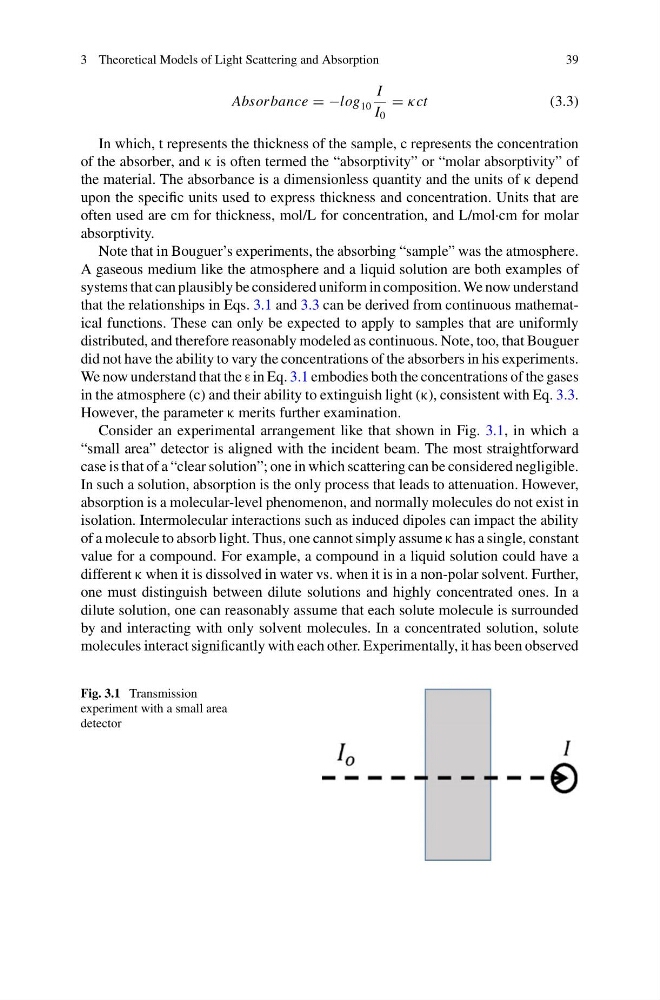
Consider an experimental arrangement like that shown in Fig. 3.1, in which a
“small area” detector is aligned with the incident beam. The most straightforward
case is that of a “clear solution”; one in which scattering can be considered negligible.
In such a solution, absorption is the only process that leads to attenuation. However,
absorption is a molecular-level phenomenon, and normally molecules do not exist in
isolation. Intermolecular interactions such as induced dipoles can impact the ability
of a molecule to absorb light. Thus, one cannot simply assume κ has a single, constant
value for a compound. For example, a compound in a liquid solution could have a
different κ when it is dissolved in water vs. when it is in a non-polar solvent. Further,
one must distinguish between dilute solutions and highly concentrated ones. In a
dilute solution, one can reasonably assume that each solute molecule is surrounded
by and interacting with only solvent molecules. In a concentrated solution, solute
molecules interact significantly with each other. Experimentally, it has been observed
Fig. 3.1 Transmission
experiment with a small area
detector
39
Absorbance = −log 10
I
I 0
= κct
(3.3)
In which, t represents the thickness of the sample, c represents the concentration
of the absorber, and κ is often termed the “absorptivity” or “molar absorptivity” of
the material. The absorbance is a dimensionless quantity and the units of κ depend
upon the specific units used to express thickness and concentration. Units that are
often used are cm for thickness, mol/L for concentration, and L/mol·cm for molar
absorptivity.
Note that in Bouguer’s experiments, the absorbing “sample” was the atmosphere.
A gaseous medium like the atmosphere and a liquid solution are both examples of
systems that can plausibly be considered uniform in composition. We now understand
that the relationships in Eqs. 3.1 and 3.3 can be derived from continuous mathematical functions. These can only be expected to apply to samples that are uniformly
distributed, and therefore reasonably modeled as continuous. Note, too, that Bouguer
did not have the ability to vary the concentrations of the absorbers in his experiments.
We now understand that the ε in Eq. 3.1 embodies both the concentrations of the gases
in the atmosphere (c) and their ability to extinguish light (κ), consistent with Eq. 3.3.
However, the parameter κ merits further examination.
Consider an experimental arrangement like that shown in Fig. 3.1, in which a
“small area” detector is aligned with the incident beam. The most straightforward
case is that of a “clear solution”; one in which scattering can be considered negligible.
In such a solution, absorption is the only process that leads to attenuation. However,
absorption is a molecular-level phenomenon, and normally molecules do not exist in
isolation. Intermolecular interactions such as induced dipoles can impact the ability
of a molecule to absorb light. Thus, one cannot simply assume κ has a single, constant
value for a compound. For example, a compound in a liquid solution could have a
different κ when it is dissolved in water vs. when it is in a non-polar solvent. Further,
one must distinguish between dilute solutions and highly concentrated ones. In a
dilute solution, one can reasonably assume that each solute molecule is surrounded
by and interacting with only solvent molecules. In a concentrated solution, solute
molecules interact significantly with each other. Experimentally, it has been observed
Fig. 3.1 Transmission
experiment with a small area
detector