

428
C. W. Huck
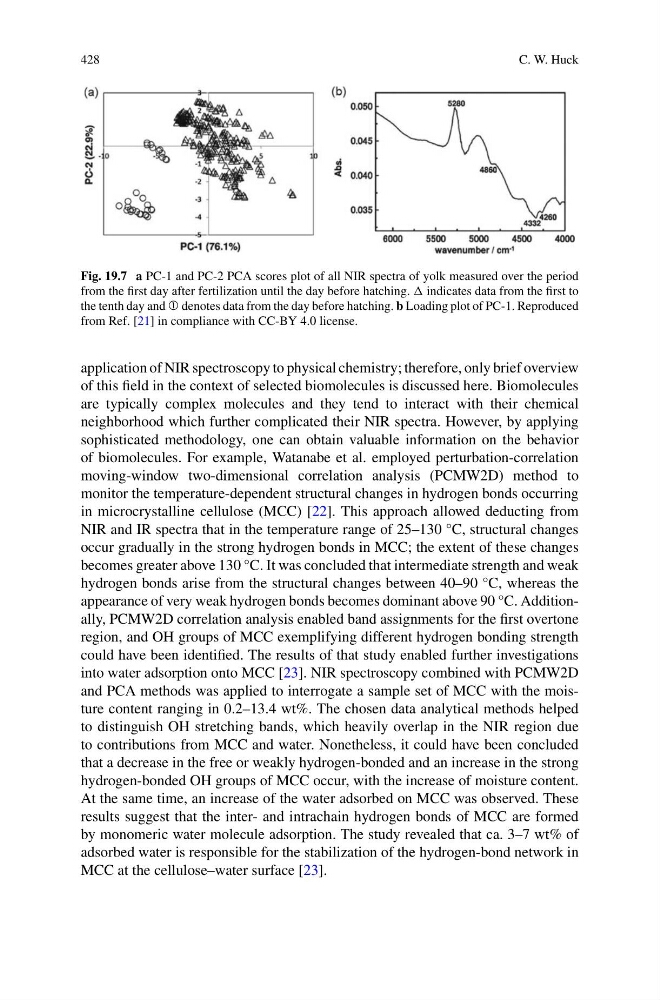
Fig. 19.7 a PC-1 and PC-2 PCA scores plot of all NIR spectra of yolk measured over the period
from the first day after fertilization until the day before hatching. indicates data from the first to
the tenth day and denotes data from the day before hatching. b Loading plot of PC-1. Reproduced
from Ref. [21] in compliance with CC-BY 4.0 license.
application of NIR spectroscopy to physical chemistry; therefore, only brief overview
of this field in the context of selected biomolecules is discussed here. Biomolecules
are typically complex molecules and they tend to interact with their chemical
neighborhood which further complicated their NIR spectra. However, by applying
sophisticated methodology, one can obtain valuable information on the behavior
of biomolecules. For example, Watanabe et al. employed perturbation-correlation
moving-window two-dimensional correlation analysis (PCMW2D) method to
monitor the temperature-dependent structural changes in hydrogen bonds occurring
in microcrystalline cellulose (MCC) [22]. This approach allowed deducting from
NIR and IR spectra that in the temperature range of 25–130 °C, structural changes
occur gradually in the strong hydrogen bonds in MCC; the extent of these changes
becomes greater above 130 °C. It was concluded that intermediate strength and weak
hydrogen bonds arise from the structural changes between 40–90 °C, whereas the
appearance of very weak hydrogen bonds becomes dominant above 90 °C. Additionally, PCMW2D correlation analysis enabled band assignments for the first overtone
region, and OH groups of MCC exemplifying different hydrogen bonding strength
could have been identified. The results of that study enabled further investigations
into water adsorption onto MCC [23]. NIR spectroscopy combined with PCMW2D
and PCA methods was applied to interrogate a sample set of MCC with the moisture content ranging in 0.2–13.4 wt%. The chosen data analytical methods helped
to distinguish OH stretching bands, which heavily overlap in the NIR region due
to contributions from MCC and water. Nonetheless, it could have been concluded
that a decrease in the free or weakly hydrogen-bonded and an increase in the strong
hydrogen-bonded OH groups of MCC occur, with the increase of moisture content.
At the same time, an increase of the water adsorbed on MCC was observed. These
results suggest that the inter- and intrachain hydrogen bonds of MCC are formed
by monomeric water molecule adsorption. The study revealed that ca. 3–7 wt% of
adsorbed water is responsible for the stabilization of the hydrogen-bond network in
MCC at the cellulose–water surface [23].
C. W. Huck
Fig. 19.7 a PC-1 and PC-2 PCA scores plot of all NIR spectra of yolk measured over the period
from the first day after fertilization until the day before hatching. indicates data from the first to
the tenth day and denotes data from the day before hatching. b Loading plot of PC-1. Reproduced
from Ref. [21] in compliance with CC-BY 4.0 license.
application of NIR spectroscopy to physical chemistry; therefore, only brief overview
of this field in the context of selected biomolecules is discussed here. Biomolecules
are typically complex molecules and they tend to interact with their chemical
neighborhood which further complicated their NIR spectra. However, by applying
sophisticated methodology, one can obtain valuable information on the behavior
of biomolecules. For example, Watanabe et al. employed perturbation-correlation
moving-window two-dimensional correlation analysis (PCMW2D) method to
monitor the temperature-dependent structural changes in hydrogen bonds occurring
in microcrystalline cellulose (MCC) [22]. This approach allowed deducting from
NIR and IR spectra that in the temperature range of 25–130 °C, structural changes
occur gradually in the strong hydrogen bonds in MCC; the extent of these changes
becomes greater above 130 °C. It was concluded that intermediate strength and weak
hydrogen bonds arise from the structural changes between 40–90 °C, whereas the
appearance of very weak hydrogen bonds becomes dominant above 90 °C. Additionally, PCMW2D correlation analysis enabled band assignments for the first overtone
region, and OH groups of MCC exemplifying different hydrogen bonding strength
could have been identified. The results of that study enabled further investigations
into water adsorption onto MCC [23]. NIR spectroscopy combined with PCMW2D
and PCA methods was applied to interrogate a sample set of MCC with the moisture content ranging in 0.2–13.4 wt%. The chosen data analytical methods helped
to distinguish OH stretching bands, which heavily overlap in the NIR region due
to contributions from MCC and water. Nonetheless, it could have been concluded
that a decrease in the free or weakly hydrogen-bonded and an increase in the strong
hydrogen-bonded OH groups of MCC occur, with the increase of moisture content.
At the same time, an increase of the water adsorbed on MCC was observed. These
results suggest that the inter- and intrachain hydrogen bonds of MCC are formed
by monomeric water molecule adsorption. The study revealed that ca. 3–7 wt% of
adsorbed water is responsible for the stabilization of the hydrogen-bond network in
MCC at the cellulose–water surface [23].