

18 Near-Infrared Spectroscopy in the Pharmaceutical Industry
407
-8
-6
-4
-2
0
2
4
PC1 (86%)
-1.5
-1
-0.5
0
0.5
1
1.5
PC2
(13%)
Dry mixing
Water addition
Drying
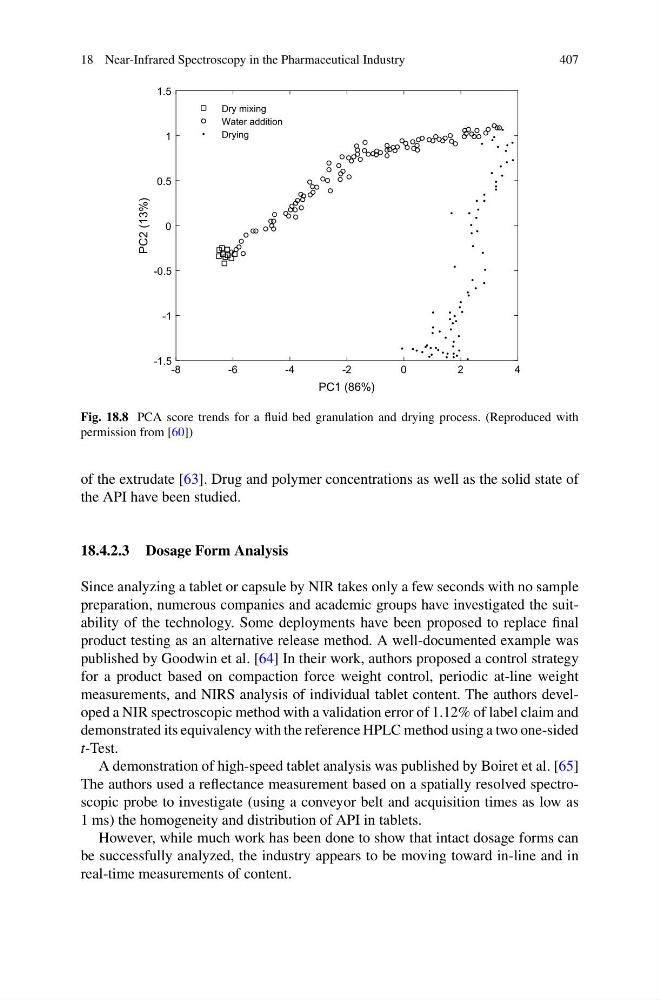
Fig. 18.8 PCA score trends for a fluid bed granulation and drying process. (Reproduced with
permission from [60])
of the extrudate [63]. Drug and polymer concentrations as well as the solid state of
the API have been studied.
18.4.2.3 Dosage Form Analysis
Since analyzing a tablet or capsule by NIR takes only a few seconds with no sample
preparation, numerous companies and academic groups have investigated the suitability of the technology. Some deployments have been proposed to replace final
product testing as an alternative release method. A well-documented example was
published by Goodwin et al. [64] In their work, authors proposed a control strategy
for a product based on compaction force weight control, periodic at-line weight
measurements, and NIRS analysis of individual tablet content. The authors developed a NIR spectroscopic method with a validation error of 1.12% of label claim and
demonstrated its equivalency with the reference HPLC method using a two one-sided
t-Test.
A demonstration of high-speed tablet analysis was published by Boiret et al. [65]
The authors used a reflectance measurement based on a spatially resolved spectroscopic probe to investigate (using a conveyor belt and acquisition times as low as
1 ms) the homogeneity and distribution of API in tablets.
However, while much work has been done to show that intact dosage forms can
be successfully analyzed, the industry appears to be moving toward in-line and in
real-time measurements of content.
407
-8
-6
-4
-2
0
2
4
PC1 (86%)
-1.5
-1
-0.5
0
0.5
1
1.5
PC2
(13%)
Dry mixing
Water addition
Drying
Fig. 18.8 PCA score trends for a fluid bed granulation and drying process. (Reproduced with
permission from [60])
of the extrudate [63]. Drug and polymer concentrations as well as the solid state of
the API have been studied.
18.4.2.3 Dosage Form Analysis
Since analyzing a tablet or capsule by NIR takes only a few seconds with no sample
preparation, numerous companies and academic groups have investigated the suitability of the technology. Some deployments have been proposed to replace final
product testing as an alternative release method. A well-documented example was
published by Goodwin et al. [64] In their work, authors proposed a control strategy
for a product based on compaction force weight control, periodic at-line weight
measurements, and NIRS analysis of individual tablet content. The authors developed a NIR spectroscopic method with a validation error of 1.12% of label claim and
demonstrated its equivalency with the reference HPLC method using a two one-sided
t-Test.
A demonstration of high-speed tablet analysis was published by Boiret et al. [65]
The authors used a reflectance measurement based on a spatially resolved spectroscopic probe to investigate (using a conveyor belt and acquisition times as low as
1 ms) the homogeneity and distribution of API in tablets.
However, while much work has been done to show that intact dosage forms can
be successfully analyzed, the industry appears to be moving toward in-line and in
real-time measurements of content.