

362
T. Ma et al.
NIRS has been envisioned as a replacement for laboratory analysis in certain applications (e.g., soil carbon credit assessment at the farm level). Moreover, there have been
many studies on the evaluation of lake sediment core composition changes by NIRS.
Since the sediment core length increases when the sampling interval decreases, the
need for a quick and inexpensive means of determining sediment composition became
apparent. Finally, the utilizations of NIRS for waste liquid evaluation, i.e., wastewater, sewage, black liquor (a waste product from the crafting process in digesting
pulpwood into paper pulp to remove lignin, hemicellulose, and other extracts from the
wood and to release cellulose fibers), atmospheric gas detection, and archeological
science will be explained in this chapter.
16.2 Wood
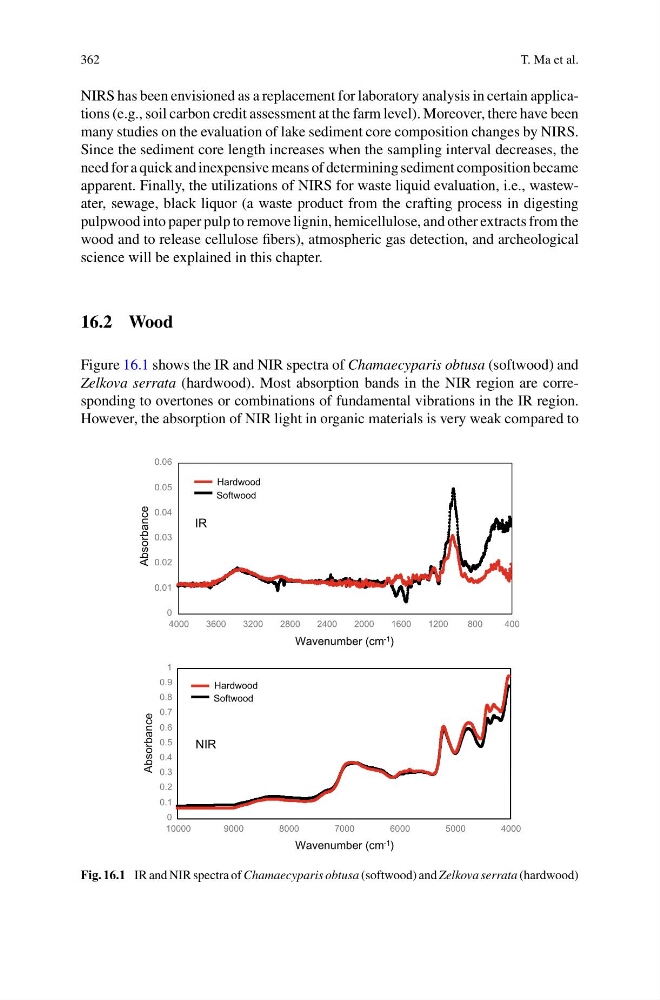
Figure 16.1 shows the IR and NIR spectra of Chamaecyparis obtusa (softwood) and
Zelkova serrata (hardwood). Most absorption bands in the NIR region are corresponding to overtones or combinations of fundamental vibrations in the IR region.
However, the absorption of NIR light in organic materials is very weak compared to
0
0.01
0.02
0.03
0.04
0.05
0.06
400
800
1200
1600
2000
2400
2800
3200
3600
4000
0
0.1
0.2
0.3
0.4
0.5
0.6
0.7
0.8
0.9
1
4000
5000
6000
7000
8000
9000
10000
Wavenumber (cm -1 )
Wavenumber (cm -1 )
Absorbance
Absorbance
Softwood
Hardwood
Softwood
Hardwood
IR
NIR
Fig. 16.1 IR and NIR spectra of Chamaecyparis obtusa (softwood) and Zelkova serrata (hardwood)
T. Ma et al.
NIRS has been envisioned as a replacement for laboratory analysis in certain applications (e.g., soil carbon credit assessment at the farm level). Moreover, there have been
many studies on the evaluation of lake sediment core composition changes by NIRS.
Since the sediment core length increases when the sampling interval decreases, the
need for a quick and inexpensive means of determining sediment composition became
apparent. Finally, the utilizations of NIRS for waste liquid evaluation, i.e., wastewater, sewage, black liquor (a waste product from the crafting process in digesting
pulpwood into paper pulp to remove lignin, hemicellulose, and other extracts from the
wood and to release cellulose fibers), atmospheric gas detection, and archeological
science will be explained in this chapter.
16.2 Wood
Figure 16.1 shows the IR and NIR spectra of Chamaecyparis obtusa (softwood) and
Zelkova serrata (hardwood). Most absorption bands in the NIR region are corresponding to overtones or combinations of fundamental vibrations in the IR region.
However, the absorption of NIR light in organic materials is very weak compared to
0
0.01
0.02
0.03
0.04
0.05
0.06
400
800
1200
1600
2000
2400
2800
3200
3600
4000
0
0.1
0.2
0.3
0.4
0.5
0.6
0.7
0.8
0.9
1
4000
5000
6000
7000
8000
9000
10000
Wavenumber (cm -1 )
Wavenumber (cm -1 )
Absorbance
Absorbance
Softwood
Hardwood
Softwood
Hardwood
IR
NIR
Fig. 16.1 IR and NIR spectra of Chamaecyparis obtusa (softwood) and Zelkova serrata (hardwood)