

314
M. A. Czarnecki et al.
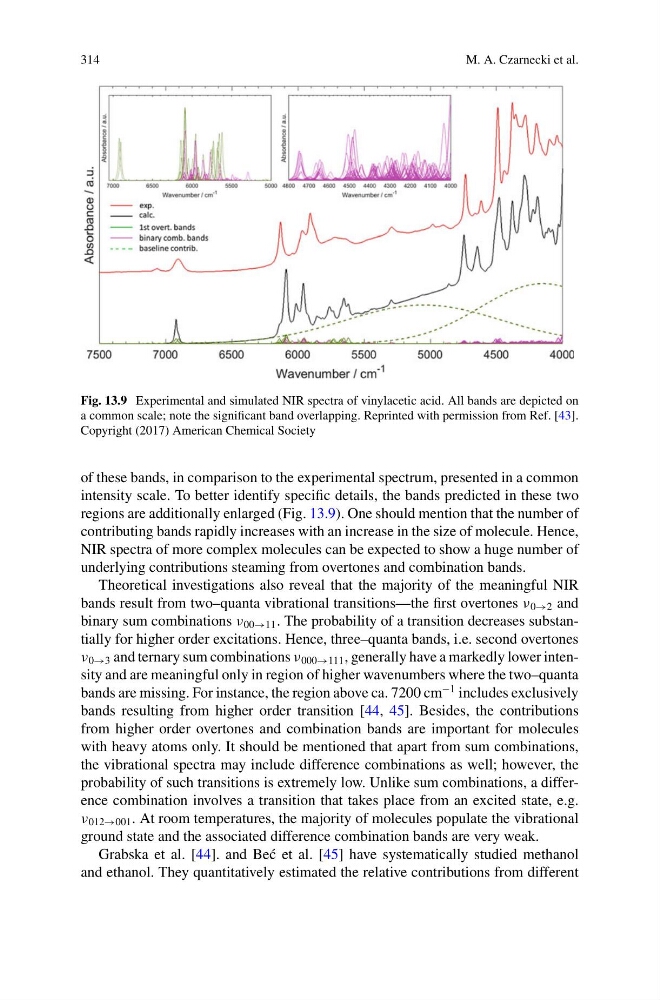
Fig. 13.9 Experimental and simulated NIR spectra of vinylacetic acid. All bands are depicted on
a common scale; note the significant band overlapping. Reprinted with permission from Ref. [43].
Copyright (2017) American Chemical Society
of these bands, in comparison to the experimental spectrum, presented in a common
intensity scale. To better identify specific details, the bands predicted in these two
regions are additionally enlarged (Fig. 13.9). One should mention that the number of
contributing bands rapidly increases with an increase in the size of molecule. Hence,
NIR spectra of more complex molecules can be expected to show a huge number of
underlying contributions steaming from overtones and combination bands.
Theoretical investigations also reveal that the majority of the meaningful NIR
bands result from two–quanta vibrational transitions—the first overtones ν 0→2 and
binary sum combinations ν 00→11 . The probability of a transition decreases substantially for higher order excitations. Hence, three–quanta bands, i.e. second overtones
ν 0→3 and ternary sum combinations ν 000→111 , generally have a markedly lower intensity and are meaningful only in region of higher wavenumbers where the two–quanta
bands are missing. For instance, the region above ca. 7200 cm
−1 includes exclusively
bands resulting from higher order transition [44, 45]. Besides, the contributions
from higher order overtones and combination bands are important for molecules
with heavy atoms only. It should be mentioned that apart from sum combinations,
the vibrational spectra may include difference combinations as well; however, the
probability of such transitions is extremely low. Unlike sum combinations, a difference combination involves a transition that takes place from an excited state, e.g.
ν 012→001 . At room temperatures, the majority of molecules populate the vibrational
ground state and the associated difference combination bands are very weak.
Grabska et al. [44]. and Be´ c et al. [45] have systematically studied methanol
and ethanol. They quantitatively estimated the relative contributions from different
M. A. Czarnecki et al.
Fig. 13.9 Experimental and simulated NIR spectra of vinylacetic acid. All bands are depicted on
a common scale; note the significant band overlapping. Reprinted with permission from Ref. [43].
Copyright (2017) American Chemical Society
of these bands, in comparison to the experimental spectrum, presented in a common
intensity scale. To better identify specific details, the bands predicted in these two
regions are additionally enlarged (Fig. 13.9). One should mention that the number of
contributing bands rapidly increases with an increase in the size of molecule. Hence,
NIR spectra of more complex molecules can be expected to show a huge number of
underlying contributions steaming from overtones and combination bands.
Theoretical investigations also reveal that the majority of the meaningful NIR
bands result from two–quanta vibrational transitions—the first overtones ν 0→2 and
binary sum combinations ν 00→11 . The probability of a transition decreases substantially for higher order excitations. Hence, three–quanta bands, i.e. second overtones
ν 0→3 and ternary sum combinations ν 000→111 , generally have a markedly lower intensity and are meaningful only in region of higher wavenumbers where the two–quanta
bands are missing. For instance, the region above ca. 7200 cm
−1 includes exclusively
bands resulting from higher order transition [44, 45]. Besides, the contributions
from higher order overtones and combination bands are important for molecules
with heavy atoms only. It should be mentioned that apart from sum combinations,
the vibrational spectra may include difference combinations as well; however, the
probability of such transitions is extremely low. Unlike sum combinations, a difference combination involves a transition that takes place from an excited state, e.g.
ν 012→001 . At room temperatures, the majority of molecules populate the vibrational
ground state and the associated difference combination bands are very weak.
Grabska et al. [44]. and Be´ c et al. [45] have systematically studied methanol
and ethanol. They quantitatively estimated the relative contributions from different