

13 Overview of Application of NIR Spectroscopy to Physical …
311
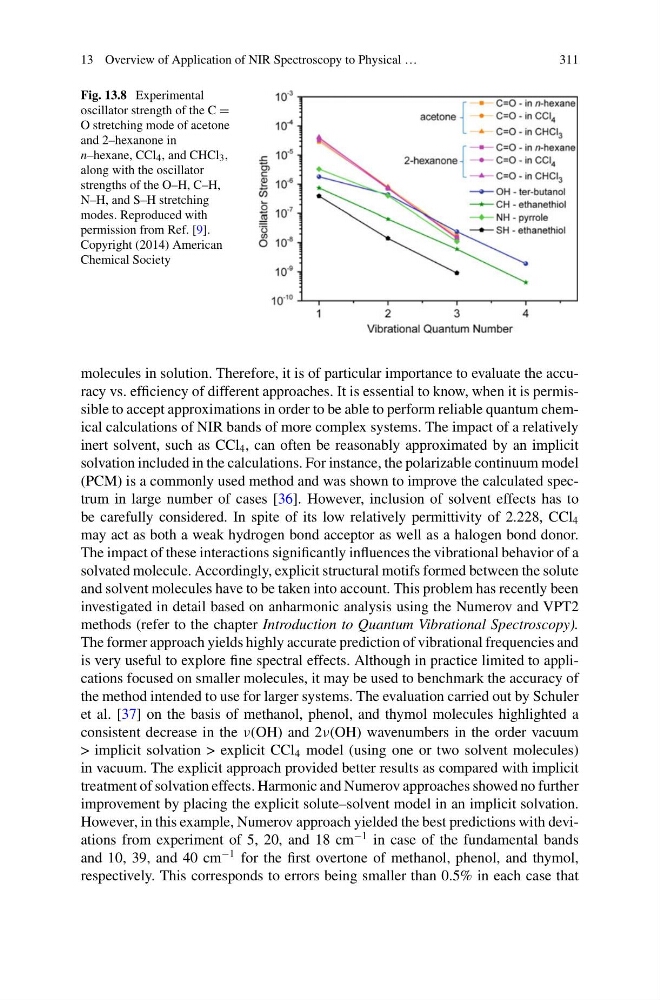
Fig. 13.8 Experimental
oscillator strength of the C =
O stretching mode of acetone
and 2–hexanone in
n–hexane, CCl 4 , and CHCl 3 ,
along with the oscillator
strengths of the O–H, C–H,
N–H, and S–H stretching
modes. Reproduced with
permission from Ref. [9].
Copyright (2014) American
Chemical Society
molecules in solution. Therefore, it is of particular importance to evaluate the accuracy vs. efficiency of different approaches. It is essential to know, when it is permissible to accept approximations in order to be able to perform reliable quantum chemical calculations of NIR bands of more complex systems. The impact of a relatively
inert solvent, such as CCl 4 , can often be reasonably approximated by an implicit
solvation included in the calculations. For instance, the polarizable continuum model
(PCM) is a commonly used method and was shown to improve the calculated spectrum in large number of cases [36]. However, inclusion of solvent effects has to
be carefully considered. In spite of its low relatively permittivity of 2.228, CCl 4
may act as both a weak hydrogen bond acceptor as well as a halogen bond donor.
The impact of these interactions significantly influences the vibrational behavior of a
solvated molecule. Accordingly, explicit structural motifs formed between the solute
and solvent molecules have to be taken into account. This problem has recently been
investigated in detail based on anharmonic analysis using the Numerov and VPT2
methods (refer to the chapter Introduction to Quantum Vibrational Spectroscopy).
The former approach yields highly accurate prediction of vibrational frequencies and
is very useful to explore fine spectral effects. Although in practice limited to applications focused on smaller molecules, it may be used to benchmark the accuracy of
the method intended to use for larger systems. The evaluation carried out by Schuler
et al. [37] on the basis of methanol, phenol, and thymol molecules highlighted a
consistent decrease in the ν(OH) and 2ν(OH) wavenumbers in the order vacuum
> implicit solvation > explicit CCl 4 model (using one or two solvent molecules)
in vacuum. The explicit approach provided better results as compared with implicit
treatment of solvation effects. Harmonic and Numerov approaches showed no further
improvement by placing the explicit solute–solvent model in an implicit solvation.
However, in this example, Numerov approach yielded the best predictions with deviations from experiment of 5, 20, and 18 cm
−1 in case of the fundamental bands
and 10, 39, and 40 cm
−1 for the first overtone of methanol, phenol, and thymol,
respectively. This corresponds to errors being smaller than 0.5% in each case that
311
Fig. 13.8 Experimental
oscillator strength of the C =
O stretching mode of acetone
and 2–hexanone in
n–hexane, CCl 4 , and CHCl 3 ,
along with the oscillator
strengths of the O–H, C–H,
N–H, and S–H stretching
modes. Reproduced with
permission from Ref. [9].
Copyright (2014) American
Chemical Society
molecules in solution. Therefore, it is of particular importance to evaluate the accuracy vs. efficiency of different approaches. It is essential to know, when it is permissible to accept approximations in order to be able to perform reliable quantum chemical calculations of NIR bands of more complex systems. The impact of a relatively
inert solvent, such as CCl 4 , can often be reasonably approximated by an implicit
solvation included in the calculations. For instance, the polarizable continuum model
(PCM) is a commonly used method and was shown to improve the calculated spectrum in large number of cases [36]. However, inclusion of solvent effects has to
be carefully considered. In spite of its low relatively permittivity of 2.228, CCl 4
may act as both a weak hydrogen bond acceptor as well as a halogen bond donor.
The impact of these interactions significantly influences the vibrational behavior of a
solvated molecule. Accordingly, explicit structural motifs formed between the solute
and solvent molecules have to be taken into account. This problem has recently been
investigated in detail based on anharmonic analysis using the Numerov and VPT2
methods (refer to the chapter Introduction to Quantum Vibrational Spectroscopy).
The former approach yields highly accurate prediction of vibrational frequencies and
is very useful to explore fine spectral effects. Although in practice limited to applications focused on smaller molecules, it may be used to benchmark the accuracy of
the method intended to use for larger systems. The evaluation carried out by Schuler
et al. [37] on the basis of methanol, phenol, and thymol molecules highlighted a
consistent decrease in the ν(OH) and 2ν(OH) wavenumbers in the order vacuum
> implicit solvation > explicit CCl 4 model (using one or two solvent molecules)
in vacuum. The explicit approach provided better results as compared with implicit
treatment of solvation effects. Harmonic and Numerov approaches showed no further
improvement by placing the explicit solute–solvent model in an implicit solvation.
However, in this example, Numerov approach yielded the best predictions with deviations from experiment of 5, 20, and 18 cm
−1 in case of the fundamental bands
and 10, 39, and 40 cm
−1 for the first overtone of methanol, phenol, and thymol,
respectively. This corresponds to errors being smaller than 0.5% in each case that