

13 Overview of Application of NIR Spectroscopy to Physical …
299
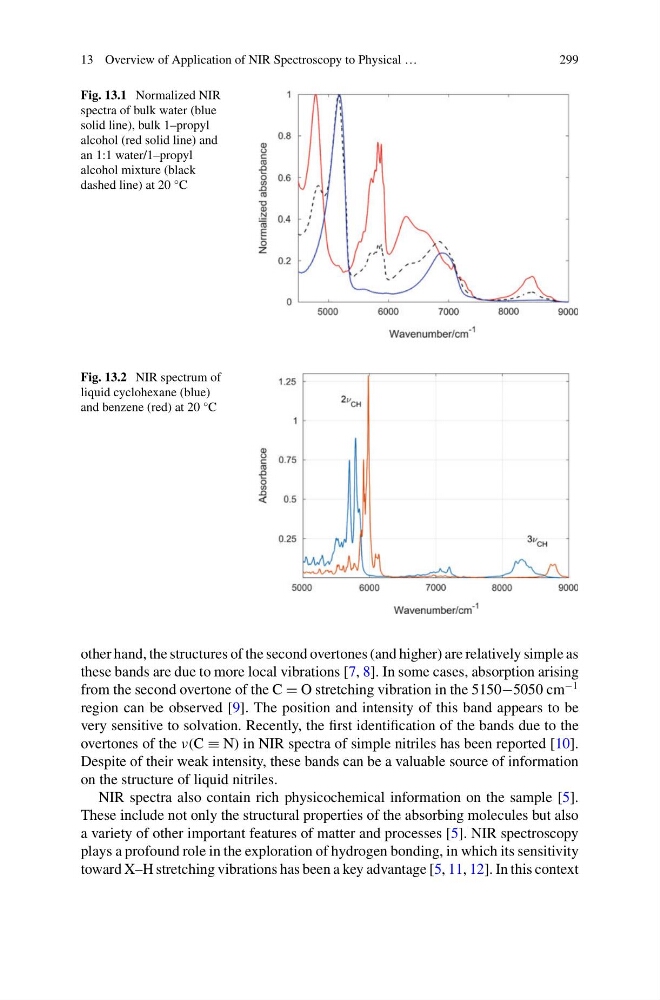
Fig. 13.1 Normalized NIR
spectra of bulk water (blue
solid line), bulk 1–propyl
alcohol (red solid line) and
an 1:1 water/1–propyl
alcohol mixture (black
dashed line) at 20 °C
Fig. 13.2 NIR spectrum of
liquid cyclohexane (blue)
and benzene (red) at 20 °C
other hand, the structures of the second overtones (and higher) are relatively simple as
these bands are due to more local vibrations [7, 8]. In some cases, absorption arising
from the second overtone of the C = O stretching vibration in the 5150−5050 cm
−1
region can be observed [9]. The position and intensity of this band appears to be
very sensitive to solvation. Recently, the first identification of the bands due to the
overtones of the ν(C ≡ N) in NIR spectra of simple nitriles has been reported [10].
Despite of their weak intensity, these bands can be a valuable source of information
on the structure of liquid nitriles.
NIR spectra also contain rich physicochemical information on the sample [5].
These include not only the structural properties of the absorbing molecules but also
a variety of other important features of matter and processes [5]. NIR spectroscopy
plays a profound role in the exploration of hydrogen bonding, in which its sensitivity
toward X–H stretching vibrations has been a key advantage [5, 11, 12]. In this context
299
Fig. 13.1 Normalized NIR
spectra of bulk water (blue
solid line), bulk 1–propyl
alcohol (red solid line) and
an 1:1 water/1–propyl
alcohol mixture (black
dashed line) at 20 °C
Fig. 13.2 NIR spectrum of
liquid cyclohexane (blue)
and benzene (red) at 20 °C
other hand, the structures of the second overtones (and higher) are relatively simple as
these bands are due to more local vibrations [7, 8]. In some cases, absorption arising
from the second overtone of the C = O stretching vibration in the 5150−5050 cm
−1
region can be observed [9]. The position and intensity of this band appears to be
very sensitive to solvation. Recently, the first identification of the bands due to the
overtones of the ν(C ≡ N) in NIR spectra of simple nitriles has been reported [10].
Despite of their weak intensity, these bands can be a valuable source of information
on the structure of liquid nitriles.
NIR spectra also contain rich physicochemical information on the sample [5].
These include not only the structural properties of the absorbing molecules but also
a variety of other important features of matter and processes [5]. NIR spectroscopy
plays a profound role in the exploration of hydrogen bonding, in which its sensitivity
toward X–H stretching vibrations has been a key advantage [5, 11, 12]. In this context