

284
B. Igne et al.
upon method development. Finally, plans are put in place to address those with the
highest scores. They can be categorized as:
• Controlled variables.
– Procedural control (i.e., lamp warm up may have a high risk because running
the instrument when the lamp is not stable will affect the results. However, it
can be proceduralized that the lamp needs to be on for a set time prior to use)
– Physical control (i.e., sample will be presented in a holder to ensure reproducibility)
• Experimental variables. These variables should be explored during method
development and will result in the risks being:
– Accepted: variability during use will not significantly affect the method (i.e.,
environmental pressures and humidity for well-controlled instruments)
– Avoided: variability of the sample will be removed prior to analysis (i.e.,
milling to a target particle size, drying to a constant moisture level)
– Mitigated: variability will be built in the chemometrics model (i.e., if the sample
varies in moisture, removing the -OH absorption bands from the spectra prior to
modeling can limit the method from being sensitive to moisture variability, or
if the sample particle size is expected to change, a design of experiment should
be used to ensure that variability is presented to the model and preprocessing
methods are employed to reduce their impact on the analytes(s) of interest and
the remaining impact is maintained in the model as within-model variability
(i.e., measured with the model diagnostic Hotelling’s T
2 ) or out-of-model
variability (i.e., measured with the model diagnostic Q-residual)
However, mitigating or avoiding all risks is impossible. Resource and time
constraints will push the scientific team to make trade-offs when building a model.
The result will be models that are robust to certain degrees to most but not all sources
of variability that the method could encounter in the future. It is also important
to recognize that identifying a risk does not mean that it can be fully managed or
addressed.
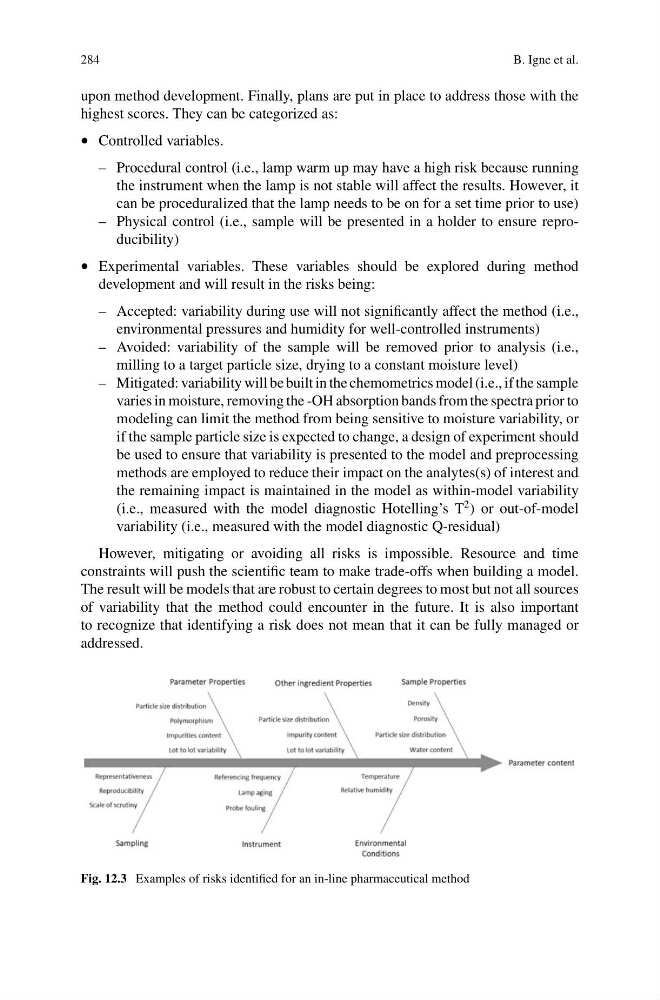
Fig. 12.3 Examples of risks identified for an in-line pharmaceutical method
B. Igne et al.
upon method development. Finally, plans are put in place to address those with the
highest scores. They can be categorized as:
• Controlled variables.
– Procedural control (i.e., lamp warm up may have a high risk because running
the instrument when the lamp is not stable will affect the results. However, it
can be proceduralized that the lamp needs to be on for a set time prior to use)
– Physical control (i.e., sample will be presented in a holder to ensure reproducibility)
• Experimental variables. These variables should be explored during method
development and will result in the risks being:
– Accepted: variability during use will not significantly affect the method (i.e.,
environmental pressures and humidity for well-controlled instruments)
– Avoided: variability of the sample will be removed prior to analysis (i.e.,
milling to a target particle size, drying to a constant moisture level)
– Mitigated: variability will be built in the chemometrics model (i.e., if the sample
varies in moisture, removing the -OH absorption bands from the spectra prior to
modeling can limit the method from being sensitive to moisture variability, or
if the sample particle size is expected to change, a design of experiment should
be used to ensure that variability is presented to the model and preprocessing
methods are employed to reduce their impact on the analytes(s) of interest and
the remaining impact is maintained in the model as within-model variability
(i.e., measured with the model diagnostic Hotelling’s T
2 ) or out-of-model
variability (i.e., measured with the model diagnostic Q-residual)
However, mitigating or avoiding all risks is impossible. Resource and time
constraints will push the scientific team to make trade-offs when building a model.
The result will be models that are robust to certain degrees to most but not all sources
of variability that the method could encounter in the future. It is also important
to recognize that identifying a risk does not mean that it can be fully managed or
addressed.
Fig. 12.3 Examples of risks identified for an in-line pharmaceutical method