

274
T. Inagaki and S. Tsuchikawa
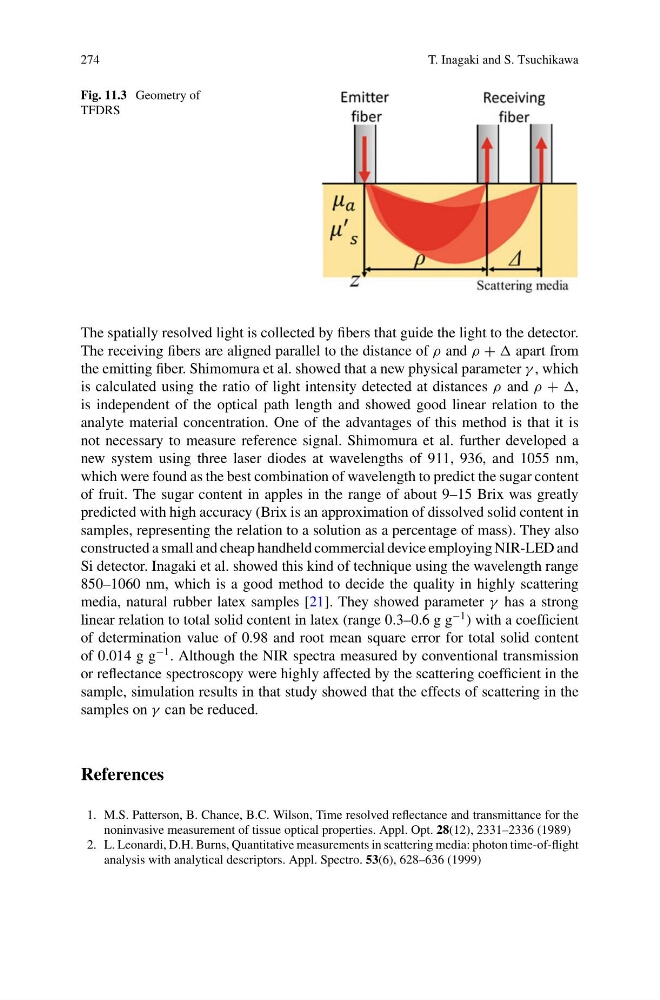
Fig. 11.3 Geometry of
TFDRS
The spatially resolved light is collected by fibers that guide the light to the detector.
The receiving fibers are aligned parallel to the distance of ρ and ρ + apart from
the emitting fiber. Shimomura et al. showed that a new physical parameter γ , which
is calculated using the ratio of light intensity detected at distances ρ and ρ + ,
is independent of the optical path length and showed good linear relation to the
analyte material concentration. One of the advantages of this method is that it is
not necessary to measure reference signal. Shimomura et al. further developed a
new system using three laser diodes at wavelengths of 911, 936, and 1055 nm,
which were found as the best combination of wavelength to predict the sugar content
of fruit. The sugar content in apples in the range of about 9–15 Brix was greatly
predicted with high accuracy (Brix is an approximation of dissolved solid content in
samples, representing the relation to a solution as a percentage of mass). They also
constructed a small and cheap handheld commercial device employing NIR-LED and
Si detector. Inagaki et al. showed this kind of technique using the wavelength range
850–1060 nm, which is a good method to decide the quality in highly scattering
media, natural rubber latex samples [21]. They showed parameter γ has a strong
linear relation to total solid content in latex (range 0.3–0.6 g g
−1 ) with a coefficient
of determination value of 0.98 and root mean square error for total solid content
of 0.014 g g
−1 . Although the NIR spectra measured by conventional transmission
or reflectance spectroscopy were highly affected by the scattering coefficient in the
sample, simulation results in that study showed that the effects of scattering in the
samples on γ can be reduced.
References
1. M.S. Patterson, B. Chance, B.C. Wilson, Time resolved reflectance and transmittance for the
noninvasive measurement of tissue optical properties. Appl. Opt. 28(12), 2331–2336 (1989)
2. L. Leonardi, D.H. Burns, Quantitative measurements in scattering media: photon time-of-flight
analysis with analytical descriptors. Appl. Spectro. 53(6), 628–636 (1999)
T. Inagaki and S. Tsuchikawa
Fig. 11.3 Geometry of
TFDRS
The spatially resolved light is collected by fibers that guide the light to the detector.
The receiving fibers are aligned parallel to the distance of ρ and ρ + apart from
the emitting fiber. Shimomura et al. showed that a new physical parameter γ , which
is calculated using the ratio of light intensity detected at distances ρ and ρ + ,
is independent of the optical path length and showed good linear relation to the
analyte material concentration. One of the advantages of this method is that it is
not necessary to measure reference signal. Shimomura et al. further developed a
new system using three laser diodes at wavelengths of 911, 936, and 1055 nm,
which were found as the best combination of wavelength to predict the sugar content
of fruit. The sugar content in apples in the range of about 9–15 Brix was greatly
predicted with high accuracy (Brix is an approximation of dissolved solid content in
samples, representing the relation to a solution as a percentage of mass). They also
constructed a small and cheap handheld commercial device employing NIR-LED and
Si detector. Inagaki et al. showed this kind of technique using the wavelength range
850–1060 nm, which is a good method to decide the quality in highly scattering
media, natural rubber latex samples [21]. They showed parameter γ has a strong
linear relation to total solid content in latex (range 0.3–0.6 g g
−1 ) with a coefficient
of determination value of 0.98 and root mean square error for total solid content
of 0.014 g g
−1 . Although the NIR spectra measured by conventional transmission
or reflectance spectroscopy were highly affected by the scattering coefficient in the
sample, simulation results in that study showed that the effects of scattering in the
samples on γ can be reduced.
References
1. M.S. Patterson, B. Chance, B.C. Wilson, Time resolved reflectance and transmittance for the
noninvasive measurement of tissue optical properties. Appl. Opt. 28(12), 2331–2336 (1989)
2. L. Leonardi, D.H. Burns, Quantitative measurements in scattering media: photon time-of-flight
analysis with analytical descriptors. Appl. Spectro. 53(6), 628–636 (1999)