

10 Hardware of Near-Infrared Spectroscopy
251
⎛
⎜
⎝
M 1
. . .
M k
⎞
⎟
⎠ =
⎛
⎜
⎝
P
1
1 · · · P
k
1
. . .
. . .
. . .
P
1
n · · · P
1
n
⎞
⎟
⎠ ·
⎛
⎜
⎝
I 1
. . .
I k
⎞
⎟
⎠ or M = P × I
(10.15)
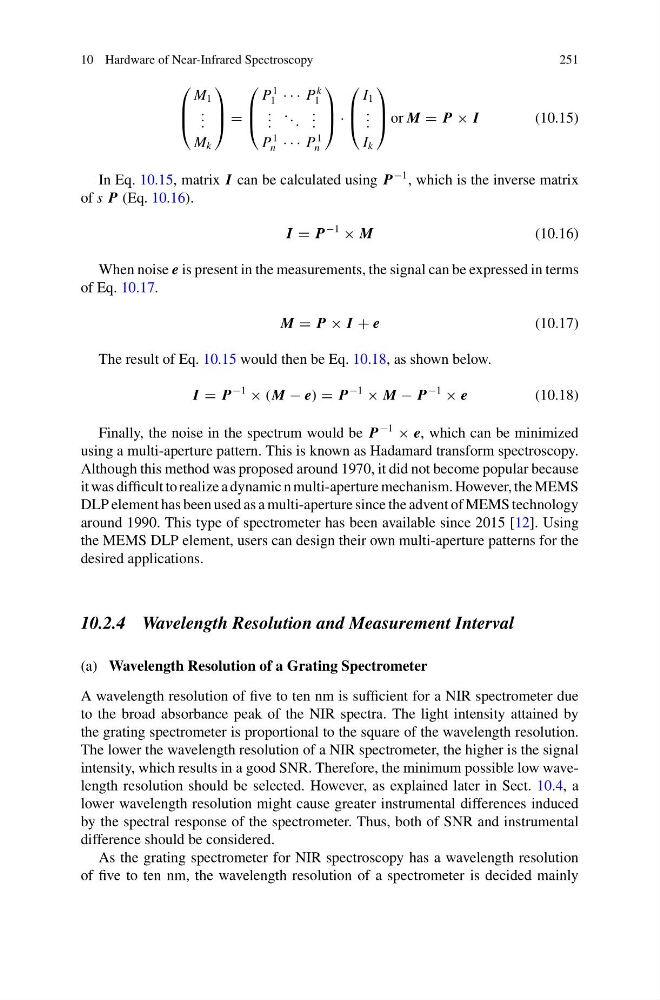
In Eq. 10.15, matrix I can be calculated using P
−1 , which is the inverse matrix
of s P (Eq. 10.16).
I = P
−1
× M
(10.16)
When noise e is present in the measurements, the signal can be expressed in terms
of Eq. 10.17.
M = P × I + e
(10.17)
The result of Eq. 10.15 would then be Eq. 10.18, as shown below.
I = P
−1
× (M − e) = P
−1
× M − P
−1
× e
(10.18)
Finally, the noise in the spectrum would be P
−1
× e, which can be minimized
using a multi-aperture pattern. This is known as Hadamard transform spectroscopy.
Although this method was proposed around 1970, it did not become popular because
it was difficult to realize a dynamic n multi-aperture mechanism. However, the MEMS
DLP element has been used as a multi-aperture since the advent of MEMS technology
around 1990. This type of spectrometer has been available since 2015 [12]. Using
the MEMS DLP element, users can design their own multi-aperture patterns for the
desired applications.
10.2.4 Wavelength Resolution and Measurement Interval
(a) Wavelength Resolution of a Grating Spectrometer
A wavelength resolution of five to ten nm is sufficient for a NIR spectrometer due
to the broad absorbance peak of the NIR spectra. The light intensity attained by
the grating spectrometer is proportional to the square of the wavelength resolution.
The lower the wavelength resolution of a NIR spectrometer, the higher is the signal
intensity, which results in a good SNR. Therefore, the minimum possible low wavelength resolution should be selected. However, as explained later in Sect. 10.4, a
lower wavelength resolution might cause greater instrumental differences induced
by the spectral response of the spectrometer. Thus, both of SNR and instrumental
difference should be considered.
As the grating spectrometer for NIR spectroscopy has a wavelength resolution
of five to ten nm, the wavelength resolution of a spectrometer is decided mainly
251
⎛
⎜
⎝
M 1
. . .
M k
⎞
⎟
⎠ =
⎛
⎜
⎝
P
1
1 · · · P
k
1
. . .
. . .
. . .
P
1
n · · · P
1
n
⎞
⎟
⎠ ·
⎛
⎜
⎝
I 1
. . .
I k
⎞
⎟
⎠ or M = P × I
(10.15)
In Eq. 10.15, matrix I can be calculated using P
−1 , which is the inverse matrix
of s P (Eq. 10.16).
I = P
−1
× M
(10.16)
When noise e is present in the measurements, the signal can be expressed in terms
of Eq. 10.17.
M = P × I + e
(10.17)
The result of Eq. 10.15 would then be Eq. 10.18, as shown below.
I = P
−1
× (M − e) = P
−1
× M − P
−1
× e
(10.18)
Finally, the noise in the spectrum would be P
−1
× e, which can be minimized
using a multi-aperture pattern. This is known as Hadamard transform spectroscopy.
Although this method was proposed around 1970, it did not become popular because
it was difficult to realize a dynamic n multi-aperture mechanism. However, the MEMS
DLP element has been used as a multi-aperture since the advent of MEMS technology
around 1990. This type of spectrometer has been available since 2015 [12]. Using
the MEMS DLP element, users can design their own multi-aperture patterns for the
desired applications.
10.2.4 Wavelength Resolution and Measurement Interval
(a) Wavelength Resolution of a Grating Spectrometer
A wavelength resolution of five to ten nm is sufficient for a NIR spectrometer due
to the broad absorbance peak of the NIR spectra. The light intensity attained by
the grating spectrometer is proportional to the square of the wavelength resolution.
The lower the wavelength resolution of a NIR spectrometer, the higher is the signal
intensity, which results in a good SNR. Therefore, the minimum possible low wavelength resolution should be selected. However, as explained later in Sect. 10.4, a
lower wavelength resolution might cause greater instrumental differences induced
by the spectral response of the spectrometer. Thus, both of SNR and instrumental
difference should be considered.
As the grating spectrometer for NIR spectroscopy has a wavelength resolution
of five to ten nm, the wavelength resolution of a spectrometer is decided mainly