

238
T. Okura
depending on the nature of the target of measurements. A typical high-grade NIR
spectrometer has a low noise level of less than 20 µabs. Such a low noise level can
be realized using high-grade A/D conversion instead of a pen recorder, and the new
fast repeat scanning (FRS) method developed by Karl Norris.
10.1.2 Noise Reduction Using the FRS Method
The noise reduction technology used for an instrument, before the advent of digital
technology until 1970, involved slow speed measurements and noise reduction using
the time constant of the amplifier circuit. For example, the UV-VIS or Raman spectrometers employed in that era took a long time (>10 min or sometimes hours) to
measure the sample, and the spectra were generated using a long time constant.
White noise with flat frequency characteristics can be reduced by employing slow
scanning speeds and longer time constants. However, the actual noise is composed of
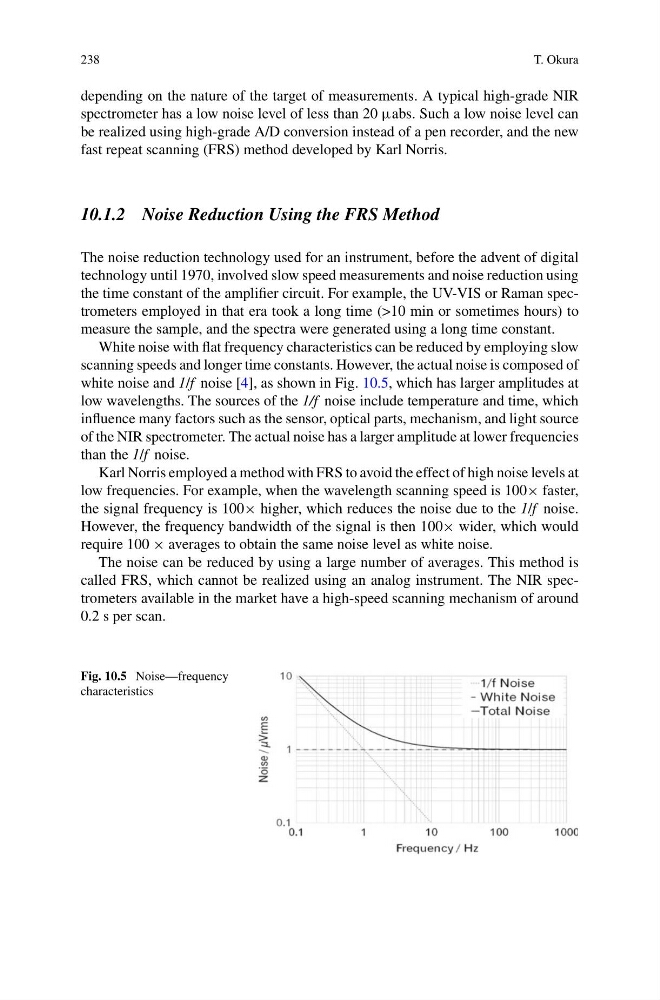
white noise and 1/f noise [4], as shown in Fig. 10.5, which has larger amplitudes at
low wavelengths. The sources of the 1/f noise include temperature and time, which
influence many factors such as the sensor, optical parts, mechanism, and light source
of the NIR spectrometer. The actual noise has a larger amplitude at lower frequencies
than the 1/f noise.
Karl Norris employed a method with FRS to avoid the effect of high noise levels at
low frequencies. For example, when the wavelength scanning speed is 100× faster,
the signal frequency is 100× higher, which reduces the noise due to the 1/f noise.
However, the frequency bandwidth of the signal is then 100× wider, which would
require 100 × averages to obtain the same noise level as white noise.
The noise can be reduced by using a large number of averages. This method is
called FRS, which cannot be realized using an analog instrument. The NIR spectrometers available in the market have a high-speed scanning mechanism of around
0.2 s per scan.
Fig. 10.5 Noise—frequency
characteristics
T. Okura
depending on the nature of the target of measurements. A typical high-grade NIR
spectrometer has a low noise level of less than 20 µabs. Such a low noise level can
be realized using high-grade A/D conversion instead of a pen recorder, and the new
fast repeat scanning (FRS) method developed by Karl Norris.
10.1.2 Noise Reduction Using the FRS Method
The noise reduction technology used for an instrument, before the advent of digital
technology until 1970, involved slow speed measurements and noise reduction using
the time constant of the amplifier circuit. For example, the UV-VIS or Raman spectrometers employed in that era took a long time (>10 min or sometimes hours) to
measure the sample, and the spectra were generated using a long time constant.
White noise with flat frequency characteristics can be reduced by employing slow
scanning speeds and longer time constants. However, the actual noise is composed of
white noise and 1/f noise [4], as shown in Fig. 10.5, which has larger amplitudes at
low wavelengths. The sources of the 1/f noise include temperature and time, which
influence many factors such as the sensor, optical parts, mechanism, and light source
of the NIR spectrometer. The actual noise has a larger amplitude at lower frequencies
than the 1/f noise.
Karl Norris employed a method with FRS to avoid the effect of high noise levels at
low frequencies. For example, when the wavelength scanning speed is 100× faster,
the signal frequency is 100× higher, which reduces the noise due to the 1/f noise.
However, the frequency bandwidth of the signal is then 100× wider, which would
require 100 × averages to obtain the same noise level as white noise.
The noise can be reduced by using a large number of averages. This method is
called FRS, which cannot be realized using an analog instrument. The NIR spectrometers available in the market have a high-speed scanning mechanism of around
0.2 s per scan.
Fig. 10.5 Noise—frequency
characteristics