

2 Principles and Characteristics of NIR Spectroscopy
13
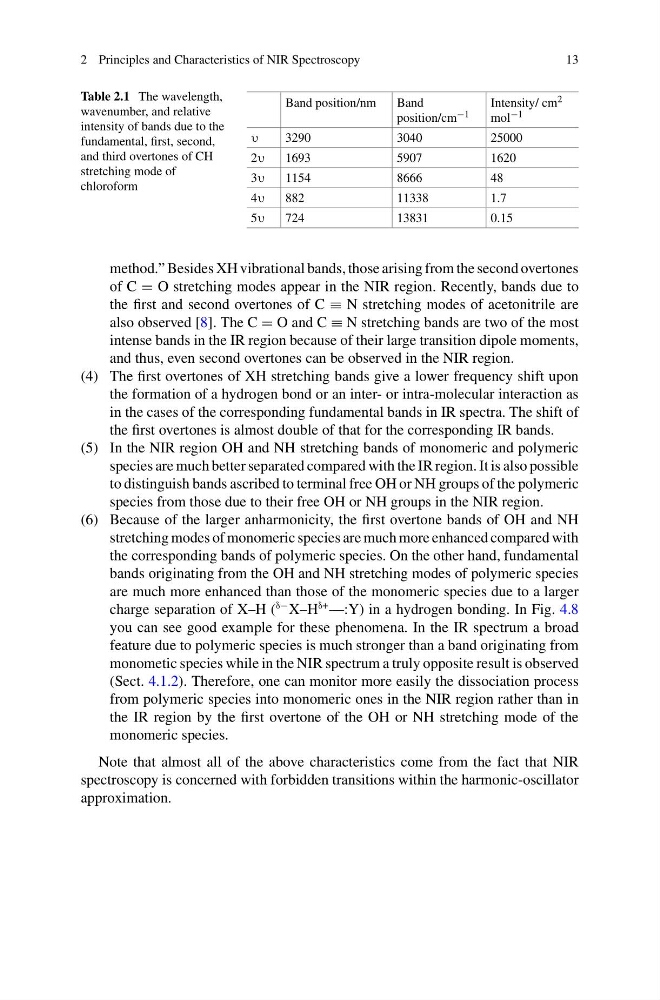
Table 2.1 The wavelength,
wavenumber, and relative
intensity of bands due to the
fundamental, first, second,
and third overtones of CH
stretching mode of
chloroform
Band position/nm
Band
position/cm −1
Intensity/ cm 2
mol −1
υ
3290
3040
25000
2υ
1693
5907
1620
3υ
1154
8666
48
4υ
882
11338
1.7
5υ
724
13831
0.15
method.” Besides XH vibrational bands, those arising from the second overtones
of C = O stretching modes appear in the NIR region. Recently, bands due to
the first and second overtones of C ≡ N stretching modes of acetonitrile are
also observed [8]. The C = O and C ≡ N stretching bands are two of the most
intense bands in the IR region because of their large transition dipole moments,
and thus, even second overtones can be observed in the NIR region.
(4) The first overtones of XH stretching bands give a lower frequency shift upon
the formation of a hydrogen bond or an inter- or intra-molecular interaction as
in the cases of the corresponding fundamental bands in IR spectra. The shift of
the first overtones is almost double of that for the corresponding IR bands.
(5) In the NIR region OH and NH stretching bands of monomeric and polymeric
species are much better separated compared with the IR region. It is also possible
to distinguish bands ascribed to terminal free OH or NH groups of the polymeric
species from those due to their free OH or NH groups in the NIR region.
(6) Because of the larger anharmonicity, the first overtone bands of OH and NH
stretching modes of monomeric species are much more enhanced compared with
the corresponding bands of polymeric species. On the other hand, fundamental
bands originating from the OH and NH stretching modes of polymeric species
are much more enhanced than those of the monomeric species due to a larger
charge separation of X–H (
δ− X–H
δ+ —:Y) in a hydrogen bonding. In Fig. 4.8
you can see good example for these phenomena. In the IR spectrum a broad
feature due to polymeric species is much stronger than a band originating from
monometic species while in the NIR spectrum a truly opposite result is observed
(Sect. 4.1.2). Therefore, one can monitor more easily the dissociation process
from polymeric species into monomeric ones in the NIR region rather than in
the IR region by the first overtone of the OH or NH stretching mode of the
monomeric species.
Note that almost all of the above characteristics come from the fact that NIR
spectroscopy is concerned with forbidden transitions within the harmonic-oscillator
approximation.
13
Table 2.1 The wavelength,
wavenumber, and relative
intensity of bands due to the
fundamental, first, second,
and third overtones of CH
stretching mode of
chloroform
Band position/nm
Band
position/cm −1
Intensity/ cm 2
mol −1
υ
3290
3040
25000
2υ
1693
5907
1620
3υ
1154
8666
48
4υ
882
11338
1.7
5υ
724
13831
0.15
method.” Besides XH vibrational bands, those arising from the second overtones
of C = O stretching modes appear in the NIR region. Recently, bands due to
the first and second overtones of C ≡ N stretching modes of acetonitrile are
also observed [8]. The C = O and C ≡ N stretching bands are two of the most
intense bands in the IR region because of their large transition dipole moments,
and thus, even second overtones can be observed in the NIR region.
(4) The first overtones of XH stretching bands give a lower frequency shift upon
the formation of a hydrogen bond or an inter- or intra-molecular interaction as
in the cases of the corresponding fundamental bands in IR spectra. The shift of
the first overtones is almost double of that for the corresponding IR bands.
(5) In the NIR region OH and NH stretching bands of monomeric and polymeric
species are much better separated compared with the IR region. It is also possible
to distinguish bands ascribed to terminal free OH or NH groups of the polymeric
species from those due to their free OH or NH groups in the NIR region.
(6) Because of the larger anharmonicity, the first overtone bands of OH and NH
stretching modes of monomeric species are much more enhanced compared with
the corresponding bands of polymeric species. On the other hand, fundamental
bands originating from the OH and NH stretching modes of polymeric species
are much more enhanced than those of the monomeric species due to a larger
charge separation of X–H (
δ− X–H
δ+ —:Y) in a hydrogen bonding. In Fig. 4.8
you can see good example for these phenomena. In the IR spectrum a broad
feature due to polymeric species is much stronger than a band originating from
monometic species while in the NIR spectrum a truly opposite result is observed
(Sect. 4.1.2). Therefore, one can monitor more easily the dissociation process
from polymeric species into monomeric ones in the NIR region rather than in
the IR region by the first overtone of the OH or NH stretching mode of the
monomeric species.
Note that almost all of the above characteristics come from the fact that NIR
spectroscopy is concerned with forbidden transitions within the harmonic-oscillator
approximation.