

186
K. M. Sørensen et al.
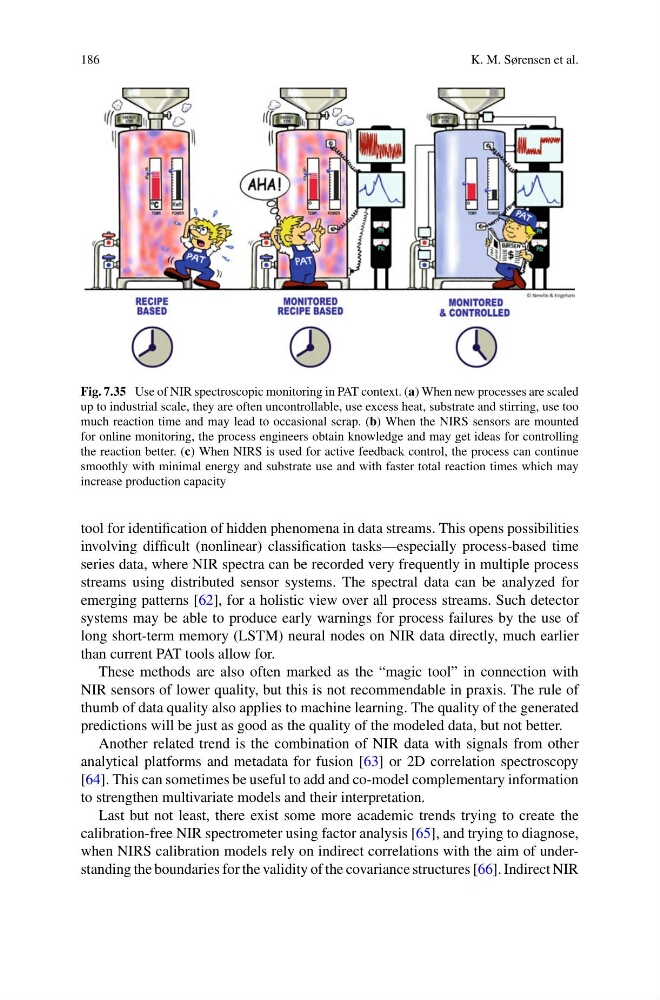
Fig. 7.35 Use of NIR spectroscopic monitoring in PAT context. (a) When new processes are scaled
up to industrial scale, they are often uncontrollable, use excess heat, substrate and stirring, use too
much reaction time and may lead to occasional scrap. (b) When the NIRS sensors are mounted
for online monitoring, the process engineers obtain knowledge and may get ideas for controlling
the reaction better. (c) When NIRS is used for active feedback control, the process can continue
smoothly with minimal energy and substrate use and with faster total reaction times which may
increase production capacity
tool for identification of hidden phenomena in data streams. This opens possibilities
involving difficult (nonlinear) classification tasks—especially process-based time
series data, where NIR spectra can be recorded very frequently in multiple process
streams using distributed sensor systems. The spectral data can be analyzed for
emerging patterns [62], for a holistic view over all process streams. Such detector
systems may be able to produce early warnings for process failures by the use of
long short-term memory (LSTM) neural nodes on NIR data directly, much earlier
than current PAT tools allow for.
These methods are also often marked as the “magic tool” in connection with
NIR sensors of lower quality, but this is not recommendable in praxis. The rule of
thumb of data quality also applies to machine learning. The quality of the generated
predictions will be just as good as the quality of the modeled data, but not better.
Another related trend is the combination of NIR data with signals from other
analytical platforms and metadata for fusion [63] or 2D correlation spectroscopy
[64]. This can sometimes be useful to add and co-model complementary information
to strengthen multivariate models and their interpretation.
Last but not least, there exist some more academic trends trying to create the
calibration-free NIR spectrometer using factor analysis [65], and trying to diagnose,
when NIRS calibration models rely on indirect correlations with the aim of understanding the boundaries for the validity of the covariance structures [66]. Indirect NIR
K. M. Sørensen et al.
Fig. 7.35 Use of NIR spectroscopic monitoring in PAT context. (a) When new processes are scaled
up to industrial scale, they are often uncontrollable, use excess heat, substrate and stirring, use too
much reaction time and may lead to occasional scrap. (b) When the NIRS sensors are mounted
for online monitoring, the process engineers obtain knowledge and may get ideas for controlling
the reaction better. (c) When NIRS is used for active feedback control, the process can continue
smoothly with minimal energy and substrate use and with faster total reaction times which may
increase production capacity
tool for identification of hidden phenomena in data streams. This opens possibilities
involving difficult (nonlinear) classification tasks—especially process-based time
series data, where NIR spectra can be recorded very frequently in multiple process
streams using distributed sensor systems. The spectral data can be analyzed for
emerging patterns [62], for a holistic view over all process streams. Such detector
systems may be able to produce early warnings for process failures by the use of
long short-term memory (LSTM) neural nodes on NIR data directly, much earlier
than current PAT tools allow for.
These methods are also often marked as the “magic tool” in connection with
NIR sensors of lower quality, but this is not recommendable in praxis. The rule of
thumb of data quality also applies to machine learning. The quality of the generated
predictions will be just as good as the quality of the modeled data, but not better.
Another related trend is the combination of NIR data with signals from other
analytical platforms and metadata for fusion [63] or 2D correlation spectroscopy
[64]. This can sometimes be useful to add and co-model complementary information
to strengthen multivariate models and their interpretation.
Last but not least, there exist some more academic trends trying to create the
calibration-free NIR spectrometer using factor analysis [65], and trying to diagnose,
when NIRS calibration models rely on indirect correlations with the aim of understanding the boundaries for the validity of the covariance structures [66]. Indirect NIR