

146
K. M. Sørensen et al.
Fructose amount (component 1)
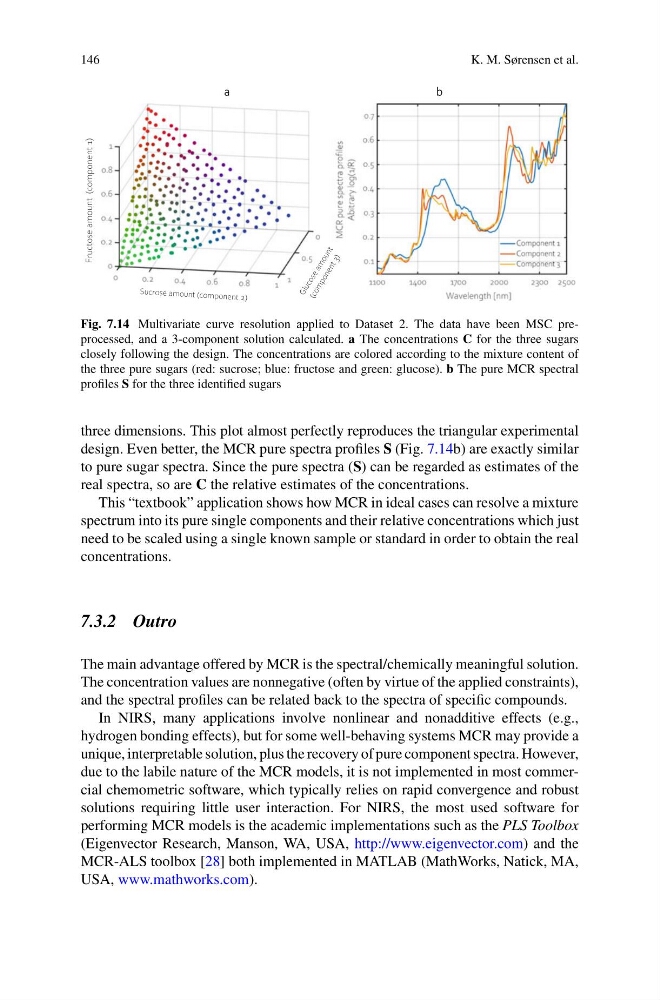
Fig. 7.14 Multivariate curve resolution applied to Dataset 2. The data have been MSC preprocessed, and a 3-component solution calculated. a The concentrations C for the three sugars
closely following the design. The concentrations are colored according to the mixture content of
the three pure sugars (red: sucrose; blue: fructose and green: glucose). b The pure MCR spectral
profiles S for the three identified sugars
three dimensions. This plot almost perfectly reproduces the triangular experimental
design. Even better, the MCR pure spectra profiles S (Fig. 7.14b) are exactly similar
to pure sugar spectra. Since the pure spectra (S) can be regarded as estimates of the
real spectra, so are C the relative estimates of the concentrations.
This “textbook” application shows how MCR in ideal cases can resolve a mixture
spectrum into its pure single components and their relative concentrations which just
need to be scaled using a single known sample or standard in order to obtain the real
concentrations.
7.3.2 Outro
The main advantage offered by MCR is the spectral/chemically meaningful solution.
The concentration values are nonnegative (often by virtue of the applied constraints),
and the spectral profiles can be related back to the spectra of specific compounds.
In NIRS, many applications involve nonlinear and nonadditive effects (e.g.,
hydrogen bonding effects), but for some well-behaving systems MCR may provide a
unique, interpretable solution, plus the recovery of pure component spectra. However,
due to the labile nature of the MCR models, it is not implemented in most commercial chemometric software, which typically relies on rapid convergence and robust
solutions requiring little user interaction. For NIRS, the most used software for
performing MCR models is the academic implementations such as the PLS Toolbox
(Eigenvector Research, Manson, WA, USA, http://www.eigenvector.com) and the
MCR-ALS toolbox [28] both implemented in MATLAB (MathWorks, Natick, MA,
USA, www.mathworks.com).
K. M. Sørensen et al.
Fructose amount (component 1)
Fig. 7.14 Multivariate curve resolution applied to Dataset 2. The data have been MSC preprocessed, and a 3-component solution calculated. a The concentrations C for the three sugars
closely following the design. The concentrations are colored according to the mixture content of
the three pure sugars (red: sucrose; blue: fructose and green: glucose). b The pure MCR spectral
profiles S for the three identified sugars
three dimensions. This plot almost perfectly reproduces the triangular experimental
design. Even better, the MCR pure spectra profiles S (Fig. 7.14b) are exactly similar
to pure sugar spectra. Since the pure spectra (S) can be regarded as estimates of the
real spectra, so are C the relative estimates of the concentrations.
This “textbook” application shows how MCR in ideal cases can resolve a mixture
spectrum into its pure single components and their relative concentrations which just
need to be scaled using a single known sample or standard in order to obtain the real
concentrations.
7.3.2 Outro
The main advantage offered by MCR is the spectral/chemically meaningful solution.
The concentration values are nonnegative (often by virtue of the applied constraints),
and the spectral profiles can be related back to the spectra of specific compounds.
In NIRS, many applications involve nonlinear and nonadditive effects (e.g.,
hydrogen bonding effects), but for some well-behaving systems MCR may provide a
unique, interpretable solution, plus the recovery of pure component spectra. However,
due to the labile nature of the MCR models, it is not implemented in most commercial chemometric software, which typically relies on rapid convergence and robust
solutions requiring little user interaction. For NIRS, the most used software for
performing MCR models is the academic implementations such as the PLS Toolbox
(Eigenvector Research, Manson, WA, USA, http://www.eigenvector.com) and the
MCR-ALS toolbox [28] both implemented in MATLAB (MathWorks, Natick, MA,
USA, www.mathworks.com).