

128
K. M. Sørensen et al.
7.1 Introduction
All models are wrong, but some are useful
—George Edward Pelham Box, British statistician
The revolutionary progression of near-infrared (NIR) spectroscopy has evolved
hand-in-hand with the development of the personal computer, which is essential
for the comprehensive data analysis of NIR spectra. If the PC had not been developed, NIR spectroscopy as a widespread analytical discipline would probably not
exist today. As evident from previous chapters, NIR spectra contain no baselineseparated peaks that can be integrated and quantified, but rather deeply convoluted
and strongly overlapped spectral features. Retrieving information from such signals is
a demanding numerical exercise. This can however be managed well by the computer,
and together the NIR spectrometer and the PC have revolutionized quality control in
practically all areas of primary food and feed production in the form of ultra-rapid,
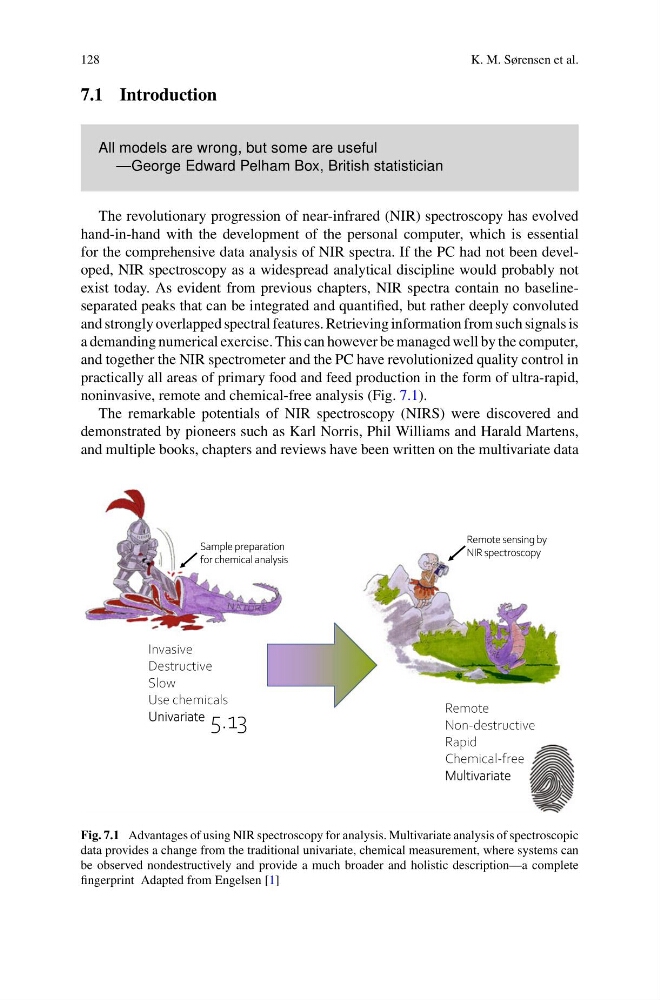
noninvasive, remote and chemical-free analysis (Fig. 7.1).
The remarkable potentials of NIR spectroscopy (NIRS) were discovered and
demonstrated by pioneers such as Karl Norris, Phil Williams and Harald Martens,
and multiple books, chapters and reviews have been written on the multivariate data
Remote sensing by
NIR spectroscopy
Sample preparation
for chemical analysis
Invasive
Destructive
Slow
Use chemicals
Univariate
Remote
Non-destructive
Rapid
Chemical-free
Multivariate
5.13
Fig. 7.1 Advantages of using NIR spectroscopy for analysis. Multivariate analysis of spectroscopic
data provides a change from the traditional univariate, chemical measurement, where systems can
be observed nondestructively and provide a much broader and holistic description—a complete
fingerprint Adapted from Engelsen [1]
K. M. Sørensen et al.
7.1 Introduction
All models are wrong, but some are useful
—George Edward Pelham Box, British statistician
The revolutionary progression of near-infrared (NIR) spectroscopy has evolved
hand-in-hand with the development of the personal computer, which is essential
for the comprehensive data analysis of NIR spectra. If the PC had not been developed, NIR spectroscopy as a widespread analytical discipline would probably not
exist today. As evident from previous chapters, NIR spectra contain no baselineseparated peaks that can be integrated and quantified, but rather deeply convoluted
and strongly overlapped spectral features. Retrieving information from such signals is
a demanding numerical exercise. This can however be managed well by the computer,
and together the NIR spectrometer and the PC have revolutionized quality control in
practically all areas of primary food and feed production in the form of ultra-rapid,
noninvasive, remote and chemical-free analysis (Fig. 7.1).
The remarkable potentials of NIR spectroscopy (NIRS) were discovered and
demonstrated by pioneers such as Karl Norris, Phil Williams and Harald Martens,
and multiple books, chapters and reviews have been written on the multivariate data
Remote sensing by
NIR spectroscopy
Sample preparation
for chemical analysis
Invasive
Destructive
Slow
Use chemicals
Univariate
Remote
Non-destructive
Rapid
Chemical-free
Multivariate
5.13
Fig. 7.1 Advantages of using NIR spectroscopy for analysis. Multivariate analysis of spectroscopic
data provides a change from the traditional univariate, chemical measurement, where systems can
be observed nondestructively and provide a much broader and holistic description—a complete
fingerprint Adapted from Engelsen [1]