

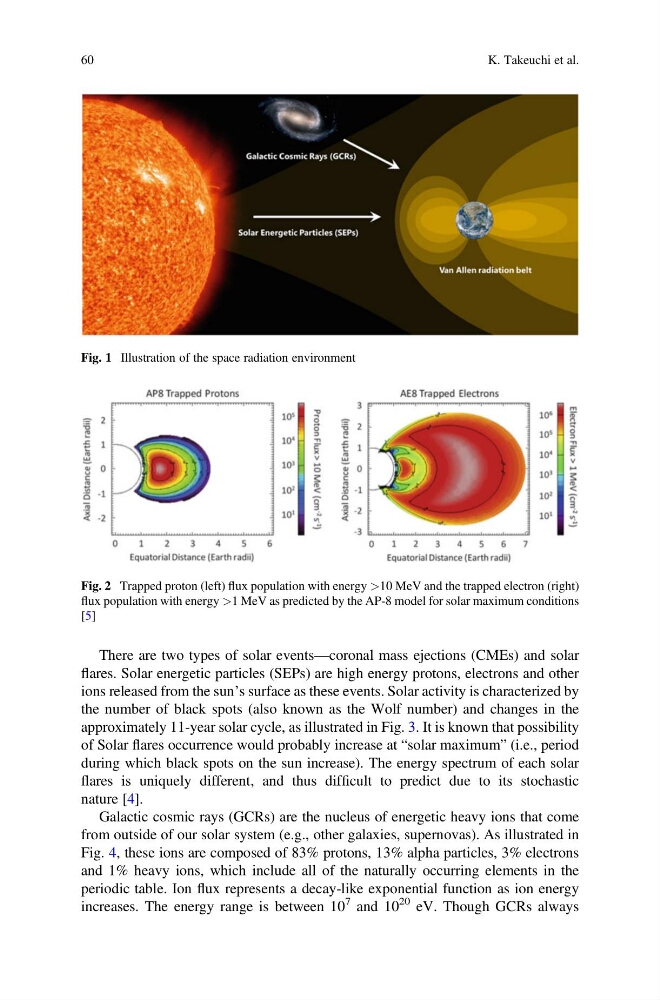
There are two types of solar events—coronal mass ejections (CMEs) and solar
flares. Solar energetic particles (SEPs) are high energy protons, electrons and other
ions released from the sun’s surface as these events. Solar activity is characterized by
the number of black spots (also known as the Wolf number) and changes in the
approximately 11-year solar cycle, as illustrated in Fig. 3. It is known that possibility
of Solar flares occurrence would probably increase at “solar maximum” (i.e., period
during which black spots on the sun increase). The energy spectrum of each solar
flares is uniquely different, and thus difficult to predict due to its stochastic
nature [4].
Galactic cosmic rays (GCRs) are the nucleus of energetic heavy ions that come
from outside of our solar system (e.g., other galaxies, supernovas). As illustrated in
Fig. 4, these ions are composed of 83% protons, 13% alpha particles, 3% electrons
and 1% heavy ions, which include all of the naturally occurring elements in the
periodic table. Ion flux represents a decay-like exponential function as ion energy
increases. The energy range is between 10
7 and 10
20 eV. Though GCRs always
Fig. 1 Illustration of the space radiation environment
Fig. 2 Trapped proton (left) flux population with energy >10 MeV and the trapped electron (right)
flux population with energy >1 MeV as predicted by the AP-8 model for solar maximum conditions
[5]
60
K. Takeuchi et al.
flares. Solar energetic particles (SEPs) are high energy protons, electrons and other
ions released from the sun’s surface as these events. Solar activity is characterized by
the number of black spots (also known as the Wolf number) and changes in the
approximately 11-year solar cycle, as illustrated in Fig. 3. It is known that possibility
of Solar flares occurrence would probably increase at “solar maximum” (i.e., period
during which black spots on the sun increase). The energy spectrum of each solar
flares is uniquely different, and thus difficult to predict due to its stochastic
nature [4].
Galactic cosmic rays (GCRs) are the nucleus of energetic heavy ions that come
from outside of our solar system (e.g., other galaxies, supernovas). As illustrated in
Fig. 4, these ions are composed of 83% protons, 13% alpha particles, 3% electrons
and 1% heavy ions, which include all of the naturally occurring elements in the
periodic table. Ion flux represents a decay-like exponential function as ion energy
increases. The energy range is between 10
7 and 10
20 eV. Though GCRs always
Fig. 1 Illustration of the space radiation environment
Fig. 2 Trapped proton (left) flux population with energy >10 MeV and the trapped electron (right)
flux population with energy >1 MeV as predicted by the AP-8 model for solar maximum conditions
[5]
60
K. Takeuchi et al.