

is generated. As result of this heating, Cu filaments are oxidized to form Cu
z+ ions
with thermally assistance, and Cu
z+ ions diffuse into the matrix of Ta 2 O 5 to cuts the
bridge of the Cu filament, which is called RESET operation. Finally, the Cu
z+ ions
move to the negatively charged Cu electrode and precipitate as Cu atoms on the
electrode by the reduction reaction to keep Cu
+ ion concentration in Ta 2 O 5 , thereby
stabilizing the OFF state. Since the behavior of these atomic switches is governed by
ion migration and the solid electrochemical reaction, the voltage required for the
SET and RESET operations depends on the required energy for ionic conductivity of
the metal ion of the matrix layer, formation of the filament and so on.
3.2 Quantized Conductance
The gapless-type atomic switches also show quantized conductance by controlling
the point contact between metal filaments and electrodes, as well as the gap-type
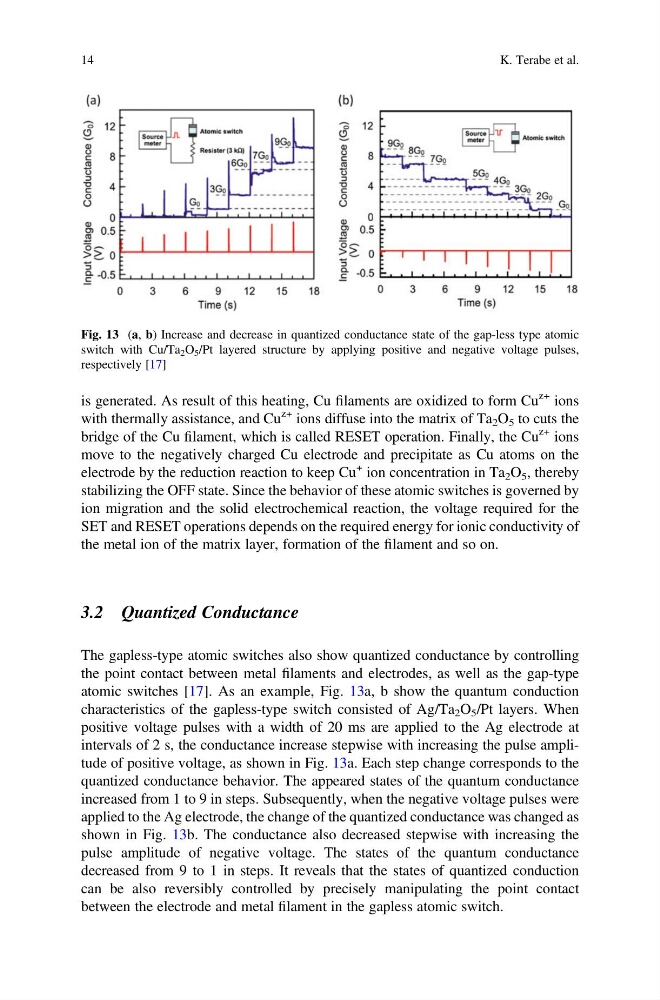
atomic switches [17]. As an example, Fig. 13a, b show the quantum conduction
characteristics of the gapless-type switch consisted of Ag/Ta 2 O 5 /Pt layers. When
positive voltage pulses with a width of 20 ms are applied to the Ag electrode at
intervals of 2 s, the conductance increase stepwise with increasing the pulse amplitude of positive voltage, as shown in Fig. 13a. Each step change corresponds to the
quantized conductance behavior. The appeared states of the quantum conductance
increased from 1 to 9 in steps. Subsequently, when the negative voltage pulses were
applied to the Ag electrode, the change of the quantized conductance was changed as
shown in Fig. 13b. The conductance also decreased stepwise with increasing the
pulse amplitude of negative voltage. The states of the quantum conductance
decreased from 9 to 1 in steps. It reveals that the states of quantized conduction
can be also reversibly controlled by precisely manipulating the point contact
between the electrode and metal filament in the gapless atomic switch.
Fig. 13 (a, b) Increase and decrease in quantized conductance state of the gap-less type atomic
switch with Cu/Ta 2 O 5 /Pt layered structure by applying positive and negative voltage pulses,
respectively [17]
14
K. Terabe et al.
z+ ions
with thermally assistance, and Cu
z+ ions diffuse into the matrix of Ta 2 O 5 to cuts the
bridge of the Cu filament, which is called RESET operation. Finally, the Cu
z+ ions
move to the negatively charged Cu electrode and precipitate as Cu atoms on the
electrode by the reduction reaction to keep Cu
+ ion concentration in Ta 2 O 5 , thereby
stabilizing the OFF state. Since the behavior of these atomic switches is governed by
ion migration and the solid electrochemical reaction, the voltage required for the
SET and RESET operations depends on the required energy for ionic conductivity of
the metal ion of the matrix layer, formation of the filament and so on.
3.2 Quantized Conductance
The gapless-type atomic switches also show quantized conductance by controlling
the point contact between metal filaments and electrodes, as well as the gap-type
atomic switches [17]. As an example, Fig. 13a, b show the quantum conduction
characteristics of the gapless-type switch consisted of Ag/Ta 2 O 5 /Pt layers. When
positive voltage pulses with a width of 20 ms are applied to the Ag electrode at
intervals of 2 s, the conductance increase stepwise with increasing the pulse amplitude of positive voltage, as shown in Fig. 13a. Each step change corresponds to the
quantized conductance behavior. The appeared states of the quantum conductance
increased from 1 to 9 in steps. Subsequently, when the negative voltage pulses were
applied to the Ag electrode, the change of the quantized conductance was changed as
shown in Fig. 13b. The conductance also decreased stepwise with increasing the
pulse amplitude of negative voltage. The states of the quantum conductance
decreased from 9 to 1 in steps. It reveals that the states of quantized conduction
can be also reversibly controlled by precisely manipulating the point contact
between the electrode and metal filament in the gapless atomic switch.
Fig. 13 (a, b) Increase and decrease in quantized conductance state of the gap-less type atomic
switch with Cu/Ta 2 O 5 /Pt layered structure by applying positive and negative voltage pulses,
respectively [17]
14
K. Terabe et al.