

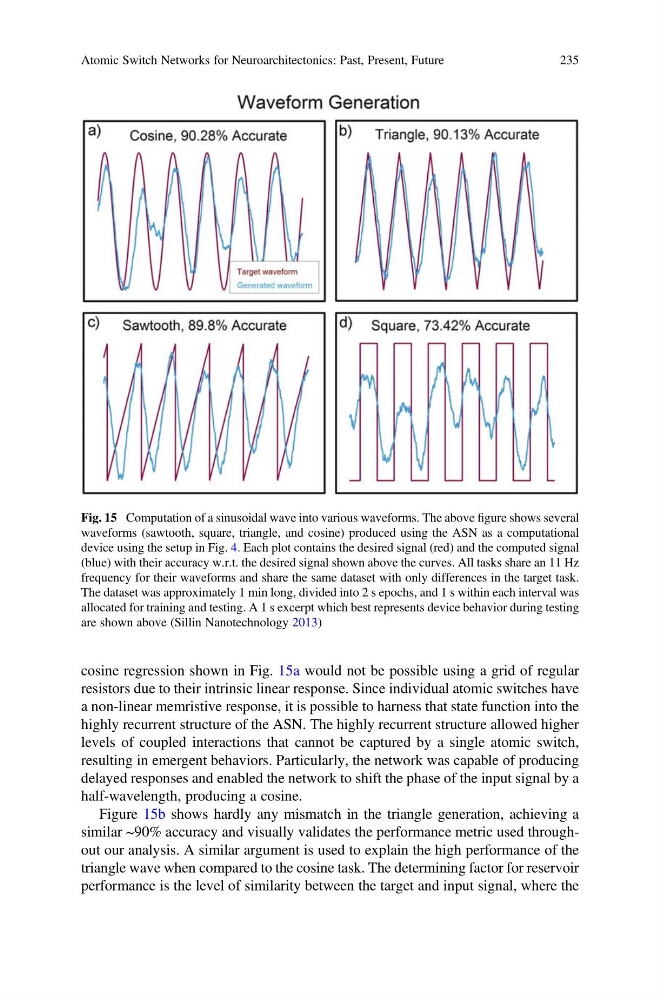
cosine regression shown in Fig. 15a would not be possible using a grid of regular
resistors due to their intrinsic linear response. Since individual atomic switches have
a non-linear memristive response, it is possible to harness that state function into the
highly recurrent structure of the ASN. The highly recurrent structure allowed higher
levels of coupled interactions that cannot be captured by a single atomic switch,
resulting in emergent behaviors. Particularly, the network was capable of producing
delayed responses and enabled the network to shift the phase of the input signal by a
half-wavelength, producing a cosine.
Figure 15b shows hardly any mismatch in the triangle generation, achieving a
similar ~90% accuracy and visually validates the performance metric used throughout our analysis. A similar argument is used to explain the high performance of the
triangle wave when compared to the cosine task. The determining factor for reservoir
performance is the level of similarity between the target and input signal, where the
Fig. 15 Computation of a sinusoidal wave into various waveforms. The above figure shows several
waveforms (sawtooth, square, triangle, and cosine) produced using the ASN as a computational
device using the setup in Fig. 4. Each plot contains the desired signal (red) and the computed signal
(blue) with their accuracy w.r.t. the desired signal shown above the curves. All tasks share an 11 Hz
frequency for their waveforms and share the same dataset with only differences in the target task.
The dataset was approximately 1 min long, divided into 2 s epochs, and 1 s within each interval was
allocated for training and testing. A 1 s excerpt which best represents device behavior during testing
are shown above (Sillin Nanotechnology 2013)
Atomic Switch Networks for Neuroarchitectonics: Past, Present, Future
235
resistors due to their intrinsic linear response. Since individual atomic switches have
a non-linear memristive response, it is possible to harness that state function into the
highly recurrent structure of the ASN. The highly recurrent structure allowed higher
levels of coupled interactions that cannot be captured by a single atomic switch,
resulting in emergent behaviors. Particularly, the network was capable of producing
delayed responses and enabled the network to shift the phase of the input signal by a
half-wavelength, producing a cosine.
Figure 15b shows hardly any mismatch in the triangle generation, achieving a
similar ~90% accuracy and visually validates the performance metric used throughout our analysis. A similar argument is used to explain the high performance of the
triangle wave when compared to the cosine task. The determining factor for reservoir
performance is the level of similarity between the target and input signal, where the
Fig. 15 Computation of a sinusoidal wave into various waveforms. The above figure shows several
waveforms (sawtooth, square, triangle, and cosine) produced using the ASN as a computational
device using the setup in Fig. 4. Each plot contains the desired signal (red) and the computed signal
(blue) with their accuracy w.r.t. the desired signal shown above the curves. All tasks share an 11 Hz
frequency for their waveforms and share the same dataset with only differences in the target task.
The dataset was approximately 1 min long, divided into 2 s epochs, and 1 s within each interval was
allocated for training and testing. A 1 s excerpt which best represents device behavior during testing
are shown above (Sillin Nanotechnology 2013)
Atomic Switch Networks for Neuroarchitectonics: Past, Present, Future
235