

found in the brain act as compartmentalized networks ascribed to specific brain
functions, but are capable of growing through heuristic learning. Computing and
cognitive capabilities developed through an evolutionary scheme selectively prune
weakly correlated neurons and enforce strongly correlated neurons as described in
Hebbian learning [13]. These features drastically increase the power of the human
brain to complete complicated tasks too computationally expensive for current
CMOS technology.
Mead drew upon the natural computing capability of neuron networks to develop
the concept of neuromorphic hardware in the mid 1980s. Neuromorphic engineers
attempt to emulate neuron functionalities and brain architectures to be capable of
performing similar multisensory complex tasks such as associative-dissociative
memorization of unstructured data, pattern recognition, and chaotic series prediction, to name a few. Initial attempts to harness brain dynamics for computation relied
upon contemporary CMOS technology to construct purpose-built field programmable gate arrays (FPGAs), and supercomputer assisted software within the field of
machine learning. Artificial neural networks first developed as the perceptron [14] by
Frank Rosenblatt adopted the same connectionist theory as biological neurons.
Implemented using camera photocells while contemporary variations are realized
in software, the perceptron consisted of a collection of nodes representing neurons
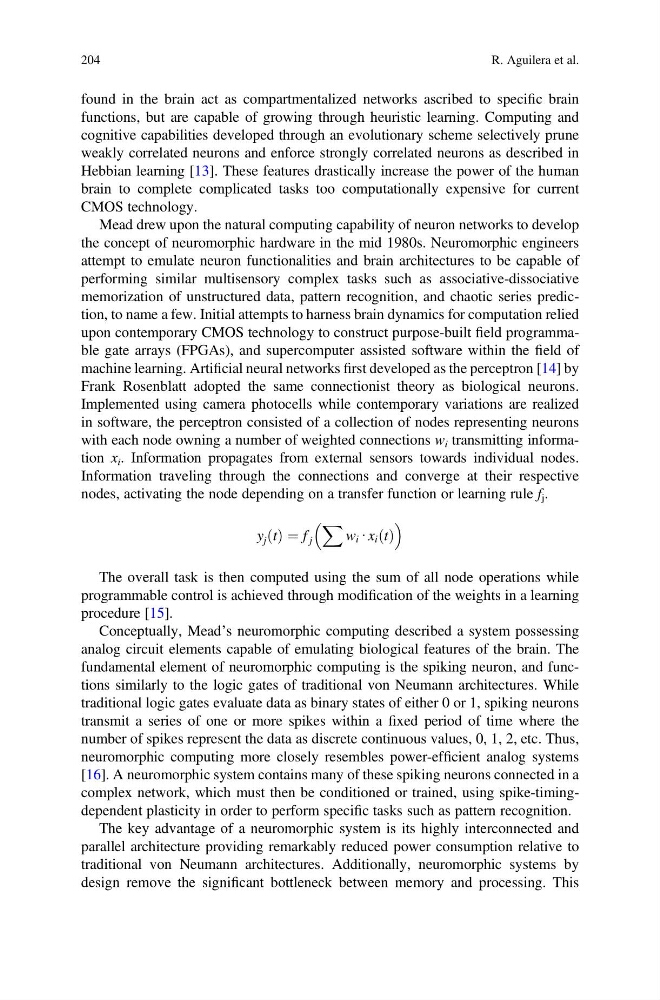
with each node owning a number of weighted connections w i transmitting information x i . Information propagates from external sensors towards individual nodes.
Information traveling through the connections and converge at their respective
nodes, activating the node depending on a transfer function or learning rule f j .
y j t
ð Þ ¼ f j
X w i ∙ x i t
ð Þ
The overall task is then computed using the sum of all node operations while
programmable control is achieved through modification of the weights in a learning
procedure [15].
Conceptually, Mead’s neuromorphic computing described a system possessing
analog circuit elements capable of emulating biological features of the brain. The
fundamental element of neuromorphic computing is the spiking neuron, and functions similarly to the logic gates of traditional von Neumann architectures. While
traditional logic gates evaluate data as binary states of either 0 or 1, spiking neurons
transmit a series of one or more spikes within a fixed period of time where the
number of spikes represent the data as discrete continuous values, 0, 1, 2, etc. Thus,
neuromorphic computing more closely resembles power-efficient analog systems
[16]. A neuromorphic system contains many of these spiking neurons connected in a
complex network, which must then be conditioned or trained, using spike-timingdependent plasticity in order to perform specific tasks such as pattern recognition.
The key advantage of a neuromorphic system is its highly interconnected and
parallel architecture providing remarkably reduced power consumption relative to
traditional von Neumann architectures. Additionally, neuromorphic systems by
design remove the significant bottleneck between memory and processing. This
204
R. Aguilera et al.
functions, but are capable of growing through heuristic learning. Computing and
cognitive capabilities developed through an evolutionary scheme selectively prune
weakly correlated neurons and enforce strongly correlated neurons as described in
Hebbian learning [13]. These features drastically increase the power of the human
brain to complete complicated tasks too computationally expensive for current
CMOS technology.
Mead drew upon the natural computing capability of neuron networks to develop
the concept of neuromorphic hardware in the mid 1980s. Neuromorphic engineers
attempt to emulate neuron functionalities and brain architectures to be capable of
performing similar multisensory complex tasks such as associative-dissociative
memorization of unstructured data, pattern recognition, and chaotic series prediction, to name a few. Initial attempts to harness brain dynamics for computation relied
upon contemporary CMOS technology to construct purpose-built field programmable gate arrays (FPGAs), and supercomputer assisted software within the field of
machine learning. Artificial neural networks first developed as the perceptron [14] by
Frank Rosenblatt adopted the same connectionist theory as biological neurons.
Implemented using camera photocells while contemporary variations are realized
in software, the perceptron consisted of a collection of nodes representing neurons
with each node owning a number of weighted connections w i transmitting information x i . Information propagates from external sensors towards individual nodes.
Information traveling through the connections and converge at their respective
nodes, activating the node depending on a transfer function or learning rule f j .
y j t
ð Þ ¼ f j
X w i ∙ x i t
ð Þ
The overall task is then computed using the sum of all node operations while
programmable control is achieved through modification of the weights in a learning
procedure [15].
Conceptually, Mead’s neuromorphic computing described a system possessing
analog circuit elements capable of emulating biological features of the brain. The
fundamental element of neuromorphic computing is the spiking neuron, and functions similarly to the logic gates of traditional von Neumann architectures. While
traditional logic gates evaluate data as binary states of either 0 or 1, spiking neurons
transmit a series of one or more spikes within a fixed period of time where the
number of spikes represent the data as discrete continuous values, 0, 1, 2, etc. Thus,
neuromorphic computing more closely resembles power-efficient analog systems
[16]. A neuromorphic system contains many of these spiking neurons connected in a
complex network, which must then be conditioned or trained, using spike-timingdependent plasticity in order to perform specific tasks such as pattern recognition.
The key advantage of a neuromorphic system is its highly interconnected and
parallel architecture providing remarkably reduced power consumption relative to
traditional von Neumann architectures. Additionally, neuromorphic systems by
design remove the significant bottleneck between memory and processing. This
204
R. Aguilera et al.