

Based on the above results, we demonstrated an on-demand nanodevice with
configurable electrical and neuromorphic functions in a Pt/WO 3 – x /Pt device, as
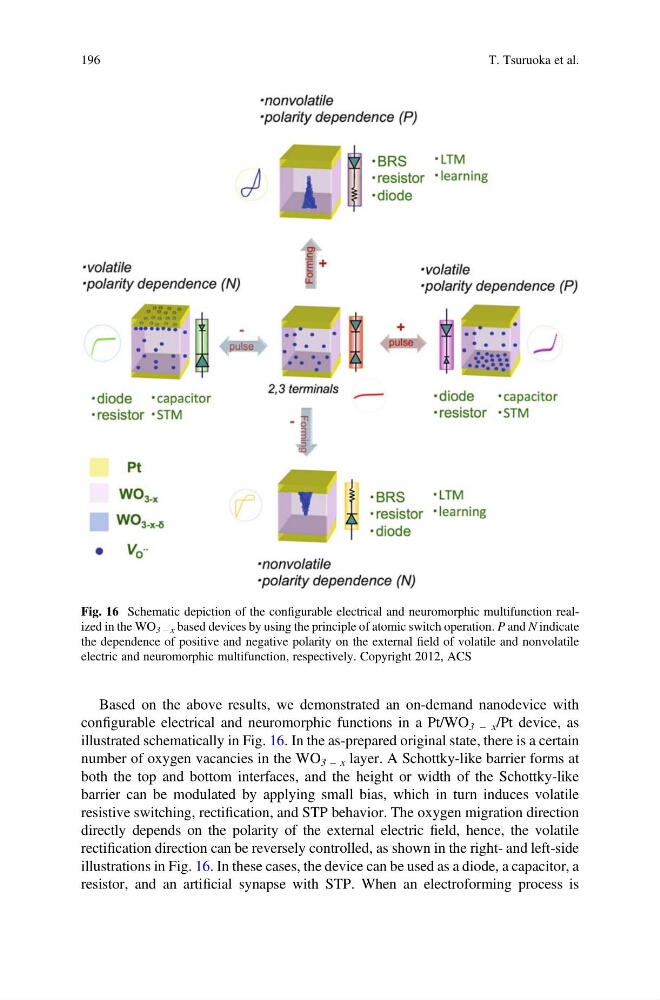
illustrated schematically in Fig. 16. In the as-prepared original state, there is a certain
number of oxygen vacancies in the WO 3 – x layer. A Schottky-like barrier forms at
both the top and bottom interfaces, and the height or width of the Schottky-like
barrier can be modulated by applying small bias, which in turn induces volatile
resistive switching, rectification, and STP behavior. The oxygen migration direction
directly depends on the polarity of the external electric field, hence, the volatile
rectification direction can be reversely controlled, as shown in the right- and left-side
illustrations in Fig. 16. In these cases, the device can be used as a diode, a capacitor, a
resistor, and an artificial synapse with STP. When an electroforming process is
Fig. 16 Schematic depiction of the configurable electrical and neuromorphic multifunction realized in the WO 3 – x based devices by using the principle of atomic switch operation. P and N indicate
the dependence of positive and negative polarity on the external field of volatile and nonvolatile
electric and neuromorphic multifunction, respectively. Copyright 2012, ACS
196
T. Tsuruoka et al.
configurable electrical and neuromorphic functions in a Pt/WO 3 – x /Pt device, as
illustrated schematically in Fig. 16. In the as-prepared original state, there is a certain
number of oxygen vacancies in the WO 3 – x layer. A Schottky-like barrier forms at
both the top and bottom interfaces, and the height or width of the Schottky-like
barrier can be modulated by applying small bias, which in turn induces volatile
resistive switching, rectification, and STP behavior. The oxygen migration direction
directly depends on the polarity of the external electric field, hence, the volatile
rectification direction can be reversely controlled, as shown in the right- and left-side
illustrations in Fig. 16. In these cases, the device can be used as a diode, a capacitor, a
resistor, and an artificial synapse with STP. When an electroforming process is
Fig. 16 Schematic depiction of the configurable electrical and neuromorphic multifunction realized in the WO 3 – x based devices by using the principle of atomic switch operation. P and N indicate
the dependence of positive and negative polarity on the external field of volatile and nonvolatile
electric and neuromorphic multifunction, respectively. Copyright 2012, ACS
196
T. Tsuruoka et al.