

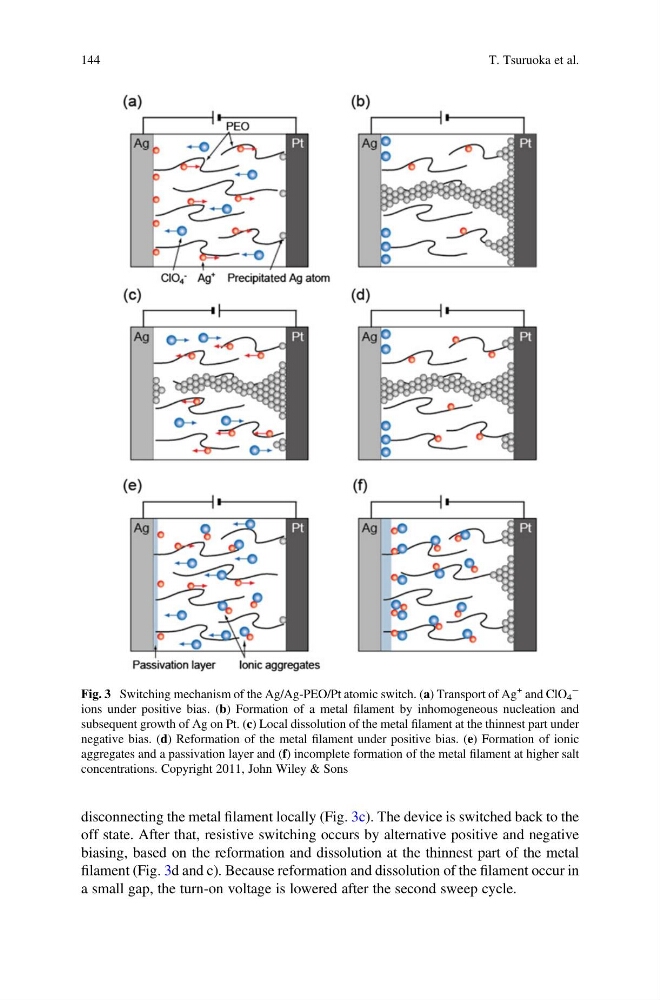
disconnecting the metal filament locally (Fig. 3c). The device is switched back to the
off state. After that, resistive switching occurs by alternative positive and negative
biasing, based on the reformation and dissolution at the thinnest part of the metal
filament (Fig. 3d and c). Because reformation and dissolution of the filament occur in
a small gap, the turn-on voltage is lowered after the second sweep cycle.
Fig. 3 Switching mechanism of the Ag/Ag-PEO/Pt atomic switch. (a) Transport of Ag
+ and ClO 4
À
ions under positive bias. (b) Formation of a metal filament by inhomogeneous nucleation and
subsequent growth of Ag on Pt. (c) Local dissolution of the metal filament at the thinnest part under
negative bias. (d) Reformation of the metal filament under positive bias. (e) Formation of ionic
aggregates and a passivation layer and (f) incomplete formation of the metal filament at higher salt
concentrations. Copyright 2011, John Wiley & Sons
144
T. Tsuruoka et al.
off state. After that, resistive switching occurs by alternative positive and negative
biasing, based on the reformation and dissolution at the thinnest part of the metal
filament (Fig. 3d and c). Because reformation and dissolution of the filament occur in
a small gap, the turn-on voltage is lowered after the second sweep cycle.
Fig. 3 Switching mechanism of the Ag/Ag-PEO/Pt atomic switch. (a) Transport of Ag
+ and ClO 4
À
ions under positive bias. (b) Formation of a metal filament by inhomogeneous nucleation and
subsequent growth of Ag on Pt. (c) Local dissolution of the metal filament at the thinnest part under
negative bias. (d) Reformation of the metal filament under positive bias. (e) Formation of ionic
aggregates and a passivation layer and (f) incomplete formation of the metal filament at higher salt
concentrations. Copyright 2011, John Wiley & Sons
144
T. Tsuruoka et al.