

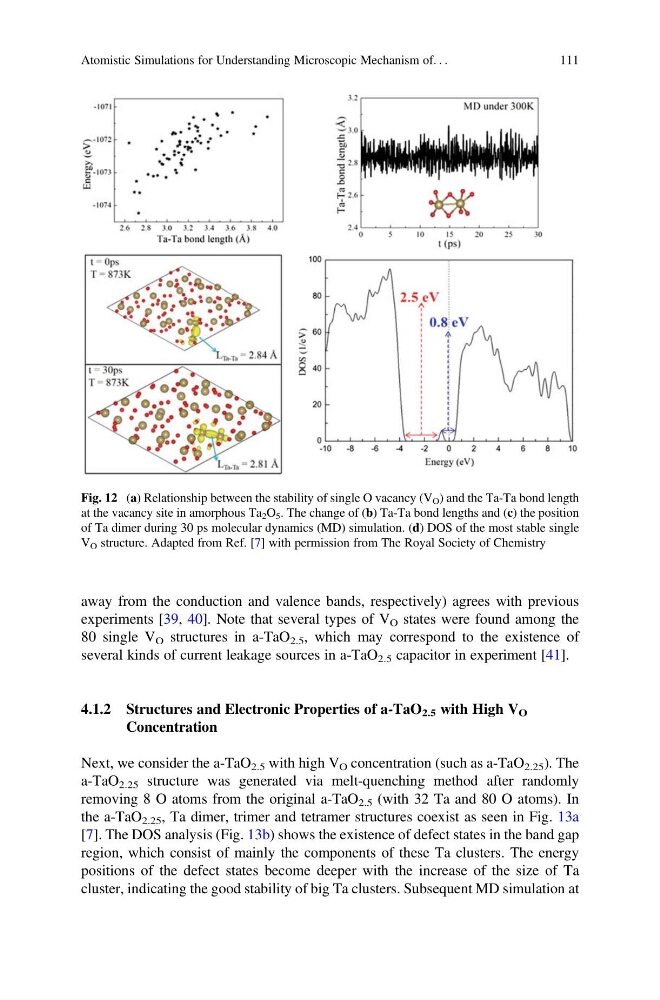
away from the conduction and valence bands, respectively) agrees with previous
experiments [39, 40]. Note that several types of V O states were found among the
80 single V O structures in a-TaO 2.5 , which may correspond to the existence of
several kinds of current leakage sources in a-TaO 2.5 capacitor in experiment [41].
4.1.2 Structures and Electronic Properties of a-TaO 2.5 with High V O
Concentration
Next, we consider the a-TaO 2.5 with high V O concentration (such as a-TaO 2.25 ). The
a-TaO 2.25 structure was generated via melt-quenching method after randomly
removing 8 O atoms from the original a-TaO 2.5 (with 32 Ta and 80 O atoms). In
the a-TaO 2.25 , Ta dimer, trimer and tetramer structures coexist as seen in Fig. 13a
[7]. The DOS analysis (Fig. 13b) shows the existence of defect states in the band gap
region, which consist of mainly the components of these Ta clusters. The energy
positions of the defect states become deeper with the increase of the size of Ta
cluster, indicating the good stability of big Ta clusters. Subsequent MD simulation at
Fig. 12 (a) Relationship between the stability of single O vacancy (V O ) and the Ta-Ta bond length
at the vacancy site in amorphous Ta 2 O 5 . The change of (b) Ta-Ta bond lengths and (c) the position
of Ta dimer during 30 ps molecular dynamics (MD) simulation. (d) DOS of the most stable single
V O structure. Adapted from Ref. [7] with permission from The Royal Society of Chemistry
Atomistic Simulations for Understanding Microscopic Mechanism of. . .
111
experiments [39, 40]. Note that several types of V O states were found among the
80 single V O structures in a-TaO 2.5 , which may correspond to the existence of
several kinds of current leakage sources in a-TaO 2.5 capacitor in experiment [41].
4.1.2 Structures and Electronic Properties of a-TaO 2.5 with High V O
Concentration
Next, we consider the a-TaO 2.5 with high V O concentration (such as a-TaO 2.25 ). The
a-TaO 2.25 structure was generated via melt-quenching method after randomly
removing 8 O atoms from the original a-TaO 2.5 (with 32 Ta and 80 O atoms). In
the a-TaO 2.25 , Ta dimer, trimer and tetramer structures coexist as seen in Fig. 13a
[7]. The DOS analysis (Fig. 13b) shows the existence of defect states in the band gap
region, which consist of mainly the components of these Ta clusters. The energy
positions of the defect states become deeper with the increase of the size of Ta
cluster, indicating the good stability of big Ta clusters. Subsequent MD simulation at
Fig. 12 (a) Relationship between the stability of single O vacancy (V O ) and the Ta-Ta bond length
at the vacancy site in amorphous Ta 2 O 5 . The change of (b) Ta-Ta bond lengths and (c) the position
of Ta dimer during 30 ps molecular dynamics (MD) simulation. (d) DOS of the most stable single
V O structure. Adapted from Ref. [7] with permission from The Royal Society of Chemistry
Atomistic Simulations for Understanding Microscopic Mechanism of. . .
111