

subsequently quenched down to room temperature (300 K) with the rate of 4 K/3 ps.
After that, the as-generated amorphous structure was further equilibrated at room
temperature for 9 ps.
The amorphous model generated in this way has the following structural features
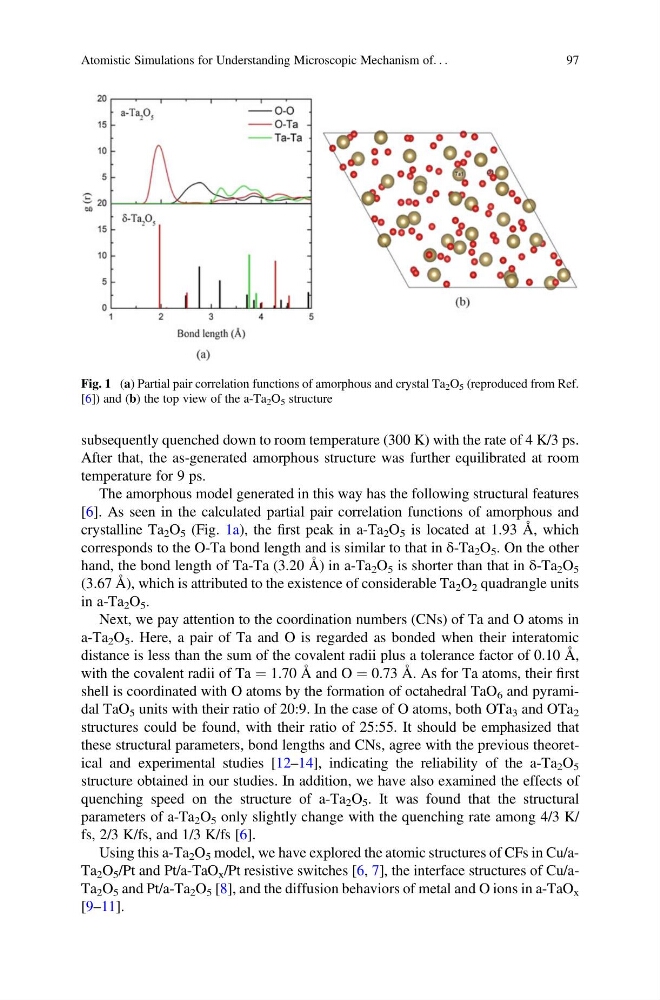
[6]. As seen in the calculated partial pair correlation functions of amorphous and
crystalline Ta 2 O 5 (Fig. 1a), the first peak in a-Ta 2 O 5 is located at 1.93 Å, which
corresponds to the O-Ta bond length and is similar to that in δ-Ta 2 O 5 . On the other
hand, the bond length of Ta-Ta (3.20 Å) in a-Ta 2 O 5 is shorter than that in δ-Ta 2 O 5
(3.67 Å), which is attributed to the existence of considerable Ta 2 O 2 quadrangle units
in a-Ta 2 O 5 .
Next, we pay attention to the coordination numbers (CNs) of Ta and O atoms in
a-Ta 2 O 5 . Here, a pair of Ta and O is regarded as bonded when their interatomic
distance is less than the sum of the covalent radii plus a tolerance factor of 0.10 Å,
with the covalent radii of Ta ¼ 1.70 Å and O ¼ 0.73 Å. As for Ta atoms, their first
shell is coordinated with O atoms by the formation of octahedral TaO 6 and pyramidal TaO 5 units with their ratio of 20:9. In the case of O atoms, both OTa 3 and OTa 2
structures could be found, with their ratio of 25:55. It should be emphasized that
these structural parameters, bond lengths and CNs, agree with the previous theoretical and experimental studies [12–14], indicating the reliability of the a-Ta 2 O 5
structure obtained in our studies. In addition, we have also examined the effects of
quenching speed on the structure of a-Ta 2 O 5 . It was found that the structural
parameters of a-Ta 2 O 5 only slightly change with the quenching rate among 4/3 K/
fs, 2/3 K/fs, and 1/3 K/fs [6].
Using this a-Ta 2 O 5 model, we have explored the atomic structures of CFs in Cu/aTa 2 O 5 /Pt and Pt/a-TaO x /Pt resistive switches [6, 7], the interface structures of Cu/aTa 2 O 5 and Pt/a-Ta 2 O 5 [8], and the diffusion behaviors of metal and O ions in a-TaO x
[9–11].
Fig. 1 (a) Partial pair correlation functions of amorphous and crystal Ta 2 O 5 (reproduced from Ref.
[6]) and (b) the top view of the a-Ta 2 O 5 structure
Atomistic Simulations for Understanding Microscopic Mechanism of. . .
97
After that, the as-generated amorphous structure was further equilibrated at room
temperature for 9 ps.
The amorphous model generated in this way has the following structural features
[6]. As seen in the calculated partial pair correlation functions of amorphous and
crystalline Ta 2 O 5 (Fig. 1a), the first peak in a-Ta 2 O 5 is located at 1.93 Å, which
corresponds to the O-Ta bond length and is similar to that in δ-Ta 2 O 5 . On the other
hand, the bond length of Ta-Ta (3.20 Å) in a-Ta 2 O 5 is shorter than that in δ-Ta 2 O 5
(3.67 Å), which is attributed to the existence of considerable Ta 2 O 2 quadrangle units
in a-Ta 2 O 5 .
Next, we pay attention to the coordination numbers (CNs) of Ta and O atoms in
a-Ta 2 O 5 . Here, a pair of Ta and O is regarded as bonded when their interatomic
distance is less than the sum of the covalent radii plus a tolerance factor of 0.10 Å,
with the covalent radii of Ta ¼ 1.70 Å and O ¼ 0.73 Å. As for Ta atoms, their first
shell is coordinated with O atoms by the formation of octahedral TaO 6 and pyramidal TaO 5 units with their ratio of 20:9. In the case of O atoms, both OTa 3 and OTa 2
structures could be found, with their ratio of 25:55. It should be emphasized that
these structural parameters, bond lengths and CNs, agree with the previous theoretical and experimental studies [12–14], indicating the reliability of the a-Ta 2 O 5
structure obtained in our studies. In addition, we have also examined the effects of
quenching speed on the structure of a-Ta 2 O 5 . It was found that the structural
parameters of a-Ta 2 O 5 only slightly change with the quenching rate among 4/3 K/
fs, 2/3 K/fs, and 1/3 K/fs [6].
Using this a-Ta 2 O 5 model, we have explored the atomic structures of CFs in Cu/aTa 2 O 5 /Pt and Pt/a-TaO x /Pt resistive switches [6, 7], the interface structures of Cu/aTa 2 O 5 and Pt/a-Ta 2 O 5 [8], and the diffusion behaviors of metal and O ions in a-TaO x
[9–11].
Fig. 1 (a) Partial pair correlation functions of amorphous and crystal Ta 2 O 5 (reproduced from Ref.
[6]) and (b) the top view of the a-Ta 2 O 5 structure
Atomistic Simulations for Understanding Microscopic Mechanism of. . .
97