

Ordering Transitions in Short-Chain Alcohols
91
nucleation, tiny seeds of crystals are formed that will continue to grow by advancing
the liquid/crystal interface across the remaining liquid medium. Molecular mobility
of the mother phase, surface tension of the liquid/crystal interface, intermolecular
attractions, purity of the sample and its interactions with the environment, are known
to govern the crystallization tendency of supercooled liquids [5–8]. Crystallization is
therefore a complex phenomenon, in which, apart from the thermodynamic driving
force, several factors are simultaneously involved.
Along with the thermodynamic barrier to nucleation and crystal growth, it is
well established that the molecular mobility plays a critical role in the crystalline
development, although the exact nature of this interrelationship is still a matter of
debate [9]. Most of the examples discussed in the present chapter relate to ordering
transitions near the glass transition temperature, T g , where the transport of molecules
across the liquid/crystal interface for creating new crystalline layers is the limiting
factor. Since it is directly related to the molecular dynamics, crystal growth is very
dependent on temperature. One of the theoretical frameworks that, with some degree
of approximation, have successfully explained the liquid-to-crystal transition is the
classical nucleation theory (CNT) [10–13]. A detailed description of the theory is
beyond the scope of the present chapter, but it may be useful to point out that the
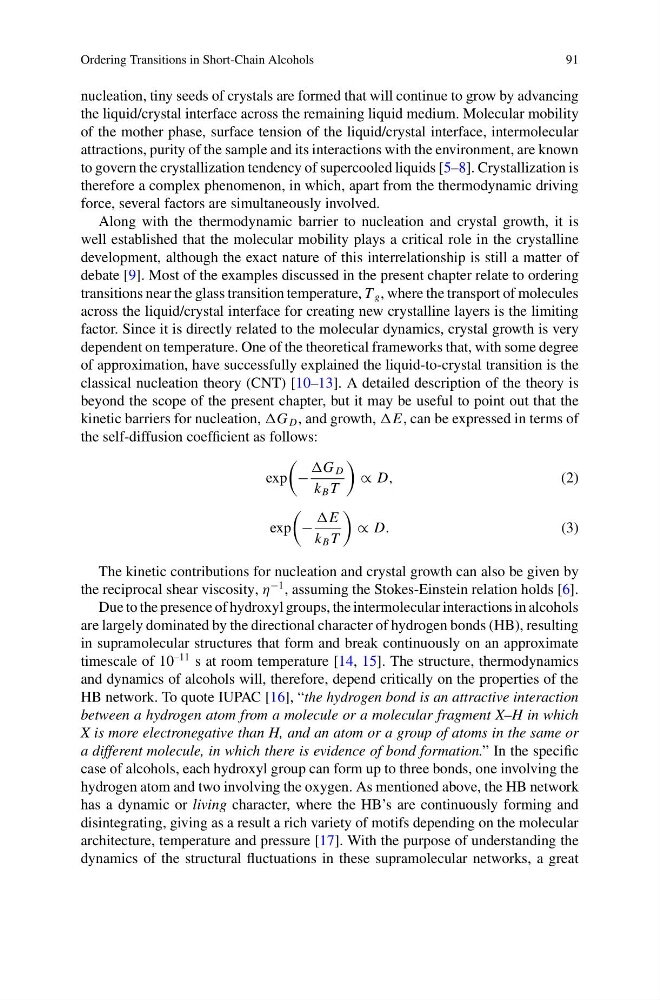
kinetic barriers for nucleation, G D , and growth, E, can be expressed in terms of
the self-diffusion coefficient as follows:
exp
−
G D
k B T
∝ D,
(2)
exp
−
E
k B T
∝ D.
(3)
The kinetic contributions for nucleation and crystal growth can also be given by
the reciprocal shear viscosity, η
−1 , assuming the Stokes-Einstein relation holds [6].
Due to the presence of hydroxyl groups, the intermolecular interactions in alcohols
are largely dominated by the directional character of hydrogen bonds (HB), resulting
in supramolecular structures that form and break continuously on an approximate
timescale of 10
–11 s at room temperature [14, 15]. The structure, thermodynamics
and dynamics of alcohols will, therefore, depend critically on the properties of the
HB network. To quote IUPAC [16], “the hydrogen bond is an attractive interaction
between a hydrogen atom from a molecule or a molecular fragment X–H in which
X is more electronegative than H, and an atom or a group of atoms in the same or
a different molecule, in which there is evidence of bond formation.” In the specific
case of alcohols, each hydroxyl group can form up to three bonds, one involving the
hydrogen atom and two involving the oxygen. As mentioned above, the HB network
has a dynamic or living character, where the HB’s are continuously forming and
disintegrating, giving as a result a rich variety of motifs depending on the molecular
architecture, temperature and pressure [17]. With the purpose of understanding the
dynamics of the structural fluctuations in these supramolecular networks, a great
91
nucleation, tiny seeds of crystals are formed that will continue to grow by advancing
the liquid/crystal interface across the remaining liquid medium. Molecular mobility
of the mother phase, surface tension of the liquid/crystal interface, intermolecular
attractions, purity of the sample and its interactions with the environment, are known
to govern the crystallization tendency of supercooled liquids [5–8]. Crystallization is
therefore a complex phenomenon, in which, apart from the thermodynamic driving
force, several factors are simultaneously involved.
Along with the thermodynamic barrier to nucleation and crystal growth, it is
well established that the molecular mobility plays a critical role in the crystalline
development, although the exact nature of this interrelationship is still a matter of
debate [9]. Most of the examples discussed in the present chapter relate to ordering
transitions near the glass transition temperature, T g , where the transport of molecules
across the liquid/crystal interface for creating new crystalline layers is the limiting
factor. Since it is directly related to the molecular dynamics, crystal growth is very
dependent on temperature. One of the theoretical frameworks that, with some degree
of approximation, have successfully explained the liquid-to-crystal transition is the
classical nucleation theory (CNT) [10–13]. A detailed description of the theory is
beyond the scope of the present chapter, but it may be useful to point out that the
kinetic barriers for nucleation, G D , and growth, E, can be expressed in terms of
the self-diffusion coefficient as follows:
exp
−
G D
k B T
∝ D,
(2)
exp
−
E
k B T
∝ D.
(3)
The kinetic contributions for nucleation and crystal growth can also be given by
the reciprocal shear viscosity, η
−1 , assuming the Stokes-Einstein relation holds [6].
Due to the presence of hydroxyl groups, the intermolecular interactions in alcohols
are largely dominated by the directional character of hydrogen bonds (HB), resulting
in supramolecular structures that form and break continuously on an approximate
timescale of 10
–11 s at room temperature [14, 15]. The structure, thermodynamics
and dynamics of alcohols will, therefore, depend critically on the properties of the
HB network. To quote IUPAC [16], “the hydrogen bond is an attractive interaction
between a hydrogen atom from a molecule or a molecular fragment X–H in which
X is more electronegative than H, and an atom or a group of atoms in the same or
a different molecule, in which there is evidence of bond formation.” In the specific
case of alcohols, each hydroxyl group can form up to three bonds, one involving the
hydrogen atom and two involving the oxygen. As mentioned above, the HB network
has a dynamic or living character, where the HB’s are continuously forming and
disintegrating, giving as a result a rich variety of motifs depending on the molecular
architecture, temperature and pressure [17]. With the purpose of understanding the
dynamics of the structural fluctuations in these supramolecular networks, a great