

62
J. Knapik-Kowalczuk et al.
It should be pointed out that the structural relaxation process moves toward higher
frequencies during heating of the sample, indicating increased molecular mobility.
For some pharmaceuticals, above a certain temperature, a rapid drop in the intensity
of the α-relaxation peak (in the case of ε
) and a gradual decrease of the static
permittivity (ε s ) (in this case of ε
) can be observed. Discussed phenomenon was
observed in case of the presented above FLU, NIM and EZB. The rapid drop in
the intensity of the α-relaxation process begins at temperatures equal to 295, 325.5
and 385 K for FLU, NIM and EZB, respectively (see Fig. 2a–f). This, naturally, is
a consequence of the reduction in the total number of actively reorienting dipoles,
which contribute to the relaxation process while the fraction of amorphous phase
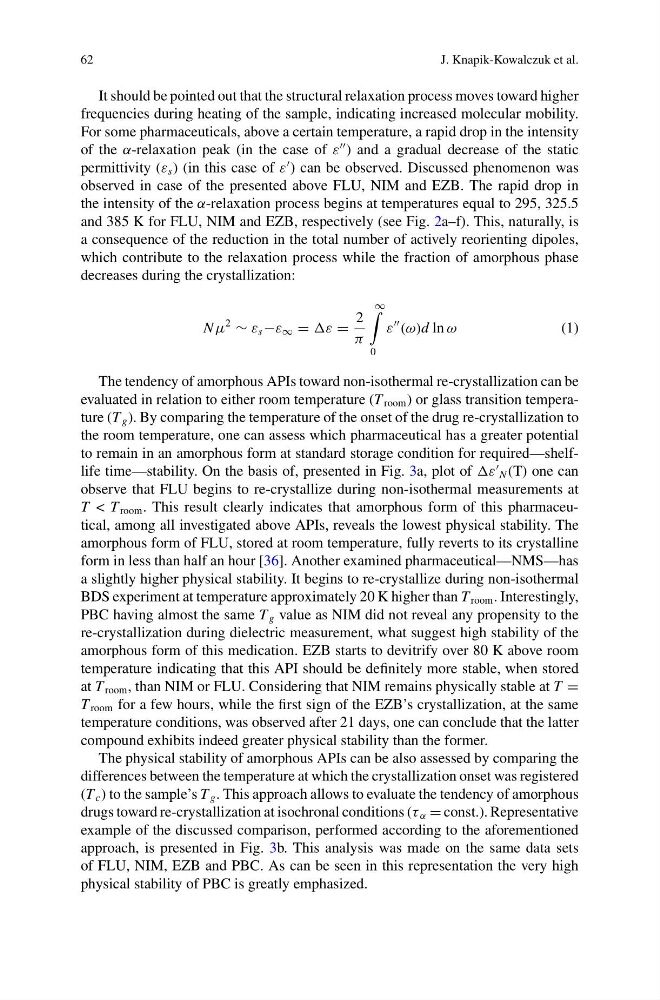
decreases during the crystallization:
N μ
2
∼ ε s −ε ∞ = ε =
2
π
∞
0
ε
(ω)d ln ω
(1)
The tendency of amorphous APIs toward non-isothermal re-crystallization can be
evaluated in relation to either room temperature (T room ) or glass transition temperature (T g ). By comparing the temperature of the onset of the drug re-crystallization to
the room temperature, one can assess which pharmaceutical has a greater potential
to remain in an amorphous form at standard storage condition for required—shelflife time—stability. On the basis of, presented in Fig. 3a, plot of ε
N (T) one can
observe that FLU begins to re-crystallize during non-isothermal measurements at
T < T room . This result clearly indicates that amorphous form of this pharmaceutical, among all investigated above APIs, reveals the lowest physical stability. The
amorphous form of FLU, stored at room temperature, fully reverts to its crystalline
form in less than half an hour [36]. Another examined pharmaceutical—NMS—has
a slightly higher physical stability. It begins to re-crystallize during non-isothermal
BDS experiment at temperature approximately 20 K higher than T room . Interestingly,
PBC having almost the same T g value as NIM did not reveal any propensity to the
re-crystallization during dielectric measurement, what suggest high stability of the
amorphous form of this medication. EZB starts to devitrify over 80 K above room
temperature indicating that this API should be definitely more stable, when stored
at T room , than NIM or FLU. Considering that NIM remains physically stable at T =
T room for a few hours, while the first sign of the EZB’s crystallization, at the same
temperature conditions, was observed after 21 days, one can conclude that the latter
compound exhibits indeed greater physical stability than the former.
The physical stability of amorphous APIs can be also assessed by comparing the
differences between the temperature at which the crystallization onset was registered
(T c ) to the sample’s T g . This approach allows to evaluate the tendency of amorphous
drugs toward re-crystallization at isochronal conditions (τ α = const.). Representative
example of the discussed comparison, performed according to the aforementioned
approach, is presented in Fig. 3b. This analysis was made on the same data sets
of FLU, NIM, EZB and PBC. As can be seen in this representation the very high
physical stability of PBC is greatly emphasized.
J. Knapik-Kowalczuk et al.
It should be pointed out that the structural relaxation process moves toward higher
frequencies during heating of the sample, indicating increased molecular mobility.
For some pharmaceuticals, above a certain temperature, a rapid drop in the intensity
of the α-relaxation peak (in the case of ε
) and a gradual decrease of the static
permittivity (ε s ) (in this case of ε
) can be observed. Discussed phenomenon was
observed in case of the presented above FLU, NIM and EZB. The rapid drop in
the intensity of the α-relaxation process begins at temperatures equal to 295, 325.5
and 385 K for FLU, NIM and EZB, respectively (see Fig. 2a–f). This, naturally, is
a consequence of the reduction in the total number of actively reorienting dipoles,
which contribute to the relaxation process while the fraction of amorphous phase
decreases during the crystallization:
N μ
2
∼ ε s −ε ∞ = ε =
2
π
∞
0
ε
(ω)d ln ω
(1)
The tendency of amorphous APIs toward non-isothermal re-crystallization can be
evaluated in relation to either room temperature (T room ) or glass transition temperature (T g ). By comparing the temperature of the onset of the drug re-crystallization to
the room temperature, one can assess which pharmaceutical has a greater potential
to remain in an amorphous form at standard storage condition for required—shelflife time—stability. On the basis of, presented in Fig. 3a, plot of ε
N (T) one can
observe that FLU begins to re-crystallize during non-isothermal measurements at
T < T room . This result clearly indicates that amorphous form of this pharmaceutical, among all investigated above APIs, reveals the lowest physical stability. The
amorphous form of FLU, stored at room temperature, fully reverts to its crystalline
form in less than half an hour [36]. Another examined pharmaceutical—NMS—has
a slightly higher physical stability. It begins to re-crystallize during non-isothermal
BDS experiment at temperature approximately 20 K higher than T room . Interestingly,
PBC having almost the same T g value as NIM did not reveal any propensity to the
re-crystallization during dielectric measurement, what suggest high stability of the
amorphous form of this medication. EZB starts to devitrify over 80 K above room
temperature indicating that this API should be definitely more stable, when stored
at T room , than NIM or FLU. Considering that NIM remains physically stable at T =
T room for a few hours, while the first sign of the EZB’s crystallization, at the same
temperature conditions, was observed after 21 days, one can conclude that the latter
compound exhibits indeed greater physical stability than the former.
The physical stability of amorphous APIs can be also assessed by comparing the
differences between the temperature at which the crystallization onset was registered
(T c ) to the sample’s T g . This approach allows to evaluate the tendency of amorphous
drugs toward re-crystallization at isochronal conditions (τ α = const.). Representative
example of the discussed comparison, performed according to the aforementioned
approach, is presented in Fig. 3b. This analysis was made on the same data sets
of FLU, NIM, EZB and PBC. As can be seen in this representation the very high
physical stability of PBC is greatly emphasized.