

Crystallization of Amorphous Pharmaceuticals at Ambient and Elevated …
57
Table 1 Solubility and permeability drugs in the market and in the development pipeline according
to Biopharmaceutical Classification System
BCS class
Solubility
Permeability
% drugs on the market a
% drugs in the R&D
pipeline a
I
High
High
35
5–10
II
Low
High
30
60–70
III
High
Low
25
5–10
IV
Low
Low
10
10–20
a Data are taken from [3, 4]
measurements of the rate of mass transfer across the human intestinal membrane [2].
A drug substance is considered highly permeable when the extent of absorption is
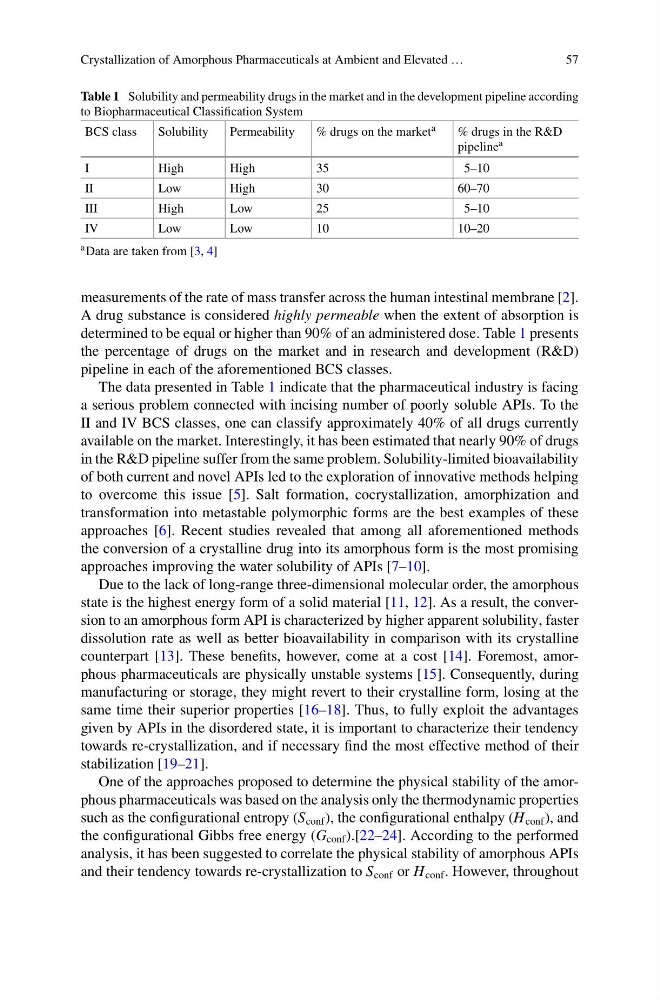
determined to be equal or higher than 90% of an administered dose. Table 1 presents
the percentage of drugs on the market and in research and development (R&D)
pipeline in each of the aforementioned BCS classes.
The data presented in Table 1 indicate that the pharmaceutical industry is facing
a serious problem connected with incising number of poorly soluble APIs. To the
II and IV BCS classes, one can classify approximately 40% of all drugs currently
available on the market. Interestingly, it has been estimated that nearly 90% of drugs
in the R&D pipeline suffer from the same problem. Solubility-limited bioavailability
of both current and novel APIs led to the exploration of innovative methods helping
to overcome this issue [5]. Salt formation, cocrystallization, amorphization and
transformation into metastable polymorphic forms are the best examples of these
approaches [6]. Recent studies revealed that among all aforementioned methods
the conversion of a crystalline drug into its amorphous form is the most promising
approaches improving the water solubility of APIs [7–10].
Due to the lack of long-range three-dimensional molecular order, the amorphous
state is the highest energy form of a solid material [11, 12]. As a result, the conversion to an amorphous form API is characterized by higher apparent solubility, faster
dissolution rate as well as better bioavailability in comparison with its crystalline
counterpart [13]. These benefits, however, come at a cost [14]. Foremost, amorphous pharmaceuticals are physically unstable systems [15]. Consequently, during
manufacturing or storage, they might revert to their crystalline form, losing at the
same time their superior properties [16–18]. Thus, to fully exploit the advantages
given by APIs in the disordered state, it is important to characterize their tendency
towards re-crystallization, and if necessary find the most effective method of their
stabilization [19–21].
One of the approaches proposed to determine the physical stability of the amorphous pharmaceuticals was based on the analysis only the thermodynamic properties
such as the configurational entropy (S conf ), the configurational enthalpy (H conf ), and
the configurational Gibbs free energy (G conf ).[22–24]. According to the performed
analysis, it has been suggested to correlate the physical stability of amorphous APIs
and their tendency towards re-crystallization to S conf or H conf . However, throughout
57
Table 1 Solubility and permeability drugs in the market and in the development pipeline according
to Biopharmaceutical Classification System
BCS class
Solubility
Permeability
% drugs on the market a
% drugs in the R&D
pipeline a
I
High
High
35
5–10
II
Low
High
30
60–70
III
High
Low
25
5–10
IV
Low
Low
10
10–20
a Data are taken from [3, 4]
measurements of the rate of mass transfer across the human intestinal membrane [2].
A drug substance is considered highly permeable when the extent of absorption is
determined to be equal or higher than 90% of an administered dose. Table 1 presents
the percentage of drugs on the market and in research and development (R&D)
pipeline in each of the aforementioned BCS classes.
The data presented in Table 1 indicate that the pharmaceutical industry is facing
a serious problem connected with incising number of poorly soluble APIs. To the
II and IV BCS classes, one can classify approximately 40% of all drugs currently
available on the market. Interestingly, it has been estimated that nearly 90% of drugs
in the R&D pipeline suffer from the same problem. Solubility-limited bioavailability
of both current and novel APIs led to the exploration of innovative methods helping
to overcome this issue [5]. Salt formation, cocrystallization, amorphization and
transformation into metastable polymorphic forms are the best examples of these
approaches [6]. Recent studies revealed that among all aforementioned methods
the conversion of a crystalline drug into its amorphous form is the most promising
approaches improving the water solubility of APIs [7–10].
Due to the lack of long-range three-dimensional molecular order, the amorphous
state is the highest energy form of a solid material [11, 12]. As a result, the conversion to an amorphous form API is characterized by higher apparent solubility, faster
dissolution rate as well as better bioavailability in comparison with its crystalline
counterpart [13]. These benefits, however, come at a cost [14]. Foremost, amorphous pharmaceuticals are physically unstable systems [15]. Consequently, during
manufacturing or storage, they might revert to their crystalline form, losing at the
same time their superior properties [16–18]. Thus, to fully exploit the advantages
given by APIs in the disordered state, it is important to characterize their tendency
towards re-crystallization, and if necessary find the most effective method of their
stabilization [19–21].
One of the approaches proposed to determine the physical stability of the amorphous pharmaceuticals was based on the analysis only the thermodynamic properties
such as the configurational entropy (S conf ), the configurational enthalpy (H conf ), and
the configurational Gibbs free energy (G conf ).[22–24]. According to the performed
analysis, it has been suggested to correlate the physical stability of amorphous APIs
and their tendency towards re-crystallization to S conf or H conf . However, throughout